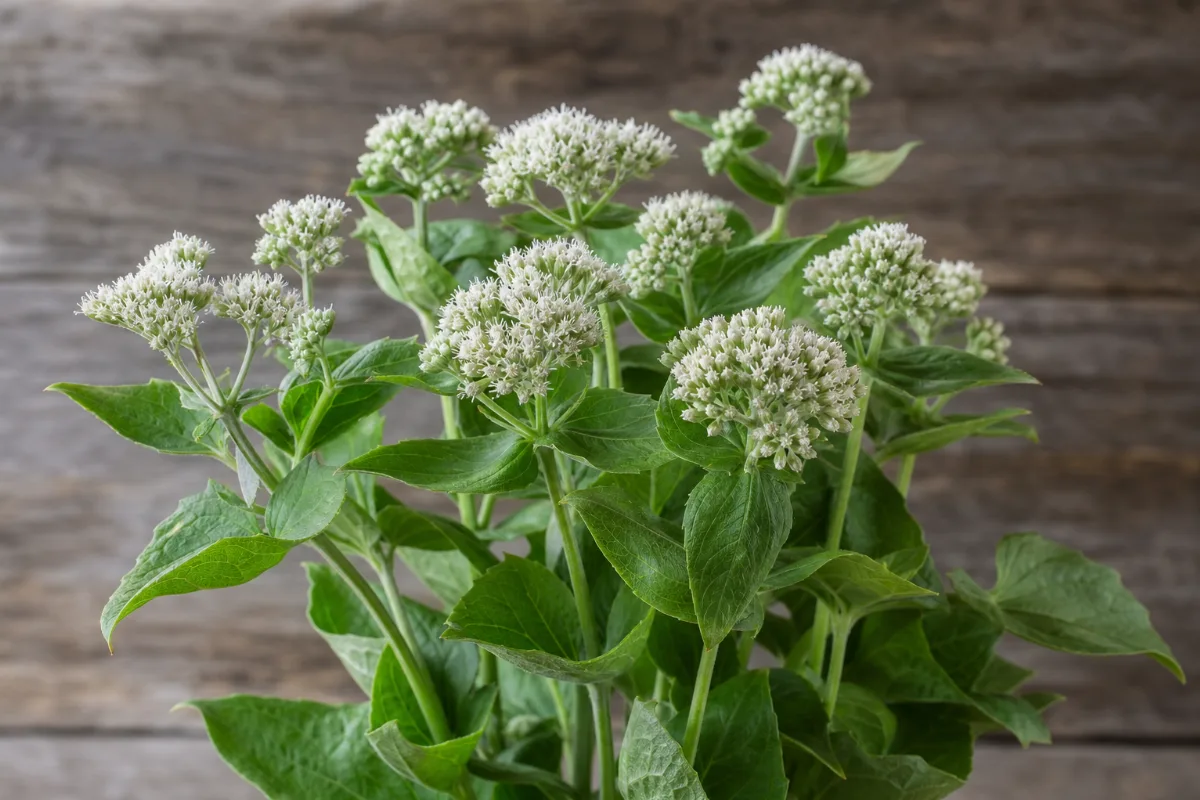
Herbs & Botanicals · Traditional cold and flu herb
Boneset
Eupatorium perfoliatum · also called Common boneset, thoroughwort
Boneset is a North American daisy-family herb that was long used in tea for colds, flu and fever. There is almost no modern human research on the herb itself, only old trials and homeopathic studies of a very diluted product. A lab study found liver-toxic-type pyrrolizidine alkaloids in all 49 samples tested. Skip it in pregnancy, breastfeeding and liver disease, and ask a doctor first.
General information, not medical advice. Last substantive update · Not medically reviewed. A named clinician has not signed off on this page. How this page is made
About Boneset
Boneset (Eupatorium perfoliatum) is a North American herb used for centuries for colds, flu and fever. Human evidence is limited to an old homeopathic trial and two open-label dengue studies of a homeopathic dilution. Lab work shows anti-inflammatory and antiviral activity. Safety matters: pyrrolizidine alkaloids were found in every sample tested, and large amounts cause vomiting.
What it is
Boneset is a perennial in the daisy family (Asteraceae). GBIF and NCBI list Eupatorium perfoliatum as an accepted species. The leaves and flowers (aerial parts) are used for tea, tincture or extract.
It is not hemp agrimony (Eupatorium cannabinum) or Joe-Pye weed (Eutrochium). They are different plants; what is said here applies to boneset only.
Traditional and current uses
Native peoples and early settlers used it for fever and infection. Doctors of the early 1900s used it for colds with deep aching and in influenza epidemics, and as an emetic and bitter tonic.
The only human trials we found used homeopathic dilutions: one 1981 trial against aspirin, and two large open-label dengue studies. No trial of boneset tea or tincture was found.
Safety in short
A 2018 analysis found pyrrolizidine alkaloids in all 49 boneset samples tested, and teas and tinctures carried high levels. These alkaloids are linked to liver disease in people. No human liver injury from boneset was found in the sources we read, and the real risk has not been measured. The authors advise caution. Not safe to assume, not proven harmful.
Large amounts cause vomiting and diarrhea according to historical and database sources. Consumer references advise against use in pregnancy, breastfeeding and liver disease, and warn of allergy in people sensitive to daisy-family plants. No EMA herbal monograph, NCCIH page, LactMed or LiverTox record was found.
At a glance
Traditional uses history, not proof
- Hot tea for fever, colds and flu-like aching (North American tradition).
- Small amounts as a bitter tonic (older herbal texts).
- Large amounts as an emetic to cause vomiting (older texts).
- Used in influenza epidemics in the early 1900s (older texts).
Studied for research
- Common cold: one old trial of a homeopathic product, very low certainty
- Dengue prevention: non-randomised studies of a homeopathic 30C product, very low certainty
- Influenza virus and inflammation: lab only
- Immune stimulation: not confirmed in lab tests
Main compounds
- Eupafolin (nepetin): a flavonoid linked to anti-inflammatory action in the lab.
- Sesquiterpene lactones: plant compounds with lab anti-inflammatory activity.
- Lycopsamine and intermedine: pyrrolizidine alkaloids found in all samples tested; liver risk not quantified.
Common forms
- Dried leaf and flower for tea
- Alcohol tincture
- Liquid extract
- Homeopathic dilutions (D2, 30C)
Research links: Pyrrolizidine alkaloids in boneset (2018) · Boneset review: chemistry and uses (2011) · Homeopathic D2 vs aspirin in colds (1981) · Research Library · Genes & Biomarkers Library
The plant and its history
- Accepted scientific name
- Eupatorium perfoliatum L.
- Naming authority
- L. (GBIF species key 5402874)
- Common names
- Boneset (English); Common boneset (English); Thoroughwort (English)
- Botanical family
- Asteraceae (the daisy family), per GBIF.
- Classification
- Plantae > Tracheophyta > Magnoliopsida > Asterales > Asteraceae > Eupatorium > Eupatorium perfoliatum
- Native range
- North America (per the 2011 review abstract).
- Habitat
- Not verified.
- What the plant looks like
- Roots: Not described.; Stems: Not described.; Leaves: Not described; the name 'perfoliatum' refers to the leaf pairs wrapping the stem (NOT verified in sources read).; Flowers: Not described.; Fruit: Not described.
- Cultivation
- Not verified.
- Harvest and processing
- Not verified.
- Look-alikes and adulterants
- Name: Hemp agrimony (Eupatorium cannabinum L.); Note: A different accepted species (GBIF 5402943). Not covered on this page; do not assume the same alkaloids or safety.; Name: Joe-Pye weed (Eutrochium purpureum and relatives); Note: Separate genus (GBIF 3138192 for E. purpureum); sometimes sold or named together with boneset. Check the Latin name.; Name: Other Eupatorium species; Note: The 2018 analysis suggested hybrids or contamination with related species in some samples.
- Sustainability and conservation
- Not verified.
Traditional use and history history, not clinical proof
| Tradition or era | Documented use | Source |
|---|---|---|
| North American Indigenous use | Fever and infections; later adopted by European settlers. | p22004891 |
| Eclectic medicine (early 1900s text) | Small doses as a bitter tonic; hot infusion as an emetic and sweat-inducer; colds with deep aching; fevers; influenza epidemics including 1918-19. | s-felter-1922 |
| Modern European phytotherapy and homeopathy | Immune-support and cold products; homeopathic D2 for colds; 30C for dengue prevention in India. | p22004891 |
Traditional use shows how a plant was used. It does not show that a supplement works or is safe today.
What is inside, and how it may work
What the plant contains and how those compounds act in cells and animals. Laboratory and animal mechanisms are not proven effects in people.
Main compounds
| Compound | Family | Where it is concentrated | Activity studied | Level of evidence |
|---|---|---|---|---|
| Eupafolin (nepetin) PubChem 5317284 | flavonoid | aerial parts | Lowered nitric oxide release in mouse cells (IC50 6 uM); linked by the 2011 review to anti-inflammatory effect. 10 9 | Laboratory research |
| Sesquiterpene lactones (including a dimeric guaianolide) | sesquiterpene lactone | aerial parts | Dimeric guaianolide lowered NO release (IC50 16 uM) in cells. 10 9 | Laboratory research |
| Lycopsamine PubChem 107938 | pyrrolizidine alkaloid (retronecine type) | aerial parts Boneset samples contained total alkaloids of 0.0002-0.07% w/w | Dominant alkaloid with intermedine in samples; classed as a pro-toxic alkaloid; boneset-specific toxicity not established. 1 | Laboratory research |
| Intermedine PubChem 114843 | pyrrolizidine alkaloid (retronecine type) | aerial parts | Dominant alkaloid with lycopsamine; see above. 1 | Laboratory research |
| Caffeic acid derivatives, flavonoids, tannins, polysaccharides, volatile oil | various | aerial parts | Listed as constituents in the 2011 review; flavonoid glycosides and caffeoylquinic acids did not explain the anti-influenza effect in cell tests. 9 2 | Laboratory research |
Mechanisms, receptors and pathways
| Target or pathway | Gene or receptor | What was found | Level |
|---|---|---|---|
| Inflammatory signalling (nitric oxide, IL-1, chemokines) | iNOS, IL1A, IL1B, CCL2, CCL22, CXCL10 | Extracts, eupafolin and a dimeric guaianolide reduced NO release and several inflammatory signals in mouse macrophages. 10 | Laboratory research |
| Influenza A virus attachment | Not specified | Hydroalcoholic extract blocked virus attachment to cells, including an oseltamivir-resistant strain; active compounds unidentified. 2 | Laboratory research |
| Cytotoxicity | Not specified | Ethanol leaf extract killed cells at EC50 12-14 ug/mL. 8 | Laboratory research |
| Alkaloid activation in the liver (theory) | CYP3A4 (theory) | Pyrrolizidine alkaloids are 'pro-toxic': the liver converts them to harmful products. The CYP3A4 link in consumer references is theoretical for boneset. 1 15 | Pharmacological theory |
Absorption, metabolism and elimination
- Absorption
- No data for boneset compounds in people.
- Distribution
- No data.
- Metabolism
- Pyrrolizidine alkaloids are 'pro-toxic': they need liver conversion to become harmful (stated in the 2018 abstract). Boneset-specific data absent.
- Elimination
- No data.
- Bioavailability
- Unknown.
Isolated compounds versus whole extracts
The studied effects belong to whole extracts or individual compounds in cells; the homeopathic dilutions contain almost none of the herb. The alkaloids are present in whole herb, tinctures and teas, so whole-herb products are the ones that carry that question.
Nutritional composition
Boneset is not a food. This page gives no nutrient content.
2 very low certainty7 not enough evidence
What is Boneset good for?
The main uses and how strong the evidence is. 'Very low' or 'insufficient' means the research is too thin to rely on. Homeopathic studies used a very diluted product, not the herb.
Benefits, one by one
Each card is a research question, not a promise. Tap a goal to filter. Open a card to see the studies, doses and limits.
Colds, flu and fever (traditional use)
Not enough evidenceBoneset is a North American herb used for centuries for colds, flu and fever. Today's evidence is old and thin. A review says old clinical data do not meet modern standards but lean positive for alcohol extracts in colds. No modern, well-run trial of the herb was found.
3 studiesNot applicable: no amounts are given here. Ask a doctor or pharmacist…
Studies, doses and limits
What the trials found
Hensel 2011 (review): clinical data on ethanolic extracts do not meet modern trial standards but show positive tendencies in common colds. The review does not name the individual studies in its abstract. Felter 1922 is a historical text, not evidence of benefit.
Results
Old, weak human data only.
Effect sizes as reported
None reported in the abstract.
Why this rating
Only old, non-modern clinical data; a review says they do not meet modern standards.
Form and dose studied
Not applicable: no amounts are given here. Ask a doctor or pharmacist about amounts.
Who was studied
Not described in the abstract.
Limits
Review abstract only; we could not see which trials it refers to.
Why researchers looked
Native peoples and early settlers in North America used it for fever and infections, and European products use it for colds.
Traditional use
North American tradition (fever, infections); Eclectic physicians of the 1800s-1920s used it for colds with deep aching and in influenza epidemics, including 1918-19.
Proposed mechanism Laboratory research
A 2011 review found lab support for anti-inflammatory effects but not for immune stimulation. Lab work only.
A proposed mechanism does not show that the effect happens in people.
Boneset also carries a pyrrolizidine alkaloid question; see the Safety tab before using it. Large doses are emetic (cause vomiting) in historical and consumer sources.
Common cold (homeopathic D2 product)
Very low certaintyOne small 1981 trial in 53 people with colds compared a very diluted homeopathic boneset product (D2) with aspirin. The two groups did not differ. With no placebo group this cannot show that boneset works, and the product is not the herb.
2 studiesNot applicable: no amounts are given here. Ask a doctor or pharmacist…
Studies, doses and limits
What the trials found
Gassinger 1981: 53 outpatients with common cold were randomly given aspirin or Eupatorium perfoliatum D2. On days 1, 4 and 10, symptoms, temperature and lab findings did not differ significantly. The authors read this as both being equally effective.
Results
No difference from aspirin; no placebo comparison.
Effect sizes as reported
No numbers in the abstract.
Why this rating
Tiny 1981 trial, no placebo group, homeopathic dilution rather than the herb.
Form and dose studied
Not applicable: no amounts are given here. Ask a doctor or pharmacist about amounts.
Who was studied
53 adults with common cold (outpatients).
Limits
No placebo; homeopathic D2, not tea or tincture; 1981; German-language paper.
Why researchers looked
Boneset is a classic homeopathic remedy for flu-like illness with aching.
Traditional use
Homeopathy: dilutions of the plant.
Proposed mechanism Pharmacological theory
No mechanism is claimed in the abstract.
A proposed mechanism does not show that the effect happens in people.
Homeopathic dilutions are not the same as herbal teas or tinctures, so these results do not apply to them.
Dengue prevention (homeopathic 30C)
Very low certaintyTwo large community studies in Delhi, India, gave a homeopathic 30C boneset product weekly and reported fewer dengue cases than in neighbouring communities that got none. They were not randomised and had no placebo, so they cannot show cause. The 30C product is a very high dilution, not the herb.
2 studiesNot applicable: no amounts are given here. Ask a doctor or pharmacist…
Studies, doses and limits
What the trials found
2023 study (40,769 people): protective effect 65.77% (95% CI 53.37-74.87) against lab-confirmed dengue; 52.58% against acute febrile illness; no hospitalisations in the medicine group vs 4.35% in controls. 2025 study (20,607 people): 72.78% (95% CI 54.45-83.74) against lab-confirmed dengue. Both authors call for randomised trials.
Results
Large differences in case rates between communities, but the design cannot separate the product from other differences.
Effect sizes as reported
65.77% and 72.78% protective effect (lab-confirmed dengue), as reported by the authors.
Why this rating
Open-label, non-randomised cohorts with no placebo; investigators work for government homeopathy bodies; a homeopathic dilution, not the herb.
Form and dose studied
Not applicable: no amounts are given here. Ask a doctor or pharmacist about amounts.
Who was studied
Residents of urban slums in Delhi, aged 1 year and up.
Limits
Not randomised or blinded; communities differ; counts rely on the reporting system; a published critical-appraisal letter exists (not read in full).
Why researchers looked
Boneset was used in homeopathy for fever illnesses such as dengue, which is called break-bone fever.
Traditional use
Homeopathy. Indian government homeopathy bodies ran these studies.
Proposed mechanism Preliminary mechanism
None shown in people. A lab study on dengue virus by related authors exists but was not read here.
A proposed mechanism does not show that the effect happens in people.
Dengue is serious. Do not rely on any herb or dilution to prevent it; mosquito control and medical care are the proven steps.
Influenza virus (lab only)
Not enough evidenceIn cell cultures, an alcohol-and-water extract of boneset stopped influenza A virus from attaching to cells, including a strain resistant to oseltamivir. This is a test-tube finding only. It does not mean boneset treats flu in people.
1 studiesNot applicable: no amounts are given here. Ask a doctor or pharmacist…
Studies, doses and limits
What the trials found
None. No human trial of the herb for influenza was found.
Results
Lab only.
Effect sizes as reported
IC50 7 and 14 ug/mL against two H1N1 strains.
Why this rating
Cell culture only.
Form and dose studied
Not applicable: no amounts are given here. Ask a doctor or pharmacist about amounts.
Who was studied
Dog and human cell lines.
Limits
No animal or human test.
Why researchers looked
Traditional use for fever and respiratory infection invites antiviral testing.
Traditional use
Traditional flu and fever use.
Proposed mechanism Laboratory research
Blocks virus attachment to cells in culture. The active compounds were not identified.
A proposed mechanism does not show that the effect happens in people.
Do not use this to justify self-treating flu. See a clinician for severe or lasting illness.
'Immune boosting' claim
Not enough evidenceBoneset is often sold as an immune stimulant. Lab testing did not confirm this. A 2011 study found no stimulation of immune cells; its effect was anti-inflammatory instead.
2 studiesNot applicable: no amounts are given here. Ask a doctor or pharmacist…
Studies, doses and limits
What the trials found
None.
Results
Not confirmed in lab tests.
Effect sizes as reported
Not applicable.
Why this rating
Lab-only, and the lab did not support the claim.
Form and dose studied
Not applicable: no amounts are given here. Ask a doctor or pharmacist about amounts.
Who was studied
Cell cultures.
Limits
No human data.
Why researchers looked
Marketing and European herbal use as an 'immunostimulant'.
Traditional use
Modern phytotherapy.
Proposed mechanism Laboratory research
Lab tests found no immune activation, only reduced inflammatory signals.
A proposed mechanism does not show that the effect happens in people.
None specific.
Fever and malaria-type illness (traditional)
Not enough evidenceBoneset was used historically for fevers, including malaria-type fevers. A review notes lab activity against the malaria parasite Plasmodium falciparum. No human trial was found, and it is not a malaria treatment.
2 studiesNot applicable: no amounts are given here. Ask a doctor or pharmacist…
Studies, doses and limits
What the trials found
None.
Results
Traditional and lab only.
Effect sizes as reported
Not applicable.
Why this rating
Lab and historical sources only.
Form and dose studied
Not applicable: no amounts are given here. Ask a doctor or pharmacist about amounts.
Who was studied
Not applicable.
Limits
No human data.
Why researchers looked
Fever use is the plant's oldest recorded use.
Traditional use
Eclectic physicians used it for intermittent (malarial-type) fevers; 1922 text.
Proposed mechanism Laboratory research
Lab antiplasmodial activity only.
A proposed mechanism does not show that the effect happens in people.
Malaria and high fever are emergencies. Do not treat with a herb.
Inflammation (lab)
Not enough evidenceIn cell tests, boneset extracts and two of its compounds, eupafolin and a dimeric guaianolide, reduced nitric oxide and several inflammatory signals. It is not tested in people for this.
2 studiesNot applicable: no amounts are given here. Ask a doctor or pharmacist…
Studies, doses and limits
What the trials found
None. No human trial for pain or joints was found.
Results
Lab only.
Effect sizes as reported
NO release IC50 over 100, 89 and 19 ug/mL for methanol, ethanol and dichloromethane extracts; eupafolin 6 uM.
Why this rating
Cell culture only.
Form and dose studied
Not applicable: no amounts are given here. Ask a doctor or pharmacist about amounts.
Who was studied
Mouse cells.
Limits
No animal or human testing in the sources read.
Why researchers looked
Used traditionally for aching bones and joints and rheumatism.
Traditional use
Traditional use for aching and rheumatic pain; 'break-bone' fever aches.
Proposed mechanism Laboratory research
Lowered NO release and inflammatory messengers in mouse macrophages in a dish.
A proposed mechanism does not show that the effect happens in people.
Do not use this in place of treatment for joint or inflammatory disease.
Toxic to cells in the dish; weak antibacterial action
Not enough evidenceAn ethanol extract of boneset leaves killed cells in a dish at levels like a cancer drug and was weakly active against two bacteria. This is not a treatment; it shows the extract is biologically active.
1 studiesNot applicable: no amounts are given here. Ask a doctor or pharmacist…
Studies, doses and limits
What the trials found
None.
Results
Lab only.
Effect sizes as reported
EC50 12-14 ug/mL; weak action against Staphylococcus aureus and Bacillus megaterium.
Why this rating
Cell culture only.
Form and dose studied
Not applicable: no amounts are given here. Ask a doctor or pharmacist about amounts.
Who was studied
Cells and bacteria in culture.
Limits
Cell toxicity is not a benefit.
Why researchers looked
Lab screening.
Traditional use
Not a traditional claim.
Proposed mechanism Laboratory research
Cell killing in culture.
A proposed mechanism does not show that the effect happens in people.
Lab cell toxicity is not proof of harm or benefit in people.
Bitter tonic and mild laxative (traditional)
Not enough evidenceOlder texts describe small amounts of boneset as a bitter tonic and mildly laxative, and large amounts as causing vomiting. No trial was found.
2 studiesNot applicable: no amounts are given here. Ask a doctor or pharmacist…
Studies, doses and limits
What the trials found
None.
Results
Historical only.
Effect sizes as reported
Not applicable.
Why this rating
Historical text only.
Form and dose studied
Not applicable: no amounts are given here. Ask a doctor or pharmacist about amounts.
Who was studied
Not applicable.
Limits
No human data.
Why researchers looked
Classic bitter-herb use.
Traditional use
Eclectic medicine (1922): simple bitter in small doses; mildly laxative; emetic in large doses.
Proposed mechanism Pharmacological theory
Not studied.
A proposed mechanism does not show that the effect happens in people.
Large amounts can cause vomiting and severe diarrhea according to consumer references.
Connections to the rest of health
How Boneset connects to the rest of our health knowledge graph. Every link says what kind of connection it is. A safety link (for example to the liver) is a warning, not a benefit. A study that merely mentions a topic never creates a benefit link.
Explore every connection: goals, body systems, organs, symptoms, genes
A. Wellness goals
| Connected to | Kind of connection | Evidence status | Context | Studies |
|---|---|---|---|---|
| Immune Support | Traditional use | Not enough evidence | Colds, flu and fever (traditional use): Boneset is a North American herb used for centuries for colds, flu and fever. Today's evidence is old and thin. A review says old clinical data do not meet modern standards but lean positive for alcohol extracts in colds. No modern, well-run trial of the herb was found. 'Immune boosting' claim: Boneset is often sold as an immune stimulant. Lab testing did not confirm this. A 2011 study found no stimulation of immune cells; its effect was anti-inflammatory instead. | 9 5 15 10 |
| Seasonal Wellness | Traditional use | Not enough evidence | Colds, flu and fever (traditional use): Boneset is a North American herb used for centuries for colds, flu and fever. Today's evidence is old and thin. A review says old clinical data do not meet modern standards but lean positive for alcohol extracts in colds. No modern, well-run trial of the herb was found. | 9 5 15 |
| Immune Support | Preliminary mechanism | Very low certainty | Common cold (homeopathic D2 product): One small 1981 trial in 53 people with colds compared a very diluted homeopathic boneset product (D2) with aspirin. The two groups did not differ. With no placebo group this cannot show that boneset works, and the product is not the herb. Dengue prevention (homeopathic 30C): Two large community studies in Delhi, India, gave a homeopathic 30C boneset product weekly and reported fewer dengue cases than in neighbouring communities that got none. They were not randomised and had no placebo, so they cannot show cause. The 30C product is a very high dilution, not the herb. | 7 15 12 13 2 |
| Inflammation Balance | Preliminary mechanism | Not enough evidence | Inflammation (lab): In cell tests, boneset extracts and two of its compounds, eupafolin and a dimeric guaianolide, reduced nitric oxide and several inflammatory signals. It is not tested in people for this. Toxic to cells in the dish; weak antibacterial action: An ethanol extract of boneset leaves killed cells in a dish at levels like a cancer drug and was weakly active against two bacteria. This is not a treatment; it shows the extract is biologically active. | 10 9 8 |
| Joint Support | Preliminary mechanism | Not enough evidence | Inflammation (lab): In cell tests, boneset extracts and two of its compounds, eupafolin and a dimeric guaianolide, reduced nitric oxide and several inflammatory signals. It is not tested in people for this. | 10 9 |
| Digestive Support | Traditional use | Not enough evidence | Bitter tonic and mild laxative (traditional): Older texts describe small amounts of boneset as a bitter tonic and mildly laxative, and large amounts as causing vomiting. No trial was found. | 5 17 |
B. Body systems
| Connected to | Kind of connection | Evidence status | Context | Studies |
|---|---|---|---|---|
| Immune System | Biological association | Not enough evidence | Studied for: Colds, flu and fever (traditional use) Studied for: Dengue prevention (homeopathic 30C) | 9 5 15 12 13 10 8 |
| Respiratory System | Biological association | Not enough evidence | Studied for: Colds, flu and fever (traditional use) Studied for: Common cold (homeopathic D2 product) | 9 5 15 7 2 |
| Musculoskeletal System | Biological association | Not enough evidence | Studied for: Inflammation (lab) | 10 9 |
| Digestive System | Biological association | Not enough evidence | Studied for: Bitter tonic and mild laxative (traditional) | 5 17 |
C. Body parts and organs
| Connected to | Kind of connection | Evidence status | Context | Studies |
|---|---|---|---|---|
| Liver | Adverse effect or risk | Not enough evidence | Alkaloids present in all 49 samples; no human injury case found; risk not quantified. Alkaloids found in all 49 samples; no human injury case found; risk not quantified. Preparation or compound: Pyrrolizidine alkaloids in aerial parts (tincture, tea) |
1 15 |
| Gut | Adverse effect or risk | Very low certainty | Emetic and loosening effect in historical and database sources. Emetic effect in historical and database sources. Preparation or compound: Hot infusion in large amounts |
5 17 |
I. Biomarkers
| Connected to | Kind of connection | Evidence status | Context | Studies |
|---|---|---|---|---|
| Lab-confirmed dengue cases | Biological association | Very low certainty | Measured in trials: lowered. A lab change is not the same as a health benefit. | 12 13 |
| Cold symptoms and body temperature | Biological association | Very low certainty | Measured in trials: no-change. A lab change is not the same as a health benefit. | 7 |
| Influenza A growth in cell culture | Biological association | Not enough evidence | Measured in trials: lowered. A lab change is not the same as a health benefit. | 2 |
| Nitric oxide release (inflammation signal) | Biological association | Not enough evidence | Measured in trials: lowered. A lab change is not the same as a health benefit. | 10 |
K. Biological pathways
L. Active compounds
| Connected to | Kind of connection | Evidence status | Context | Studies |
|---|---|---|---|---|
| Eupafolin (nepetin) | Biological association | In vitro | Lowered nitric oxide release in mouse cells (IC50 6 uM); linked by the 2011 review to anti-inflammatory effect. Preparation or compound: aerial parts |
10 9 |
| Sesquiterpene lactones (including a dimeric guaianolide) | Biological association | In vitro | Dimeric guaianolide lowered NO release (IC50 16 uM) in cells. Preparation or compound: aerial parts |
10 9 |
| Lycopsamine | Biological association | In vitro | Dominant alkaloid with intermedine in samples; classed as a pro-toxic alkaloid; boneset-specific toxicity not established. Preparation or compound: aerial parts |
1 |
| Intermedine | Biological association | In vitro | Dominant alkaloid with lycopsamine; see above. Preparation or compound: aerial parts |
1 |
| Caffeic acid derivatives, flavonoids, tannins, polysaccharides, volatile oil | Biological association | In vitro | Listed as constituents in the 2011 review; flavonoid glycosides and caffeoylquinic acids did not explain the anti-influenza effect in cell tests. Preparation or compound: aerial parts |
9 2 |
Each connection is stored with the ingredient, the connected record, the kind of connection, the evidence status, the supporting studies, the preparation or compound involved, and a review date (last reviewed October 25, 2026).
Evidence at a glance: what changed in 4 lab markers
Tap a number to show only those markers. Counts are markers, not people.
The evidence
The research centre for Boneset. Every record here was checked against PubMed or the publisher's page; we never list a study we have not verified.
Evidence by outcome
Bars show how many studies we found for each outcome, not how well it works. People are added up across trials only (reviews are not added, to avoid double counting).
How we rate evidence
High certainty
Several well-run trials or reviews agree; further research is unlikely to change the picture much.
Moderate certainty
Good trials point the same way, but some doubt remains.
Low certainty
Small, short or inconsistent trials. The finding could change with better research.
Very low certainty
Very little or very weak human data. Treat as a possibility only.
Mixed findings
Trials or reviews disagree with each other.
Not enough evidence
Not enough human research to say either way.
Evidence against
Good research found no benefit, or found harm.
We take the reviewers' own risk-of-bias and GRADE statements where they exist, and otherwise judge from study size, design, consistency, directness and whether a product matches what is sold. Many publications do not make evidence high. Method note: We read PubMed abstracts for the studies. Several safety statements come from consumer reference databases and a 1922 text, as stated; the EMA statement, the American Herbal Pharmacopoeia monograph and Drugs.com were not opened in full.
Study library: every study we checked 17
| Study | Design | People | Product, dose, length | Result |
|---|---|---|---|---|
| Colegate 2018 Potentially toxic pyrrolizidine alkaloids in Eupatorium perfoliatum and three related species. Implications for herbal use as boneset. Phytochem Anal · PMID 29968391 · DOI |
Lab analysis lab |
49 49 boneset samples plus tinctures, infusions and decoctions, and three related Eupatorium species |
Boneset (Eupatorium perfoliatum) plant samples, alcoholic tinctures, hot-water infusions and decoctions aerial parts (as sold as boneset) Not applicable (chemical analysis) Not applicable · vs Not applicable |
All 49 E. perfoliatum samples contained dehydropyrrolizidine alkaloids (0.0002-0.07% w/w), mostly lycopsamine and intermedine, their N-oxides and acetylated forms. Tinctures, infusions and decoctions had high alkaloid concentrations. Differences between samples may reflect different chemotypes, hybridisation or contamination with related species. Authors advise preclusive caution until toxicity and cancer risk are better defined. Alkaloids present in every sample tested; amounts varied about 350-fold Methods, limits and fundingOutcomes: Presence and amount of dehydropyrrolizidine alkaloids by HPLC-MS Limitations: Chemical analysis only: it measured alkaloids, not harm to people. Authors include staff of the American Herbal Pharmacopoeia and the NIH Office of Dietary Supplements. Funding and conflicts: Authors from USDA Poisonous Plant Research Laboratory, Utah State University, American Herbal Pharmacopoeia and NIH Office of Dietary Supplements; funding not stated in the abstract. Read: abstract |
| Derksen 2016 Antiviral activity of hydroalcoholic extract from Eupatorium perfoliatum L. against the attachment of influenza A virus. J Ethnopharmacol · PMID 27178637 · DOI |
Laboratory research in-vitro |
Cell cultures (dog kidney cells, human lung cells) infected with influenza A | Hydroalcoholic extract of boneset aerial parts IC50 7 and 14 ug/mL (lab concentration) Lab assay · vs Dichloromethane and methanol extracts (inactive) |
The hydroalcoholic extract inhibited two H1N1 strains (IC50 7 and 14 ug/mL; selectivity index 52 and 26), including an oseltamivir-resistant isolate, and blocked virus attachment to cells. Flavonoid glycosides and caffeoylquinic acids did not explain the effect; the active compounds were not identified. Lab inhibition only Methods, limits and fundingOutcomes: Influenza A growth, plaque formation, virus attachment Limitations: Cell culture only; no animal or human test; the active compounds are unknown. Read: abstract |
| Drugs.com Boneset (Drugs.com natural products reference) Drugs.com · Source |
Authoritative guidance n/a |
Not applicable | Boneset (Eupatorium perfoliatum) aerial parts Not given here Not applicable · vs Not applicable |
Search-result summary: FDA lists boneset as an herb of undefined safety; no direct evidence of liver toxicity from boneset itself, but plants with unsaturated pyrrolizidine alkaloids should not be ingested; large amounts of teas or extracts may cause severe diarrhea. NOT verified: the page returned 403 and was not opened. Not applicable Methods, limits and fundingOutcomes: Reference information Limitations: Search summary only. Read: search-summary |
| EMA Committee on Herbal Medicinal Products (HMPC) 2021 Public statement on the use of herbal medicinal products containing toxic, unsaturated pyrrolizidine alkaloids (PAs) including recommendations regarding contamination of herbal medicinal products with PAs (EMA/HMPC/893108/2011 Rev. 1) European Medicines Agency · Source |
Authoritative guidance n/a |
Not applicable | Boneset (Eupatorium perfoliatum) aerial parts Not given here Not applicable · vs Not applicable |
Adopted July 2021. General EU position on herbal products containing toxic unsaturated pyrrolizidine alkaloids. NOT verified in detail: the PDF could not be read here, only search-result descriptions. It does not name boneset in anything we could read. Not applicable Methods, limits and fundingOutcomes: Reference information Limitations: The document text was not opened; no intake limit or pregnancy wording is quoted here. Read: search-summary |
| Felter 1922 The Eclectic Materia Medica, Pharmacology and Therapeutics: Eupatorium perfoliatum Eclectic Medical Publications (text on henriettes-herb.com) · Source |
Traditional use n/a |
Not applicable | Boneset (Eupatorium perfoliatum) aerial parts Not given here Not applicable · vs Not applicable |
Small doses act as a bitter and tonic; large doses are emetic; a hot infusion causes vomiting and sweating, sometimes loosening the bowels. Once a favoured emetic, seldom used that way by 1922; the text advises against pushing doses to nausea. Used for fever, colds with deep aching, and in influenza epidemics including 1918-19. Not applicable Methods, limits and fundingOutcomes: Reference information Limitations: Historical text, not a trial; claims of safety and benefit are not evidence by today's standards; website copy read, not the printed book. Read: web-summary |
| GBIF 2026 GBIF Backbone: Eupatorium perfoliatum L. (key 5402874) GBIF API · Source |
Identity record n/a |
Not applicable | Boneset (Eupatorium perfoliatum) aerial parts Not given here Not applicable · vs Not applicable |
Accepted species, family Asteraceae, order Asterales, exact match. E. cannabinum L. (key 5402943) and Eutrochium purpureum (L.) E.E.Lamont (key 3138192) are separate accepted names. Not applicable Methods, limits and fundingOutcomes: Reference information Limitations: Name check only. Read: full-text |
| Gassinger 1981 A controlled clinical trial for testing the efficacy of the homeopathic drug eupatorium perfoliatum D2 in the treatment of common cold (author's transl). Arzneimittelforschung · PMID 7195723 |
Controlled trial |
53 53 outpatients with common cold (flu) |
Eupatorium perfoliatum D2, a homeopathic dilution (not a whole-herb tea or tincture) homeopathic preparation Not given in abstract Assessed on days 1, 4 and 10 · vs Acetylsalicylic acid (aspirin) |
No significant differences between the two groups on symptoms, temperature or lab findings; the authors took this as both drugs being equally effective. No difference versus aspirin; no placebo group Methods, limits and fundingOutcomes: Symptom check lists, physical examination, body temperature, lab findings Limitations: No placebo arm, so equal results do not show that either worked; 53 people; 1981; German-language paper (English abstract); homeopathic D2 only. Read: abstract |
| Habtemariam 2000 Cytotoxicity and antibacterial activity of ethanol extract from leaves of a herbal drug, boneset (Eupatorium perfoliatum). Phytother Res · PMID 11054857 · DOI |
Laboratory research in-vitro |
Cells and bacteria in culture | Ethanol extract of boneset leaves leaf EC50 12-14 ug/mL (lab) Lab assay · vs Chlorambucil (cytotoxic standard) |
Potent cytotoxicity with EC50 12-14 ug/mL, similar to chlorambucil; weak antibacterial activity against Staphylococcus aureus and Bacillus megaterium. Toxic to cells in the dish Methods, limits and fundingOutcomes: Cell toxicity; antibacterial activity Limitations: Test-tube result; cell toxicity is not a treatment and may be a warning sign. Read: abstract |
| Hensel 2011 Eupatorium perfoliatum L.: phytochemistry, traditional use and current applications. J Ethnopharmacol · PMID 22004891 · DOI |
Narrative review review |
Literature survey of phytochemistry, traditional use, clinical and preclinical data | Boneset extracts (mostly ethanolic) aerial parts Not given here Not applicable · vs Not applicable |
Describes volatile oil, caffeic acid derivatives, flavonoids, sesquiterpene lactones, tannins and polysaccharides. Preclinical work shows anti-inflammatory effects linked to eupafolin and sesquiterpene lactones. Clinical data do not meet modern GCP requirements but show positive tendencies for ethanolic extracts in common colds. Immune-stimulating effects were not confirmed in vitro. No effect size; clinical data described as not meeting modern standards Methods, limits and fundingOutcomes: Phytochemistry, traditional use, clinical and preclinical data Limitations: Narrative review; abstract only was read; the clinical studies it refers to are old and not identified in the abstract. Read: abstract |
| Maas 2011 Anti-inflammatory activity of Eupatorium perfoliatum L. extracts, eupafolin, and dimeric guaianolide via iNOS inhibitory activity and modulation of inflammation-related cytokines and chemokines. J Ethnopharmacol · PMID 21669270 · DOI |
Laboratory research in-vitro |
Mouse macrophage cells (RAW 264.7) and human blood cells in culture | Methanol, ethanol and dichloromethane extracts of boneset; eupafolin; a dimeric guaianolide aerial parts Lab concentrations Lab assay · vs Untreated cells |
No immune-stimulating activity was found. Extracts reduced nitric oxide release (IC50 over 100, 89 and 19 ug/mL); eupafolin (IC50 6 uM) and a dimeric guaianolide (16 uM) were the strongest. Several inflammatory signals (IL-1 alpha, IL-1 beta, CCL2, CCL22, CXCL10) were turned down; TNF moderately (-17%). Lab anti-inflammatory effect; immune stimulation not found Methods, limits and fundingOutcomes: Immune activation, phagocytosis, NO release, cytokines Limitations: Cell culture only; not shown in animals or people. Read: abstract |
| NCBI 2026 NCBI Taxonomy: Eupatorium perfoliatum (taxid 102777) NCBI Taxonomy · Source |
Identity record n/a |
Not applicable | Boneset (Eupatorium perfoliatum) aerial parts Not given here Not applicable · vs Not applicable |
Taxid 102777 returned for Eupatorium perfoliatum; E. cannabinum is taxid 102770. Not applicable Methods, limits and fundingOutcomes: Reference information Limitations: Search by name only. Read: full-text |
| Nayak 2023 Effectiveness of Eupatorium perfoliatum 30C in Prevention of Dengue Fever and Acute Febrile Illness during 2017 Dengue Outbreak in Urban Slums of Delhi: A Prospective, Open-Label, Community-Based, Parallel Cohort Study. Complement Med Res · PMID 37952513 · DOI |
Cohort open label |
40769 40,769 residents of six Delhi slum clusters (28,321 medicine cohort, 12,448 control) |
Eupatorium perfoliatum 30C, a homeopathic dilution (not the herb) homeopathic dilution One dose weekly 10 weeks · vs Education material only |
Protective effect 65.77% (95% CI 53.37-74.87) against lab-confirmed dengue and 52.58% (95% CI 46.37-58.07) against acute febrile illness. Hospitalisation nil in the medicine cohort vs 4.35% in controls. No adverse events reported by the medicine cohort. Authors call for randomised trials. 65.77% lower lab-confirmed dengue incidence (as reported) Methods, limits and fundingOutcomes: Lab-confirmed dengue, acute febrile illness, hospitalisation Limitations: Open label, not randomised, no placebo; communities may differ in other ways; homeopathic dilution, not the herb. Authors are from Indian government homeopathy bodies. Funding and conflicts: Authors from Central Council for Research in Homoeopathy, AYUSH and Delhi government homeopathy units; funding not stated in the abstract. Read: abstract |
| Nayak 2025 Effectiveness of Eupatorium Perfoliatum 30C in Preventing Dengue Fever-A Prospective, Community-Based, Open Label, Parallel Cohort Study in Delhi, India. Homeopathy · PMID 39447611 · DOI |
Cohort open label |
20607 20,607 residents of three Delhi slums (15,298 medicine cohort, 5,309 control) |
Eupatorium perfoliatum 30C, a homeopathic dilution (not the herb) homeopathic dilution 4 globules (age over 5) or 2 globules (age 1-5) once a week 10 weeks of dosing, 14 weeks of follow-up · vs No medicine; education material only |
Protective effect 59.59% (95% CI 50.74-66.85) against probable or lab-confirmed dengue; 72.78% (95% CI 54.45-83.74) against lab-confirmed dengue: 26 cases per 15,298 vs 33 per 5,309. Protection estimated at 72.78% for lab-confirmed dengue Methods, limits and fundingOutcomes: Dengue incidence (probable or lab-confirmed) Limitations: Open label, not randomised, communities not blinded; no placebo; homeopathic dilution cannot be credited to the herb. Authors are from Indian government homeopathy bodies. Funding and conflicts: Authors from Central Council for Research in Homoeopathy and AYUSH bodies; funding not stated in the abstract; conflict of interest: none declared. Read: abstract |
| Nutraceuticals World 2019 American Herbal Pharmacopoeia releases monograph for boneset aerial parts (trade news item) Nutraceuticals World · Source |
Authoritative guidance n/a |
Not applicable | Boneset (Eupatorium perfoliatum) aerial parts Not given here Not applicable · vs Not applicable |
Search-result summary says the AHP monograph confirmed lycopsamine and intermedine in boneset and noted limits on such alkaloids in the EU and UK. NOT verified: the page returned 403 and the monograph itself was not read. Not applicable Methods, limits and fundingOutcomes: Reference information Limitations: Search summary only; the monograph is a paid publication. Read: search-summary |
| RxList (content licensed from Natural Medicines) 2026 Boneset (supplement monograph, consumer reference) RxList · Source |
Authoritative guidance n/a |
Not applicable | Boneset (Eupatorium perfoliatum) aerial parts Not given here Not applicable · vs Not applicable |
Rates oral use in large amounts possibly unsafe; unknown whether boneset has the same liver-damaging alkaloids as related plants; advises not to use in pregnancy or breastfeeding; may worsen liver disease; allergy risk for Asteraceae-sensitive people; moderate interaction rating with CYP3A4 inducers (carbamazepine, phenobarbital, phenytoin, rifampin, rifabutin). Most uses rated insufficient evidence. Vomiting is listed as a traditional use, not as a side effect. Says a homeopathic D2 product reduced cold symptoms similarly to aspirin. Not applicable Methods, limits and fundingOutcomes: Reference information Limitations: Consumer reference, not a primary regulator; it predates or does not cite the 2018 alkaloid analysis; interaction reasoning is theoretical. Read: full-text |
| Searches run 2026-10-25 2026 EMA/HMPC herbal monograph, NCCIH fact sheet, LiverTox and LactMed records for boneset: searched, not found Regulator and database sites · Source |
Authoritative guidance n/a |
Not applicable | Boneset (Eupatorium perfoliatum) aerial parts Not given here Not applicable · vs Not applicable |
No EMA/HMPC herbal monograph for Eupatorium perfoliatum, no NCCIH boneset page (HTTP 404), no LactMed boneset record and no LiverTox boneset record were found. LiverTox pages could not be opened directly (blocked). Absence is not evidence of safety. Not applicable Methods, limits and fundingOutcomes: Reference information Limitations: Not found is not the same as does not exist; the LiverTox site was blocked and a manual check is advised. Read: not-found |
| Therapeutic Research Center (Natural Medicines) Boneset, Eupatorium perfoliatum (monograph licensed from Natural Medicines) vital.ly · Source |
Authoritative guidance n/a |
Not applicable | Boneset (Eupatorium perfoliatum) aerial parts Not given here Not applicable · vs Not applicable |
Oral use rated possibly unsafe. Reports severe diarrhea and vomiting as oral adverse effects. Pregnancy and lactation: do not use. Possible interactions: CYP3A4 inducers (moderate), other liver-enzyme inducers (echinacea, garlic, licorice, St. John's wort, schisandra) and other alkaloid-containing herbs (comfrey, coltsfoot, borage) may raise liver risk. Allergy in Asteraceae-sensitive people. Not applicable Methods, limits and fundingOutcomes: Reference information Limitations: Third-party copy of a subscription database; the interaction statements are theory-based (alkaloid conversion to toxic products); no primary studies are cited on the page. Read: full-text |
What we do not know yet
- What the evidence supports: nothing firmly. One old homeopathic trial, two open-label homeopathic dengue studies and lab work.
- What is uncertain: how much alkaloid people take from tea or tincture and whether it harms the liver.
- Safety gaps: no human liver, pregnancy, breastfeeding, child or interaction studies; no EMA monograph, NCCIH, LactMed or LiverTox record found.
How new research is added
New studies are found by a saved PubMed search and placed in a review queue. A person reads each one before it changes any rating.
Lab markers
What changed in blood or saliva tests during trials. A changed number is not the same as feeling or being healthier, and we give no "normal ranges".
Other 4
Lab-confirmed dengue cases
Lowered in trials
The number of people with dengue confirmed by testing.
Very low certaintyResults and what it means
Why it was measured
The studies' main outcome.
Statistical vs. clinical meaning
Non-randomised, open label; homeopathic.
Safety implication
Missing a case of dengue can be dangerous.
Cold symptoms and body temperature
No clear change in trials
Symptom check lists and temperature taken during a cold.
Very low certaintyResults and what it means
Why it was measured
Shows whether a cold remedy eases the illness.
Statistical vs. clinical meaning
No placebo arm, so equal means unclear.
Safety implication
None reported.
| Study | Result | People | Product |
|---|---|---|---|
| 7 | No significant difference between the boneset D2 and aspirin groups | 53 outpatients with colds | Eupatorium perfoliatum D2 (homeopathic) |
Influenza A growth in cell culture
Lowered in trials
How much extract is needed to halve virus growth in a dish.
Not enough evidenceResults and what it means
Nitric oxide release (inflammation signal)
Lowered in trials
Nitric oxide made by immune cells during inflammation.
Not enough evidenceResults and what it means
Why it was measured
A lab marker of inflammation.
Statistical vs. clinical meaning
Lab marker only; not a clinical outcome.
Safety implication
None.
| Study | Result | People | Product |
|---|---|---|---|
| 10 | Extracts lowered NO release (IC50 89 ug/mL ethanol, 19 ug/mL dichloromethane); eupafolin IC50 6 uM | Mouse macrophage cell line | Boneset extracts and eupafolin |
Safety
What studies and official sources say about side effects, medicines and who should check first. Each point shows what kind of evidence it comes from.
Main points to know 5
- Pyrrolizidine alkaloids: the main open question. A 2018 lab analysis found toxic-type pyrrolizidine alkaloids (mostly lycopsamine and intermedine and their relatives) in all 49 boneset samples tested, at 0.0002 to 0.07% of dry weight. Tinctures, teas and decoctions carried high levels. These alkaloids are linked to liver disease in people. What is NOT known: no case of liver injury from boneset was found in the sources we read, and no study has measured the actual risk. Some consumer references still say it is unknown whether boneset contains these alkaloids; the 2018 analysis shows it does. The authors recommend caution until the toxicity is better defined. We do not call it safe, and we do not claim it has been shown to injure people. Authoritative guidance 1 15 17
- Large amounts cause vomiting and diarrhea. Boneset in large amounts is an emetic (it makes people vomit). A 1922 materia medica says a hot infusion causes vomiting and sweating and that large doses are emetic. A Natural Medicines-based monograph lists severe diarrhea and vomiting as oral adverse effects. RxList lists vomiting only as a traditional use, not as a side effect. No clinical frequency data exist. Traditional use 5 17 15
- Avoid in pregnancy, breastfeeding and liver disease. Consumer reference databases advise against use in pregnancy and breastfeeding and say it might worsen existing liver disease, because of the alkaloid concern. No pregnancy or breastfeeding study exists. Authoritative guidance 15 17
- Daisy-family allergy. Boneset is in the daisy family (Asteraceae). People allergic to ragweed, chrysanthemums, marigolds or daisies may react. Authoritative guidance 15
- Other plants with the same alkaloid concern. Comfrey, coltsfoot, borage and butterbur also contain pyrrolizidine alkaloids. Combining several such herbs may add to the load, according to a consumer reference (theory-based). Pharmacological theory 17
Side effects 3
| Effect | How often | Severity and recovery | Evidence |
|---|---|---|---|
| Vomiting and severe diarrhea with large oral amounts Historical text and a database monograph; no clinical trial data. One consumer reference does not list it. | Not established | moderate Not reported | Traditional use 5 17 |
| Allergic reaction in people sensitive to daisy-family plants Based on plant family, not on reported cases. | Not established | unknown Not reported | Authoritative guidance 15 |
| None reported in the dengue studies of the homeopathic 30C product One study reported no adverse events in the medicine cohort. A homeopathic dilution is not the herb, so this says nothing about tea or tincture safety. | Not established | none reported Not applicable | Cohort study 12 |
Liver
Pyrrolizidine alkaloid liver injury (including veno-occlusive disease) is a known risk of some plants. Boneset has been shown to contain these alkaloids (lycopsamine, intermedine and relatives), so a liver risk is plausible, mainly with repeated or long use. We found no published human case of liver injury attributed to boneset in the sources read or in a PubMed title search, but we did not search exhaustively. Relative potency of boneset's alkaloids was not assessed in the sources read, and no safe amount can be given. Concentrations varied about 350-fold between samples, so risk would vary by product. 1 15 17 3
How often. Unknown. No case reports or incidence data found.
Monitoring. Liver blood tests are the standard check for unexplained jaundice, dark urine or upper right abdominal pain; no agency advice specific to boneset was found.
This is a safety connection. It is not evidence that Boneset supports liver health.
Medicines and supplements 4
| With | Why it matters | Importance | Evidence | What to do |
|---|---|---|---|---|
| CYP3A4-inducing medicines (carbamazepine, phenobarbital, phenytoin, rifampin, rifabutin) prescription | Theory: these drugs speed liver enzymes that may convert the alkaloids into toxic products. | Rated moderate by a consumer database; no human case or study. | Pharmacological theory Not enough evidence 15 17 | Tell your doctor or pharmacist before using boneset with these medicines. |
| Herbs that induce liver enzymes (echinacea, garlic, licorice, St. John's wort, schisandra) herb | Same theory as above. | Listed by a database; no human data. | Pharmacological theory Not enough evidence 17 | Avoid stacking herbs without advice. |
| Other pyrrolizidine-alkaloid herbs (comfrey, coltsfoot, borage, butterbur) herb | Added alkaloid exposure. | Theoretical. | Pharmacological theory Not enough evidence 17 | Do not combine. |
| Alcohol, other liver-stressing medicines other | General liver caution; not studied with boneset. | Unknown. | Pharmacological theory Not enough evidence 15 | Ask a pharmacist if you take medicines that stress the liver. |
Who should check first 5
| Situation | Advice | Evidence |
|---|---|---|
| Pregnancy and breastfeeding | Avoid; consumer references advise against use. No human studies. | Authoritative guidance 15 17 |
| Liver disease, or heavy alcohol use | Avoid; alkaloids might worsen liver disease. | Authoritative guidance 15 1 |
| Allergy to daisy-family plants (ragweed, chrysanthemum, marigold, daisy) | Avoid or ask a clinician. | Authoritative guidance 15 |
| Children | No safety data; a 1922 text warns against pushing doses to vomiting in children. Ask a doctor first. | Traditional use 5 |
| Taking CYP3A4-inducing medicines | Ask a pharmacist first. | Pharmacological theory 15 |
Overdose, product quality and regulators
Summary. Toxic-type pyrrolizidine alkaloids are present; their human toxicity from boneset is not established. The ethanol leaf extract was toxic to cells in a dish.
Animal. No boneset animal toxicity study was read.
Human doses studied. No human tea or tincture trials found. The homeopathic dilution studies do not inform herbal doses.
High dose or long term signals. Vomiting and diarrhea with large amounts (historical and database sources). Long-term alkaloid effects unstudied.
Overdose response. Not reported.
Genotoxicity. Not assessed in the sources read. The 2018 authors say carcinogenicity of boneset's alkaloids remains to be defined.
Toxic plant parts. Aerial parts (leaf, flower, stem) were analysed and all contained alkaloids; alkaloid amounts by plant part were not assessed in the abstract. A web summary mentioned a compound called tremerol in fresh plant; NOT verified.
The main issue is the plant's own alkaloids, but the 2018 authors also suggest some samples may be hybrids or mixed with related Eupatorium species.
Sample variation and mix-ups. Alkaloid amounts varied from 0.0002 to 0.07% w/w. Some samples had both retronecine- and heliotridine-type alkaloids, which suggested different chemotypes, hybridisation or contamination with related species. 1
| Body | Action | Date |
|---|---|---|
| NCCIH (United States) | No boneset fact sheet found (page returned 404). source | 2026 |
When to get medical help
- Yellow skin or eyes, dark urine, pale stools, or itching with tiredness: stop and seek medical care.
- Swollen belly, fluid build-up, or pain in the upper right abdomen.
- Vomiting that will not stop, severe diarrhea or signs of dehydration.
- Allergic reaction: rash, swelling of lips or face, trouble breathing.
- Pregnant or breastfeeding and you took boneset: tell your clinician.
Stop the supplement and contact a clinician or emergency service. In the US, Poison Control is 1-800-222-1222.
General information only, not medical advice. Ask a clinician or pharmacist before use, especially with medicines, in pregnancy or with a health condition. See the Natural Remedy Safety guide.
Frequently asked questions
What is boneset used for?
Does boneset help colds or flu?
Does boneset prevent dengue?
Does boneset boost the immune system?
Does boneset contain pyrrolizidine alkaloids?
Yes. A 2018 analysis found them in all 49 samples of Eupatorium perfoliatum tested, mostly lycopsamine and intermedine, at 0.0002 to 0.07% of dry weight. Teas and tinctures had high levels.
Can boneset harm the liver?
Is boneset the same as hemp agrimony or Joe-Pye weed?
Does boneset make you vomit?
Is boneset safe in pregnancy or breastfeeding?
Can boneset interact with medicines?
Explore by health goal
Immune SupportInflammation BalanceSeasonal WellnessJoint SupportDigestive Support
Editorial transparency
- Written by
- AlternativeMed editorial team. Research compiled with AI assistance, then checked against PubMed records.
- Medical review
- None. This page has not been reviewed by a physician or pharmacist.
- First published
- 2026-10-25
- Last substantive update
- 2026-10-25
- How we research
- We read PubMed abstracts for the studies. Several safety statements come from consumer reference databases and a 1922 text, as stated; the EMA statement, the American Herbal Pharmacopoeia monograph and Drugs.com were not opened in full.
- How we rate evidence
- See "How we rate evidence" in the Evidence tab.
- Independence
- No product is promoted on this page. No affiliate links are shown.
Sources 17
Each source was opened and checked. Where we read only the abstract, it says so. The small numbers in the text point here.
- Colegate SM, Upton R, Gardner DR, et al.. Potentially toxic pyrrolizidine alkaloids in Eupatorium perfoliatum and three related species. Implications for herbal use as boneset.. Phytochem Anal. 2018. PMID 29968391. DOI 10.1002/pca.2775. (abstract)
- Derksen A, Kuhn J, Hafezi W, et al.. Antiviral activity of hydroalcoholic extract from Eupatorium perfoliatum L. against the attachment of influenza A virus.. J Ethnopharmacol. 2016. PMID 27178637. DOI 10.1016/j.jep.2016.05.016. (abstract)
- Drugs.com. Boneset (Drugs.com natural products reference). Drugs.com. . (search-summary)
- EMA Committee on Herbal Medicinal Products (HMPC). Public statement on the use of herbal medicinal products containing toxic, unsaturated pyrrolizidine alkaloids (PAs) including recommendations regarding contamination of herbal medicinal products with PAs (EMA/HMPC/893108/2011 Rev. 1). European Medicines Agency. 2021. (search-summary)
- Felter HW. The Eclectic Materia Medica, Pharmacology and Therapeutics: Eupatorium perfoliatum. Eclectic Medical Publications (text on henriettes-herb.com). 1922. (web-summary)
- GBIF. GBIF Backbone: Eupatorium perfoliatum L. (key 5402874). GBIF API. 2026. (full-text)
- Gassinger CA, Wunstel G, Netter P. A controlled clinical trial for testing the efficacy of the homeopathic drug eupatorium perfoliatum D2 in the treatment of common cold (author's transl).. Arzneimittelforschung. 1981. PMID 7195723. (abstract)
- Habtemariam S, Macpherson AM. Cytotoxicity and antibacterial activity of ethanol extract from leaves of a herbal drug, boneset (Eupatorium perfoliatum).. Phytother Res. 2000. PMID 11054857. DOI 10.1002/1099-1573(200011)14:7<575::aid-ptr652>3.0.co;2-1. (abstract)
- Hensel A, Maas M, Sendker J, et al.. Eupatorium perfoliatum L.: phytochemistry, traditional use and current applications.. J Ethnopharmacol. 2011. PMID 22004891. DOI 10.1016/j.jep.2011.10.002. (abstract)
- Maas M, Deters AM, Hensel A. Anti-inflammatory activity of Eupatorium perfoliatum L. extracts, eupafolin, and dimeric guaianolide via iNOS inhibitory activity and modulation of inflammation-related cytokines and chemokines.. J Ethnopharmacol. 2011. PMID 21669270. DOI 10.1016/j.jep.2011.05.040. (abstract)
- NCBI. NCBI Taxonomy: Eupatorium perfoliatum (taxid 102777). NCBI Taxonomy. 2026. (full-text)
- Nayak D, Bhalla R, Bhalerao R, et al.. Effectiveness of Eupatorium perfoliatum 30C in Prevention of Dengue Fever and Acute Febrile Illness during 2017 Dengue Outbreak in Urban Slums of Delhi: A Prospective, Open-Label, Community-Based, Parallel Cohort Study.. Complement Med Res. 2023. PMID 37952513. DOI 10.1159/000534461. (abstract)
- Nayak D, Kaur L, Bhalerao R, et al.. Effectiveness of Eupatorium Perfoliatum 30C in Preventing Dengue Fever-A Prospective, Community-Based, Open Label, Parallel Cohort Study in Delhi, India.. Homeopathy. 2025. PMID 39447611. DOI 10.1055/s-0044-1788663. (abstract)
- Nutraceuticals World. American Herbal Pharmacopoeia releases monograph for boneset aerial parts (trade news item). Nutraceuticals World. 2019. (search-summary)
- RxList (content licensed from Natural Medicines). Boneset (supplement monograph, consumer reference). RxList. 2026. (full-text)
- Searches run 2026-10-25. EMA/HMPC herbal monograph, NCCIH fact sheet, LiverTox and LactMed records for boneset: searched, not found. Regulator and database sites. 2026. (not-found)
- Therapeutic Research Center (Natural Medicines), shown on vital.ly. Boneset, Eupatorium perfoliatum (monograph licensed from Natural Medicines). vital.ly. . (full-text)