Herbal Teas & Extracts · Herbal tea
Linden Flower Tea
Tilia cordata, Tilia platyphyllos · also called Linden tea, lime flower tea, lime blossom tea, tilleul. Not the same as lime the fruit.
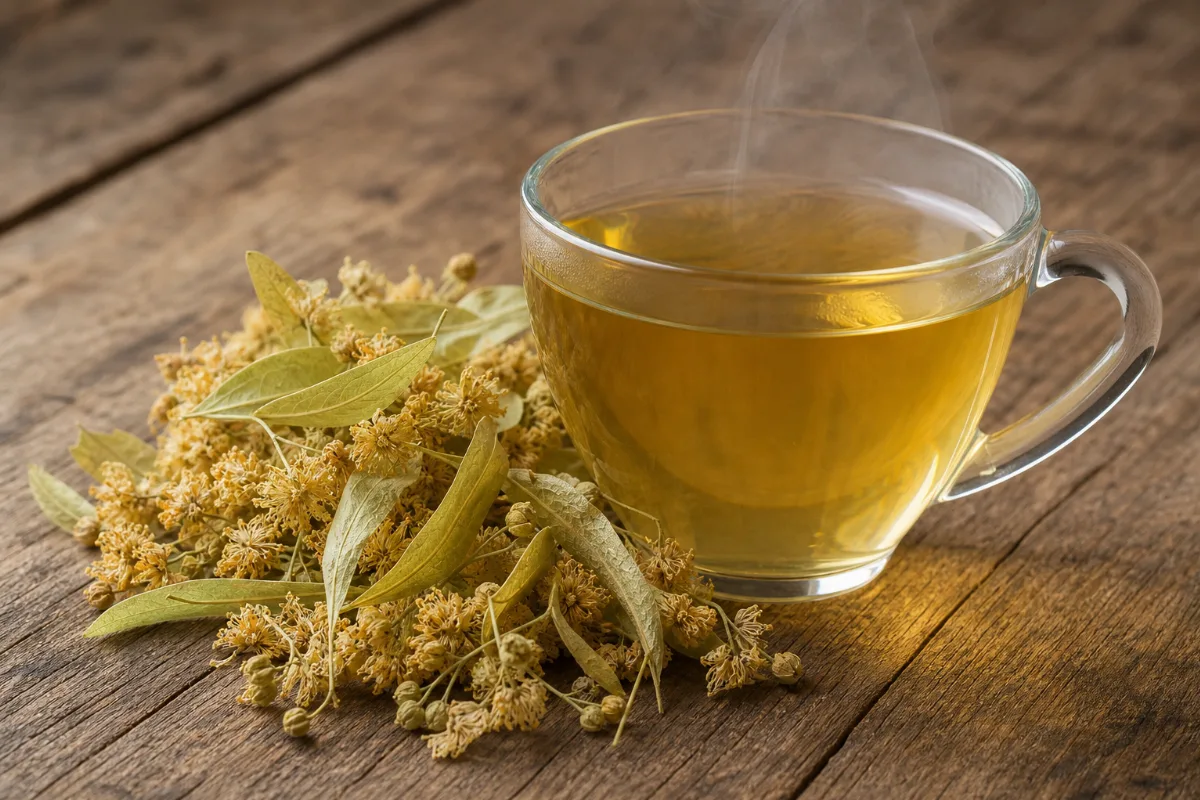
Linden flower tea is a drink made by steeping the dried flowers of linden (lime) trees in hot water. People drink it for colds and to relax. The EU lists it as a traditional remedy for colds and mild stress, based only on long use; no trial of the tea in people was found. The main cautions are that it should not be given to babies, and it is not recommended in pregnancy or breastfeeding.
General information, not medical advice. Last substantive update · Not medically reviewed. A named clinician has not signed off on this page. How this page is made
About Linden Flower Tea
Linden flower tea is the drink made from the dried flowers of Tilia cordata and Tilia platyphyllos. The EU calls it a traditional remedy for colds and mild stress, resting on long use. We found no trial of the tea in people. It has few known side effects, but it should not be given to babies, is not recommended in pregnancy or breastfeeding, and lowers iron absorption from a meal.
What it is
Linden tea is an infusion of the flowers, with their pale bracts, of two trees: Tilia cordata (small-leaved lime) and Tilia platyphyllos (large-leaved lime). Both are accepted species in the mallow family. It is not the tea plant that black and green tea come from.
Lab work found procyanidins (plant polyphenols) in the flowers, and in 2021 new alkaloids were reported in the infusion. No source we read gives a caffeine figure, so we do not state one. Blends can add true tea, so read the label.
What the research shows
Stress and colds: traditional EU uses. No trials of the tea in people were found.
Sleep and anxiety: animal studies only, on other linden species and on extracts, not on the tea.
Inflammation and antioxidant effects: lab studies on isolated compounds, and a mixed rat result.
Quality and contamination
Loose flowers can carry botulism spores: 3% of 100 loose samples in an Argentine survey, none of the tea-bag samples.
A 2026 study of trees found more metals in infusions from urban sites. Estimated intakes stayed below EFSA and JECFA reference limits, were highest in young children, and arsenic and mercury were not detectable.
We found no radiocaesium or pesticide findings for linden tea, so we state none. These studies describe particular samples, not every product.
At a glance
Traditional uses history, not proof
- The EU lists linden (lime) flower tea as a traditional herbal medicine for relief of common cold symptoms, based exclusively on long use.
- The EU also lists it for relief of mild symptoms of mental stress, again based only on long use.
- A 2022 EU review of new research found nothing to change in that listing.
Studied for research
- Mild stress, insufficient (tradition only)
- Common cold symptoms, insufficient (tradition only)
- Sleep and anxiety, insufficient (animal studies only)
- Inflammation and antioxidant effects, insufficient (lab and rat only)
Main compounds
- Procyanidins and epicatechin (lab studies)
- Polyphenols that lower iron absorption
- Newly found alkaloids (lab work)
Common forms
- Dried flowers with their bracts, loose, steeped in hot water
- Tea bags
- Liquid extracts and tinctures (different products, contain alcohol)
Research links: EU herbal monograph on lime flower (EMA) · EU 2022 review of new data (EMA) · Linden flower and infant botulism spores (abstract) · Herb teas and iron absorption (abstract) · Metals in linden infusions (abstract) · Tilia tomentosa and sleep in mice (abstract) · Research Library · Genes & Biomarkers Library
What it is and its history
- Accepted scientific name
- Tilia cordata and Tilia platyphyllos
- Naming authority
- Mill.; Scop.
- Synonyms
- Tilia x vulgaris Heyne (hybrid, named with the two species in the EU monograph)
- Common names
- Linden flower tea (English); Lime flower tea (English); Lime blossom tea (English); Tiliae flos (Latin); Tilleul (French); Tilo (Spanish)
- Family or group
- Malvaceae (the mallow family)
- Classification
- Malvales > Malvaceae > Tilia
- Native range
- Not checked.
- Habitat
- Not checked.
- What it looks like
- Flower: Not checked in a botanical source.
- Cultivation
- Not checked.
- Harvest and processing
- The EU monograph covers comminuted (cut) flower as a herbal tea and states that the material complies with the European Pharmacopoeia monograph.
- Sustainability and conservation
- Not checked.
Photographs
Traditional use and history history, not clinical proof
| Tradition or era | Documented use | Source |
|---|---|---|
| Long-standing use in the EU | The EU monograph says use for colds and mild stress rests exclusively on long-standing use. | s-ema-hmpc-tilia-flos |
Traditional use shows how it was used. It does not show that it works or is safe today.
What is inside, and how it may work
What it contains and how those compounds act in cells and animals. Laboratory and animal mechanisms are not proven effects in people.
Main compounds
| Compound | Family | Where it is concentrated | Activity studied | Level of evidence |
|---|---|---|---|---|
| Procyanidins and epicatechin | flavan-3-ols (polyphenols) | Flower Not found. | Lowered reactive oxygen species and IL-8 in human white blood cells in a dish. 2 | Lab |
| Piperidine and dihydropyrrole alkaloids | alkaloids (new in 2021) | Flower infusion Not found. | Made mouse windpipe muscle contract in lab work (per the EU 2022 review). 9 | Lab animal |
| Polyphenols (monomeric flavonoids) | polyphenols | Flower Not found. | Lowered iron absorption from a meal in people. 4 | Human data |
Mechanisms, receptors and pathways
| Target or pathway | Gene or receptor | What was found | Level |
|---|---|---|---|
| White blood cell inflammatory signals | IL-8, MIP-1 beta | Isolated procyanidins lowered IL-8 and, for some, MIP-1 beta release from stimulated human neutrophils ex vivo. 2 | Lab |
| Sleep structure | n/a | Tilia tomentosa extract increased non-REM sleep in mice. 3 | Animal research |
| Iron absorption | n/a | Polyphenols in the drink lowered iron absorption from a meal in adults. 4 | Human data |
Absorption, metabolism and elimination
- Absorption
- Not covered in the sources read.
- Distribution
- Not covered.
- Metabolism
- Not covered.
- Elimination
- Not covered.
- Bioavailability
- Not covered.
Isolated compounds versus whole extracts
A cup of linden flower tea is a water infusion of the flowers. Extracts and tinctures (made with alcohol) are separate EU-listed products. The lab compounds studied (isolated procyanidins) and the mouse extracts (a different species) cannot be read as results for the tea.
Nutritional composition
Linden tea is not a meaningful source of nutrients in the sources read, and it lowers iron absorption from a meal (1999 study).
4 not enough evidence
What is Linden Flower Tea good for?
The uses people ask about and how strong the human evidence is for each. For linden flower tea there are no human trials, so every row says where its support comes from.
Benefits, one by one
Each card is a research question, not a promise. Tap a goal to filter. Open a card to see the studies, doses and limits.
Mild mental stress
Not enough evidenceThe EU lists linden (lime) flower tea as a traditional herbal medicine for mild symptoms of mental stress, based only on long use. A 2022 EU review of new data changed nothing. No trial of the tea in people was found.
2 studiesHerbal tea of the flowers (with bracts) is what the EU monograph cove…
Studies, doses and limits
What the trials found
No clinical trial of linden flower tea for stress or anxiety was found in PubMed or in the EU documents read.
Results
No human results exist in the sources read.
Effect sizes as reported
None to report.
Why this rating
The support is a regulator listing based on tradition, not trials.
Form and dose studied
Herbal tea of the flowers (with bracts) is what the EU monograph covers. Extracts and tinctures are different products.
Who was studied
Adults and children over 12 (EU monograph).
Limits
No trials. The EU says to see a doctor if symptoms continue.
Why researchers looked
Linden flower has long been drunk to relax.
Traditional use
The EU monograph says the use rests exclusively on long-standing use.
Proposed mechanism Not established
Not established.
A proposed mechanism does not show that the effect happens in people.
See the Safety tab: not recommended under 12 for this use, nor in pregnancy or breastfeeding.
Sleep and anxiety (animal studies only)
Not enough evidenceIn mice, extracts of silver linden (a different species) increased non-REM sleep. A review of animal studies of flower extracts, American linden among them, says usefulness for anxiety still has to be shown. No human trial of the tea was found.
2 studiesExtracts in mice; not tea.
Studies, doses and limits
What the trials found
None found.
Results
Mice: more non-REM sleep, fewer brief awakenings. Review of 24 animal studies: some flower extracts acted like diazepam in rodent tests; usefulness in anxiety disorders not shown.
Effect sizes as reported
Not stated in the abstracts.
Why this rating
Animal work only, on other Tilia species and on extracts, not on the tea.
Form and dose studied
Extracts in mice; not tea.
Who was studied
Mice and rodents.
Limits
Different species, different preparation, no people.
Why researchers looked
Linden flowers are traditionally used to relax and help sleep.
Traditional use
Not covered by the EU monograph, which lists stress and colds only.
Proposed mechanism Animal research
Not established. Mouse work showed more non-REM sleep with fewer brief awakenings.
A proposed mechanism does not show that the effect happens in people.
Not applicable.
Common cold symptoms
Not enough evidenceThe EU lists linden flower tea as a traditional herbal medicine for relief of common cold symptoms, based only on long use. No trial of the tea for colds was found.
3 studiesHerbal tea (EU monograph).
Studies, doses and limits
What the trials found
None found. The EU monograph says the use rests exclusively on long-standing use.
Results
No human results.
Effect sizes as reported
None to report.
Why this rating
Tradition and a regulator listing, plus cell-dish work. No trials.
Form and dose studied
Herbal tea (EU monograph).
Who was studied
Adults and children over 4 (EU monograph, for colds).
Limits
No trials; lab cell results cannot be read as effects of a cup of tea.
Why researchers looked
Linden flower infusion is a long-standing home remedy for colds, sore throat and fever.
Traditional use
The EU monograph: for use at the first signs of a cold, with a doctor to be seen if symptoms last longer than 1 week, worsen, or breathlessness, high fever or pus-containing phlegm appears.
Proposed mechanism Lab
Lab work on isolated procyanidins found lowered reactive oxygen species and lowered IL-8 in human white blood cells in a dish. Not shown for the tea in people.
A proposed mechanism does not show that the effect happens in people.
See Safety tab.
Antioxidant and inflammation effects (lab and animal only)
Not enough evidenceCompounds from linden flowers lowered inflammatory signals in human white blood cells in a dish. In rats, linden infusion did not protect against alcohol-related oxidative stress as well as hoped. Neither tells us what a cup of tea does in a person.
2 studiesIsolated compounds (cells) and a 2% infusion (rats).
Studies, doses and limits
What the trials found
None.
Results
Cells: all ten procyanidins and epicatechin lowered reactive oxygen species; most lowered IL-8. Rats: liver enzymes AST and LDH fell with linden plus ethanol compared with ethanol alone but also rose with linden alone; oxidative markers were not restored.
Effect sizes as reported
Not stated in the abstracts.
Why this rating
Lab and animal only, with a mixed rat result.
Form and dose studied
Isolated compounds (cells) and a 2% infusion (rats).
Who was studied
Cells and rats.
Limits
Not tea in people. The rat study's authors conclude the infusion was not important as an antioxidant.
Why researchers looked
Linden flowers are rich in plant polyphenols.
Traditional use
Not described.
Proposed mechanism Lab
Procyanidins lowered reactive oxygen species and IL-8 release from stimulated human neutrophils ex vivo.
A proposed mechanism does not show that the effect happens in people.
The raised enzymes in the linden-only rats are a flag, not a finding for people.
Connections to the rest of health
How Linden Flower Tea connects to the rest of our health knowledge graph. Every link says what kind of connection it is. A safety link (for example to the liver) is a warning, not a benefit. A study that merely mentions a topic never creates a benefit link.
Explore every connection: goals, body systems, organs, symptoms, genes
A. Wellness goals
| Connected to | Kind of connection | Evidence status | Context | Studies |
|---|---|---|---|---|
| Stress Reduction | Potential benefit | Not enough evidence | Mild mental stress: The EU lists linden (lime) flower tea as a traditional herbal medicine for mild symptoms of mental stress, based only on long use. A 2022 EU review of new data changed nothing. No trial of the tea in people was found. | 8 9 |
| Calm Relaxation | Potential benefit | Not enough evidence | Mild mental stress: The EU lists linden (lime) flower tea as a traditional herbal medicine for mild symptoms of mental stress, based only on long use. A 2022 EU review of new data changed nothing. No trial of the tea in people was found. Sleep and anxiety (animal studies only): In mice, extracts of silver linden (a different species) increased non-REM sleep. A review of animal studies of flower extracts, American linden among them, says usefulness for anxiety still has to be shown. No human trial of the tea was found. | 8 9 3 5 |
| Better Sleep | Potential benefit | Not enough evidence | Sleep and anxiety (animal studies only): In mice, extracts of silver linden (a different species) increased non-REM sleep. A review of animal studies of flower extracts, American linden among them, says usefulness for anxiety still has to be shown. No human trial of the tea was found. | 3 5 |
| Seasonal Wellness | Potential benefit | Not enough evidence | Common cold symptoms: The EU lists linden flower tea as a traditional herbal medicine for relief of common cold symptoms, based only on long use. No trial of the tea for colds was found. | 8 9 2 |
| Immune Support | Potential benefit | Not enough evidence | Common cold symptoms: The EU lists linden flower tea as a traditional herbal medicine for relief of common cold symptoms, based only on long use. No trial of the tea for colds was found. | 8 9 2 |
| Inflammation Balance | Potential benefit | Not enough evidence | Antioxidant and inflammation effects (lab and animal only): Compounds from linden flowers lowered inflammatory signals in human white blood cells in a dish. In rats, linden infusion did not protect against alcohol-related oxidative stress as well as hoped. Neither tells us what a cup of tea does in a person. | 2 7 |
B. Body systems
| Connected to | Kind of connection | Evidence status | Context | Studies |
|---|---|---|---|---|
| Stress Mood | Biological association | Not enough evidence | Studied for: Mild mental stress | 8 9 |
| Sleep Recovery | Biological association | Not enough evidence | Studied for: Sleep and anxiety (animal studies only) | 3 5 |
| Respiratory Health | Biological association | Not enough evidence | Studied for: Common cold symptoms | 8 9 2 |
| Immune System | Biological association | Not enough evidence | Studied for: Antioxidant and inflammation effects (lab and animal only) | 2 7 |
E. Health conditions
| Connected to | Kind of connection | Evidence status | Context | Studies |
|---|---|---|---|---|
| Iron deficiency | Adverse effect or risk | Low certainty | Lowered iron absorption from a meal by 52% in one study. Preparation or compound: Linden flower tea with a meal |
4 |
| Pregnancy and breastfeeding | Contraindication | Low certainty | Not recommended for lack of data (EU monograph). Preparation or compound: Linden flower tea |
8 |
| Infant botulism | Adverse effect or risk | Very low certainty | Spores found in 3% of loose flower samples in one survey. Preparation or compound: Loose linden flowers |
1 |
I. Biomarkers
| Connected to | Kind of connection | Evidence status | Context | Studies |
|---|---|---|---|---|
| Non-REM sleep time (mice) | Biological association | Not enough evidence | Measured in trials: increased (mice, Tilia tomentosa extract). A lab change is not the same as a health benefit. | 3 |
| IL-8 release from human white blood cells (in a dish) | Biological association | Not enough evidence | Measured in trials: lowered (cells, isolated procyanidins). A lab change is not the same as a health benefit. | 2 |
| Liver enzymes AST and LDH (rats) | Biological association | Not enough evidence | Measured in trials: mixed (rats). A lab change is not the same as a health benefit. | 7 |
J. Genes, receptors and enzymes
| Connected to | Kind of connection | Evidence status | Context | Studies |
|---|---|---|---|---|
| IL-8 (CXCL8) | Preliminary mechanism | Lab | Release lowered in human neutrophils in a dish by isolated procyanidins. | 2 |
L. Active compounds
| Connected to | Kind of connection | Evidence status | Context | Studies |
|---|---|---|---|---|
| Procyanidins and epicatechin | Biological association | Lab | Lowered reactive oxygen species and IL-8 in human white blood cells in a dish. Preparation or compound: Flower |
2 |
| Piperidine and dihydropyrrole alkaloids | Biological association | Lab animal | Made mouse windpipe muscle contract in lab work (per the EU 2022 review). Preparation or compound: Flower infusion |
9 |
| Polyphenols (monomeric flavonoids) | Biological association | Human | Lowered iron absorption from a meal in people. Preparation or compound: Flower |
4 |
Each connection is stored with the ingredient, the connected record, the kind of connection, the evidence status, the supporting studies, the preparation or compound involved, and a review date (last reviewed October 25, 2026).
The evidence
The research centre for Linden Flower Tea. Every record here was checked against PubMed or the publisher's page; we never list a study we have not verified.
Evidence by outcome
Bars show how many studies we found for each outcome, not how well it works. People are added up across trials only (reviews are not added, to avoid double counting).
How we rate evidence
High certainty
Several well-run trials or reviews agree; further research is unlikely to change the picture much.
Moderate certainty
Good trials point the same way, but some doubt remains.
Low certainty
Small, short or inconsistent trials. The finding could change with better research.
Very low certainty
Very little or very weak human data. Treat as a possibility only.
Mixed findings
Trials or reviews disagree with each other.
Not enough evidence
Not enough human research to say either way.
Evidence against
Good research found no benefit, or found harm.
We take the reviewers' own risk-of-bias and GRADE statements where they exist, and otherwise judge from study size, design, consistency, directness and whether a product matches what is sold. Many publications do not make evidence high. Method note: We read the EU herbal monograph and its 2022 review in full, read the PubMed abstracts of the studies listed, and checked the species names in GBIF.
Study library: every study we checked 10
| Study | Design | People | Product, dose, length | Result |
|---|---|---|---|---|
| Bianco 2009 Linden flower (Tilia spp.) as potential vehicle of Clostridium botulinum spores in the transmission of infant botulism Revista Argentina de Microbiologia · PMID 20085187 |
Lab survey n/a |
200 200 samples of linden flowers (100 loose, 100 in tea bags) |
Linden (Tilia spp.) flowers tested for spores flower n/a n/a · vs Loose flowers vs tea-bag flowers |
Botulism spores were found in 3% of the loose flowers (30 spores per 100 grams); C. botulinum type A in two samples and type B in one. None of the tea-bag flowers had spores. The authors say linden flower must be considered a possible carrier and that the tea can be a risk factor for infant botulism, because in many countries it is given to infants as a sedative. Methods, limits and fundingOutcomes: Prevalence of botulism spores Limitations: A lab survey of spores in flowers, not a count of illnesses from tea. One country's products. Funding and conflicts: Research support, non-US government (per PubMed record) Read: abstract |
| Czerwińska 2018 The influence of procyanidins isolated from small-leaved lime flowers (Tilia cordata Mill.) on human neutrophils Fitoterapia · PMID 29447978 · DOI |
Lab study human cells |
Human neutrophils (white blood cells) in the lab | Ten procyanidins and epicatechin isolated from Tilia cordata flowers flower 5 to 20 micromolar in the dish n/a · vs Untreated cells |
All compounds lowered reactive oxygen species from stimulated cells. Most lowered release of IL-8, and some larger ones lowered MIP-1 beta. The authors say this partly supports the traditional use of the infusion for cold, sore throat and tonsil symptoms. Methods, limits and fundingOutcomes: Reactive oxygen species and inflammatory signals from the cells Limitations: Isolated compounds on cells in a dish, not a tea in people. Read: abstract |
| Di Soccio 2026 Tilia Tomentosa promotes sleep, preserving sleep structure npj Biological Timing and Sleep · PMID 42680851 · DOI |
Animal study mouse |
Freely moving mice with chronic recordings | Tilia tomentosa extracts (silver linden, a different species from the tea species) extract n/a chronic · vs Control mice |
Treated mice had more non-REM sleep and less wakefulness in their active hours, and fewer brief awakenings in their resting hours. The sleep structure was not impaired. The authors call it preliminary evidence. Methods, limits and fundingOutcomes: Sleep and wake recorded by EEG Limitations: Mice, a different Tilia species, an extract rather than a tea. Not evidence for people. Read: abstract |
| Hurrell 1999 Inhibition of non-haem iron absorption in man by polyphenolic-containing beverages British Journal of Nutrition · PMID 10999016 |
Controlled trial |
Adult volunteers (number not given in the abstract) | Lime flower (Tilia cordata Mill.) drink and other polyphenol drinks, taken with a bread meal flower n/a single meals · vs Water control meal |
Every drink studied cut iron absorption in a way that depended on its polyphenol content. Reductions: black tea 79 to 94%, peppermint tea 84%, pennyroyal 73%, cocoa 71%, vervain 59%, lime flower 52%, camomile 47%. The authors say this should be considered when giving dietary advice on iron. Iron absorption lowered 52% with lime flower drink Methods, limits and fundingOutcomes: Iron absorption from the meal (radio-iron incorporated into red cells) Limitations: Single meals in healthy adults; not long-term use or people who are low in iron. Group size not stated in the abstract. Funding and conflicts: Research support, non-US government (per PubMed record) Read: abstract |
| Meneses 2023 Systematic review on the anxiolytic and hypnotic effects of flower extracts in in vivo pre-clinical studies published from 2010 to 2020 Phytotherapy Research · PMID 37039741 · DOI |
Systematic review animal rodent |
24 24 animal studies of flower extracts from many plants |
Flower extracts; Tilia americana (American linden) was one of 23 plants named flower extract n/a n/a · vs Mostly diazepam as the reference |
Some flower extracts acted as well as diazepam in animal tests. Only one extract (chamomile) was defined as sedative. The authors say the usefulness of flower extracts in anxiety disorders remains to be demonstrated. Methods, limits and fundingOutcomes: Anxiety-like behaviour and sedation in rodents Limitations: Animal studies; linden is one of many plants and is a different species from the tea species. Read: abstract |
| Moțiu 2026 Molecular and Environmental Elucidation of Heavy Metal Transfer in Tilia spp.: From Soil Systems to Herbal Infusions Across Urban-Forest Gradients International Journal of Molecular Sciences · PMID 41751994 · DOI |
Lab survey n/a |
Tilia trees along an urban-forest gradient (soil, bark, leaves, flowers, infusions) | Tilia spp. infusions flower Two consumption scenarios modelled (150 and 400 mL a day) n/a · vs Urban vs forest sites |
Metal loads were higher at urban sites. Manganese, aluminium, lead and cadmium moved most readily into the infusion, and estimated intakes were highest in young children. All estimated intakes stayed below EFSA and JECFA reference limits; arsenic and mercury were not detectable in any infusion. The authors conclude Tilia infusions add little to total dietary metal exposure. Methods, limits and fundingOutcomes: Twelve elements measured; estimated daily intake by age group Limitations: One regional study of trees, not of retail products. Intake estimates are models. Read: abstract |
| Yayalacı 2014 Hepatoprotective and antioxidant activity of linden (Tilia platyphyllos L.) infusion against ethanol-induced oxidative stress in rats Journal of Membrane Biology · PMID 24337514 · DOI |
Animal study rat |
Rats in four groups | Linden flower infusion (Tilia platyphyllos), 2%, with or without 20% ethanol flower n/a n/a · vs Control, ethanol only |
The liver enzymes AST and LDH rose in the ethanol group and in the linden-only group, and fell in ethanol plus linden compared with ethanol. Oxidative-stress markers were not brought back towards normal. The authors conclude the infusion was not as important as diet-derived antioxidants. Methods, limits and fundingOutcomes: Liver enzymes and oxidative stress markers Limitations: Rats only. The linden-only group also showed raised enzymes. Mixed result. Read: abstract |
| n/a 2012 EMA/HMPC: Community herbal monograph on Tilia cordata Miller, Tilia platyphyllos Scop., Tilia x vulgaris Heyne or their mixtures, flos (lime flower), EMA/HMPC/337066/2011, adopted 22 May 2012 n/a · Source |
Authoritative guidance n/a |
n/a | n/a n/a n/a n/a · vs n/a |
Lists lime flower (as a herbal tea) as a traditional herbal medicine for relief of common cold symptoms and of mild symptoms of mental stress, based exclusively on long-standing use. Contraindication: hypersensitivity (allergy). Cold use: not recommended under 4 years; stress use: not recommended under 12 years (use in these ages not established for lack of data). A doctor should be consulted if cold symptoms last longer than 1 week, worsen, or breathlessness, high fever or pus-containing phlegm occurs; for stress, if symptoms persist. Interactions: none reported. Undesirable effects: none known. Overdose: no case reported. Pregnancy and breastfeeding: safety not established; use not recommended for lack of data. No fertility data. No studies on driving. Genotoxicity, reproductive toxicity and cancer tests have not been done. The monograph states no caution for heart conditions. Methods, limits and fundingOutcomes: Traditional use for common cold and mild mental stress; contraindications, warnings, pregnancy, interactions, side effects. Limitations: A regulator monograph, not a trial. Rests on long use. PDF text read in full on 2026-10-25. Read: full-text |
| n/a 2022 EMA/HMPC: Addendum to Assessment report on Tilia cordata, Tilia platyphyllos, Tilia x vulgaris, flos, EMA/HMPC/176303/2022, adopted 23 November 2022 n/a · Source |
Authoritative guidance n/a |
n/a | n/a n/a n/a n/a · vs n/a |
Of 244 new references, 24 were filtered and only four judged relevant. Safety-database cases (VigiLyze) reported Tilia taken together with other herbal or chemical medicines; no causal relation was proven and the reported reactions were not confirmed. The review found nothing to change in the monograph. It noted new alkaloids (piperidine and dihydropyrrole types) in lime flower infusion that made mouse windpipe muscle contract in lab work, and antioxidant and antimicrobial lab findings. Methods, limits and fundingOutcomes: Periodic review of new data 2014 to February 2022. Limitations: A regulator review of the literature, not a trial. PDF text read in full on 2026-10-25. Read: full-text |
| n/a 2026 GBIF Backbone Taxonomy: Tilia cordata Mill. (usage key 3152047) and Tilia platyphyllos Scop. (usage key 3152048) n/a · Source |
Database record n/a |
n/a | n/a n/a n/a n/a · vs n/a |
Both names are accepted species. Family Malvaceae, order Malvales. Checked through the GBIF API on 2026-10-25. Methods, limits and fundingOutcomes: Accepted names and family. Limitations: A taxonomy database record. Read: full-text |
What we do not know yet
- What the evidence supports: two traditional EU uses, an iron-absorption effect in volunteers, and lab findings on spores and metals.
- No clinical trial of linden flower tea for stress, sleep, anxiety or colds was found.
- The animal work is on other linden species and on extracts.
- No study of safety in pregnancy, breastfeeding or children.
- No source gave a caffeine measurement, or radiocaesium or pesticide results.
How new research is added
New studies are found by a saved PubMed search and are placed in a review queue. A person reads each one before it changes any evidence rating or safety wording. New publications never change ratings automatically.
Lab markers
What changed in blood or saliva tests during trials. A changed number is not the same as feeling or being healthier, and we give no "normal ranges".
Other 3
Non-REM sleep time (mice)
Increased (mice, Tilia tomentosa extract) in trials
Time spent in non-REM sleep, recorded by brain-wave recordings.
Not enough evidenceResults and what it means
Why it was measured
A basic measure of how much a sleeper rests.
Statistical vs. clinical meaning
Animal result for a different species; the authors call it preliminary.
Safety implication
None noted in the abstract.
| Study | Result | People | Product |
|---|---|---|---|
| 3 | More non-REM sleep and less wakefulness in the active hours; fewer brief awakenings in rest hours | Mice | Tilia tomentosa extracts, chronic |
IL-8 release from human white blood cells (in a dish)
Lowered (cells, isolated procyanidins) in trials
A signalling protein released by white blood cells when they are stimulated.
Not enough evidenceResults and what it means
Why it was measured
Marks inflammatory activity.
Statistical vs. clinical meaning
Lab marker, not a symptom or outcome in people.
Safety implication
None noted.
| Study | Result | People | Product |
|---|---|---|---|
| 2 | Most compounds lowered LPS-induced IL-8 release | Human neutrophils ex vivo | Procyanidins from Tilia cordata flowers, 5 to 20 micromolar |
Liver enzymes AST and LDH (rats)
Mixed (rats) in trials
Blood enzymes that rise when liver cells are stressed.
Not enough evidenceResults and what it means
Why it was measured
Used to check liver damage.
Statistical vs. clinical meaning
Animal result, mixed direction.
Safety implication
Linden alone raised the enzymes in rats; not known if relevant to people.
| Study | Result | People | Product |
|---|---|---|---|
| 7 | Raised by ethanol and by linden alone; lower with ethanol plus linden than ethanol alone | Rats | 2% Tilia platyphyllos flower infusion |
Safety
What studies and official sources say about side effects, medicines and who should check first. Each point shows what kind of evidence it comes from.
Main points to know 4
- Babies: do not give linden tea to infants. A lab survey found botulism spores in 3 of 100 samples of loose linden flowers and none in 100 samples from tea bags. The authors say linden tea can be a risk factor for infant botulism, because in many countries it is given to infants as a sedative. The EU monograph does not recommend use under 4 years for colds or under 12 for stress. Ask a doctor before giving any herbal tea to a baby. Lab survey 1 8
- Pregnancy and breastfeeding: not recommended for lack of data. The EU monograph says safety in pregnancy and breastfeeding has not been established and use is not recommended. No fertility data exist. Authoritative guidance 8
- Iron: the tea lowers iron absorption from a meal. In a 1999 study in adults, a lime flower (Tilia cordata) drink cut iron absorption from a bread meal by 52% under the study's conditions. This matters for anyone low in iron. Human trial 4
- Heart conditions: no caution is stated by the EU. The EU monograph and its 2022 review state no caution for heart conditions and report no interactions and no known side effects. That is not proof of safety: the tea has never been tested in trials. If you have a heart condition or take heart medicine, ask your doctor or pharmacist. Authoritative guidance 8 9
Side effects 2
| Effect | How often | Severity and recovery | Evidence |
|---|---|---|---|
| None known The monograph says if adverse reactions occur, see a doctor or qualified health practitioner. No driving studies have been done. | Not applicable (EU monograph) | not described Not described | Authoritative guidance 8 |
| Lower iron absorption from a meal Single meals in adults; long-term effect on iron levels not studied. | 52% lower in one study of single meals | depends on iron status Not studied | Human trial 4 |
Liver
No source read reports liver injury from linden flower tea. In a rat study, linden infusion given alone raised the liver enzymes AST and LDH. The authors saw it as a mixed result, and it is not evidence in people. LiverTox was not opened. 7
How often. No rate could be found.
Monitoring. No monitoring advice was read from an agency.
This is a safety connection. It is not evidence that Linden Flower Tea supports liver health.
Medicines and supplements 4
| With | Why it matters | Importance | Evidence | What to do |
|---|---|---|---|---|
| Medicines in general prescription | Not established. | The EU monograph says none reported. The 2022 EU review noted safety-database cases where linden was taken with other herbal or chemical medicines; no causal relation was proven and the reactions were not confirmed. | Authoritative guidance Not enough evidence 8 9 | Ask your doctor or pharmacist if you take regular medicine. |
| Lithium prescription | Not established. | No source read mentions an interaction with lithium. We do not state one. | None found Not enough evidence | Ask your doctor or pharmacist. |
| Diuretics (water tablets) prescription | Not established. | No source read mentions an interaction with diuretics. We do not state one. | None found Not enough evidence | Ask your doctor or pharmacist. |
| Iron in food and supplements nutrient | Polyphenols in the drink lower absorption of non-haem iron. | Lime flower drink lowered iron absorption from a bread meal by 52% in adults. | Human trial Low certainty 4 | If you are low in iron, ask your clinician about tea with meals. |
Who should check first 4
| Situation | Advice | Evidence |
|---|---|---|
| Allergy (hypersensitivity) to linden flower | Do not use (EU monograph). | Authoritative guidance 8 |
| Pregnancy and breastfeeding | Not recommended for lack of data (EU monograph). | Authoritative guidance 8 |
| Children: under 4 years (colds) or under 12 years (stress) | Not recommended (EU monograph); use not established for lack of data. | Authoritative guidance 8 |
| Babies under one year | Do not give linden tea to a baby. Botulism spores were found in some loose flowers; ask a doctor. | Lab survey 1 |
Overdose, product quality and regulators
Summary. No case of overdose has been reported (EU monograph). Genotoxicity tests are not adequate, and reproductive toxicity and cancer tests have not been performed (EU monograph).
Animal. Not covered beyond the rat liver study.
Human doses studied. Not stated here by design.
High dose or long term signals. Unknown.
Overdose response. No case reported.
Genotoxicity. Adequate tests not performed (EU monograph).
Toxic or hazardous parts. The flowers with their bracts are used. No toxic part was described in the sources read.
Two lab studies bear on quality: botulism spores in some loose flowers, and metals in infusions from trees at different sites. They describe products or trees tested, not harm to a person.
Botulism spores. 3% of 100 loose linden flower samples had botulism spores; none of 100 tea-bag samples did. 1
Metals. Infusions from trees at urban sites held more metals. Estimated intakes stayed below EFSA and JECFA reference limits, were highest in young children, and arsenic and mercury were undetectable. 6
Radiocaesium and pesticides. No source read gives radiocaesium or pesticide findings for linden tea, so none are stated. A PubMed search for linden or Tilia with caesium, radionuclides or pesticides found nothing.
| Body | Action | Date |
|---|---|---|
| EMA / HMPC (European Union) | Adopted an EU herbal monograph for lime flower tea as a traditional herbal medicine for relief of common cold symptoms and mild symptoms of mental stress, based only on long use. Allergy is a contraindication; not recommended in pregnancy or breastfeeding or for young children; no interactions reported; no known side effects. source | 2012-05-22 |
| EMA / HMPC (European Union) | Periodic review of new data (2014 to February 2022) found nothing to trigger a change to the monograph. source | 2022-11-23 |
When to get medical help
- Swelling of the lips, face or tongue, hives or trouble breathing after drinking the tea: get emergency help.
- A baby who becomes floppy, constipated, feeds poorly or has a weak cry: get urgent medical help (these are signs of infant botulism, a known risk with some foods; tell the doctor about any herbal tea given).
- Cold symptoms that last longer than 1 week, or breathlessness, high fever or pus-containing phlegm: see a doctor (EU monograph).
Stop using the product and contact a clinician or emergency service. In the US, Poison Control is 1-800-222-1222.
General information only, not medical advice. Ask a clinician or pharmacist before use, especially with medicines, in pregnancy or with a health condition. See the Natural Remedy Safety guide.
Frequently asked questions
What is linden flower tea?
Does linden tea help a cold?
It is a traditional EU use, based on long history only. No trial of the tea was found. The EU says to see a doctor if symptoms last longer than 1 week, or if breathlessness, high fever or pus-containing phlegm appears.
Does linden tea reduce stress or help sleep?
Does linden tea contain caffeine?
No source we read gives a caffeine figure. Linden is not the tea plant, but blends may add true tea, so read the label.
Is linden tea safe for babies?
Is linden tea safe in pregnancy or breastfeeding?
The EU says safety has not been established and use is not recommended for lack of data. Ask a midwife or doctor.
Does linden tea interact with medicines?
Is linden tea safe for people with heart conditions?
Does linden tea affect iron?
Yes. In a 1999 study a lime flower drink lowered iron absorption from a bread meal by 52%. This matters if you are low in iron.
Are there side effects?
The EU monograph says none are known. If a reaction occurs, see a doctor. Allergy to linden is a contraindication.
Can linden tea be contaminated?
Is linden tea the same as linden extract?
No. Liquid extracts and tinctures are separate EU-listed products and contain alcohol. This page covers the tea.
Explore by health goal
Calm RelaxationStress ReductionBetter SleepSeasonal WellnessImmune SupportInflammation Balance
Editorial transparency
- Written by
- AlternativeMed editorial team. Research compiled with AI assistance, then checked against PubMed records.
- Medical review
- None. This page has not been reviewed by a physician or pharmacist.
- First published
- 2026-10-25
- Last substantive update
- 2026-10-25
- How we research
- We read the EU herbal monograph and its 2022 review in full, read the PubMed abstracts of the studies listed, and checked the species names in GBIF.
- How we rate evidence
- See "How we rate evidence" in the Evidence tab.
- Independence
- No product is promoted on this page. No affiliate links are shown. This page is information, not a recommendation to drink or take anything.
Sources 10
Each source was opened and checked. Where we read only the abstract, it says so. The small numbers in the text point here.
- Bianco MI, Lúquez C, De Jong LI, Fernández RA. Linden flower (Tilia spp.) as potential vehicle of Clostridium botulinum spores in the transmission of infant botulism. Revista Argentina de Microbiologia. 2009. PMID 20085187. (abstract)
- Czerwińska ME, Dudek MK, Pawłowska KA, Pruś A, Ziaja M, Granica S. The influence of procyanidins isolated from small-leaved lime flowers (Tilia cordata Mill.) on human neutrophils. Fitoterapia. 2018. PMID 29447978. DOI 10.1016/j.fitote.2018.02.018. (abstract)
- Di Soccio A, Canova M, Rizzo N, Lodovichi C. Tilia Tomentosa promotes sleep, preserving sleep structure. npj Biological Timing and Sleep. 2026. PMID 42680851. DOI 10.1038/s44323-026-00105-0. (abstract)
- Hurrell RF, Reddy M, Cook JD. Inhibition of non-haem iron absorption in man by polyphenolic-containing beverages. British Journal of Nutrition. 1999. PMID 10999016. (abstract)
- Meneses C, Valdes-Gonzalez M, Garrido-Suárez BB, Garrido G. Systematic review on the anxiolytic and hypnotic effects of flower extracts in in vivo pre-clinical studies published from 2010 to 2020. Phytotherapy Research. 2023. PMID 37039741. DOI 10.1002/ptr.7830. (abstract)
- Moțiu PT, Pășcuț CG, Bartha S, Moga CE, Berchez O, Vlad IA, Tăut I, Rebrean FA, Bora FD. Molecular and Environmental Elucidation of Heavy Metal Transfer in Tilia spp.: From Soil Systems to Herbal Infusions Across Urban-Forest Gradients. International Journal of Molecular Sciences. 2026. PMID 41751994. DOI 10.3390/ijms27041856. (abstract)
- Yayalacı Y, Celik I, Batı B. Hepatoprotective and antioxidant activity of linden (Tilia platyphyllos L.) infusion against ethanol-induced oxidative stress in rats. Journal of Membrane Biology. 2014. PMID 24337514. DOI 10.1007/s00232-013-9622-z. (abstract)
- n/a. EMA/HMPC: Community herbal monograph on Tilia cordata Miller, Tilia platyphyllos Scop., Tilia x vulgaris Heyne or their mixtures, flos (lime flower), EMA/HMPC/337066/2011, adopted 22 May 2012. n/a. 2012. (full-text)
- n/a. EMA/HMPC: Addendum to Assessment report on Tilia cordata, Tilia platyphyllos, Tilia x vulgaris, flos, EMA/HMPC/176303/2022, adopted 23 November 2022. n/a. 2022. (full-text)
- n/a. GBIF Backbone Taxonomy: Tilia cordata Mill. (usage key 3152047) and Tilia platyphyllos Scop. (usage key 3152048). n/a. 2026. (full-text)