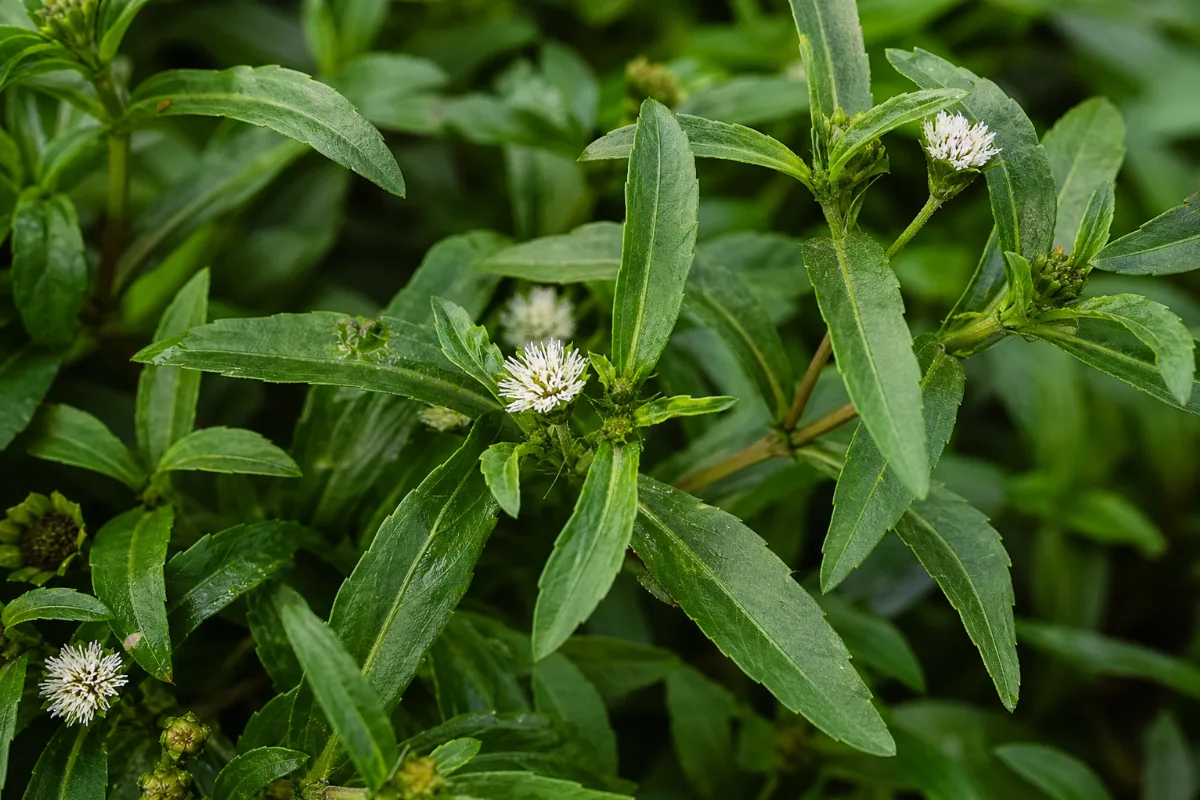
Herbs & Botanicals · Herbs · A traditional Ayurvedic hair and liver herb with very little human research
Bhringraj
Eclipta prostrata (L.) L. (also Eclipta alba) · also called Bhringraj, bhringaraja, false daisy, ink plant, bhumiraj
Bhringraj is the aerial part (leaf and shoot) of Eclipta prostrata, a small daisy-family herb. It is best known as an Ayurvedic hair-oil herb and a traditional liver and skin remedy. Its main lab-studied compounds are coumestans such as wedelolactone. Hair oil, by-mouth use and isolated compounds are different things, and this page keeps them apart.
General information, not medical advice. Last substantive update · Not medically reviewed. A named clinician has not signed off on this page. How this page is made
About Bhringraj
Bhringraj is a daisy-family herb used in Ayurvedic hair oils and as a liver and skin remedy. People have barely been studied: one small multi-herb hair-oil trial and nothing for the oral herb. Lab and animal work is interesting but unproven in people. The main cautions are daisy-family allergy and unknown effects with blood thinners, hormones, pregnancy and breastfeeding.
What it is
Bhringraj is Eclipta prostrata, a small annual herb of moist places in tropical Asia, Africa and South America. GBIF accepts the name Eclipta prostrata (L.) L. The older name Eclipta alba is still widely used in the literature.
It belongs to the daisy family (Asteraceae). The aerial parts and leaves are the parts used, as juice, powder or cooked into oils.
Wedelolactone and related coumestans are its best-known compounds.
Traditional and current uses
In Ayurveda it is a hair herb (hair fall and early graying), a liver tonic for jaundice, and a skin and wound herb. The leaves are used for snakebite in several countries, and traditional Chinese medicine uses it as a bleeding-stopping herb.
None of these uses has been confirmed in good human trials. Tradition is not proof of benefit.
What is in it and how it works
Most lab work focuses on wedelolactone, luteolin and apigenin. In mice and cultured hair cells, an extract raised a growth signal (FGF-7) and lowered a resting-phase signal (FGF-5). In rats, an extract and three compounds raised platelets and shortened clotting times.
These are mechanism findings in animals and cells. They do not show what a hair oil or capsule does in people.
What the research shows
Hair oil: one randomized, double-blind trial of a multi-herb oil (78 people, 120 days) found improved hair growth rate, density and graying scores compared with each group's own starting point. It had no placebo-only group (the comparison groups used minoxidil), the herbs are not all named in the abstract, and between-group results are not given. It cannot be credited to bhringraj.
By mouth and other uses: no human trial. Liver, hormone and clotting findings come from rats, and snake-venom findings from lab tests.
A 2025 review of 16 herbal hair-loss trials does not name bhringraj in its abstract.
At a glance
Traditional uses history, not proof
- Scalp oils for hair fall and early graying (Ayurveda).
- Jaundice and liver complaints (India, Nepal, Bangladesh).
- Skin problems, wounds, and dermatitis.
- Snakebite in some regions, and as a bleeding-stopping herb in traditional Chinese medicine.
- A rejuvenating tonic (Ayurveda).
Studied for research
- Hair loss and thinning (multi-herb oil), insufficient
- Early graying, insufficient
- Hair growth in mice and cells, very-low
- Liver (rat studies), very-low
- Skin and wounds (traditional), insufficient
- Bleeding and clotting (rat study), very-low
- Snake-venom enzymes (lab only), very-low
- Hormone effects (rat combinations), very-low
Main compounds
- Wedelolactone and demethylwedelolactone (coumestans)
- Luteolin and apigenin (flavonoids)
- Echinocystic acid and other triterpenoid saponins
- Thiophenes
Common forms
- Hair oil (leaves cooked in a base oil, often with other herbs)
- Leaf powder
- Fresh leaf or shoot juice
- Capsules, tablets or extracts
Research links: Bhringraj hair oil randomized trial (Cureus, 2026) · Eclipta prostrata review (Biomolecules, 2021) · NCCIH: Ayurvedic Medicine in Depth · Research Library · Genes & Biomarkers Library
The plant and its history
- Accepted scientific name
- Eclipta prostrata (L.) L.
- Naming authority
- (L.) L.; published in L. (1771), Mantissa Alt. 286, per GBIF
- Synonyms
- Eclipta alba (L.) Hassk. (widely used in the literature; GBIF lists it as its own entry, so the two are not fully reconciled there); Cotula alba (L.) L.; Cotula prostrata (L.) L.; Eclipta alba f. alba; Eclipta alba f. prostrata (L.) Hassk.
- Common names
- Bhringraj (also Bhringaraja, Bhrungraj) (Sanskrit/Hindi); False daisy (English); Ink plant (English); Bhumiraj (Nepali); Han lian cao (Chinese (name not verified in the sources read))
- Botanical family
- Asteraceae (the daisy family).
- Classification
- Plantae > Tracheophyta > Magnoliopsida > Asterales > Asteraceae > Eclipta > Eclipta prostrata
- Native range
- The review says it is widely distributed in tropical and subtropical regions of Asia, Africa and South America.
- Habitat
- Moist places such as swamp edges, river and lake banks and rice-field edges (review).
- What the plant looks like
- Roots: Not verified.; Stems: Branched.; Leaves: Not verified.; Flowers: White flowers (review: a medium-sized, branched, annual herb with white flowers).; Fruit: Not verified.
- Cultivation
- Easily propagated and spreads easily (review).
- Harvest and processing
- Aerial parts or whole plant are used; leaf juice, powder and leaves cooked into oil are traditional forms. Plant parts differ between studies.
- Look-alikes and adulterants
- Name: Wedelia species (e.g. Wedelia chinensis, Sphagneticola); Note: Related daisy-family plants. Wedelolactone was first isolated from Wedelia chinensis (2025 review abstract). Some may be sold under bhringraj-like names; that is NOT verified in the sources read.
- Sustainability and conservation
- Not verified. Described as a spreading weed in moist places.
Traditional use and history history, not clinical proof
| Tradition or era | Documented use | Source |
|---|---|---|
| Ayurveda (India, Nepal, Bangladesh) | Used for skin, liver (jaundice), stomach and respiratory complaints, and for hair fall and early graying. The review also notes revitalizing and anti-aging use. | p34827736 |
| Traditional Chinese medicine | Described in a 2026 paper as a 'miracle hemostatic herb' used for bleeding disorders. We did not read an original classical source. | p41887413 |
| South America | Some ethnic groups use it for snakebite (review). | p34827736 |
| Regulators | No EMA/HMPC monograph and no NCCIH herb page were found. | s-nccih-ayurveda |
Traditional use shows how a plant was used. It does not show that a supplement works or is safe today.
What is inside, and how it may work
What the plant contains and how those compounds act in cells and animals. Laboratory and animal mechanisms are not proven effects in people.
Main compounds
| Compound | Family | Where it is concentrated | Activity studied | Level of evidence |
|---|---|---|---|---|
| Wedelolactone PubChem 5281813 | coumestan | Aerial parts (higher in aerial parts than roots in one HPLC study) | Studied in the lab and in animals for anti-inflammatory, antiviral and other effects; also shortened clotting times in rats. 12 2 4 5 | Animal research |
| Demethylwedelolactone PubChem 5489605 | coumestan | Roots (higher than in aerial parts in one HPLC study) | With wedelolactone, reduced venom enzyme effects in lab tests. 13 2 | Laboratory research |
| Luteolin PubChem 5280445 | flavonoid | Not verified | Named in the 2026 rat study as a hemostatic component; also credited in the review for anticancer activity in lab work. 14 5 19 | Animal research |
| Apigenin PubChem 5280443 | flavonoid | Not verified | Named with wedelolactone and luteolin as a hemostatic component in rats. 15 5 | Animal research |
| Echinocystic acid PubChem 73309 | triterpenoid | Aerial parts (review) | Reported in rat osteoporosis work and in hepatic stellate cell work (review). 16 19 | Animal research |
| Ecalbasaponin and other triterpene saponins; thiophenes | saponins; sulphur-containing thiophenes | Varies by part | Listed in the review's chemistry tables; some thiophenes were tested on cancer cells in the lab. Individual compounds not looked up. 19 | Laboratory research |
Mechanisms, receptors and pathways
| Target or pathway | Gene or receptor | What was found | Level |
|---|---|---|---|
| Hair cycle signals FGF-7 and FGF-5; mTOR in hair papilla cells | FGF7, FGF5, MTOR | Oral extract raised FGF-7 and lowered FGF-5 in mouse skin; raised FGF-7 and activated mTOR in human dermal papilla cells. 10 | Animal research |
| PI3K-Akt pathway and clotting | PI3K-Akt (genes not named in the abstract) | Extract and three compounds shortened bleeding time and clotting times and raised platelet count in animals. 5 | Animal research |
| Venom phospholipase A2 | phospholipase A2 enzymes (venom) | Extracts and coumestans blocked venom enzyme activity in lab tests. 2 | Laboratory research |
| Hypothalamic GnRH signalling | GnRH mRNA (hypothalamus) | A two-herb extract with barley reduced the rise in GnRH mRNA in two rat puberty models. 8 | Animal research |
Absorption, metabolism and elimination
- Absorption
- Not studied in people. In a 2026 rat study, 11 compounds from the extract were found in blood serum as the parent compound and 2 as metabolites; the abstract does not say which or how much.
- Distribution
- Not studied.
- Metabolism
- Not studied in people.
- Elimination
- Not studied.
- Bioavailability
- Not studied in people. Whether anything from a hair oil reaches the blood is unknown.
Isolated compounds versus whole extracts
Most mechanism work uses isolated wedelolactone or solvent extracts (ethyl acetate, ethanol, petroleum ether). Leaf juice, powder and oil are different products, and results from an isolated compound or a lab extract do not carry over to them. The only human trial used a multi-herb oil.
Nutritional composition
Bhringraj is a medicinal herb, not a food source of vitamins or minerals in any amount that has been studied.
6 very low certainty5 not enough evidence
What was looked at
The 11 benefits and uses checked for Bhringraj, each with how strong the evidence is. Tap one to open it.
- Hair loss and thinning (herbal hair oil)Not enough evidence
- Early graying of hairNot enough evidence
- Scalp flaking and scalp conditionNot enough evidence
- Hair growth signals in mice and human hair cells (lab only)Very low certainty
- Hair regrowth compared with minoxidil in rats (lab only)Very low certainty
- Liver (traditional tonic; rat studies)Very low certainty
- Skin problems, dermatitis and wounds (traditional use)Not enough evidence
- Stopping bleeding (traditional Chinese use; animal studies)Very low certainty
- Snake-venom enzymes (lab only)Very low certainty
- Hormone effects (rat studies of combinations only)Very low certainty
- General tonic use and other lab activitiesNot enough evidence
Lab markers tracked in the studies
Hair densityHair growth rateGraying severity scoreFGF-7 and FGF-5 (hair growth signals)Liver enzymes (ALT/GPT, AST/GOT) and bilirubin in ratsPlatelets and clotting times in rats
What is Bhringraj good for?
The proposed uses and how strong the human evidence is for each. Almost everything here is traditional use or lab and animal work, and is labelled that way.
Benefits, one by one
Each card is a research question, not a promise. Tap a goal to filter. Open a card to see the studies, doses and limits.
Hair loss and thinning (herbal hair oil)
Not enough evidenceThe only human trial we found tested a multi-herb hair oil that contains bhringraj. People's hair measures improved over 120 days, but the trial had no plain placebo group and cannot show that bhringraj did the work.
3 studiesNo amounts are given here. Ask a doctor or pharmacist about amounts.
Studies, doses and limits
What the trials found
One randomized, double-blind trial (Patel 2026, 78 people, 75 finished) tested Neeli Bhringadi hair oil, a multi-herb oil, for 120 days against two other groups: the oil plus 5% minoxidil, and 5% minoxidil alone. There was no placebo-only group. All groups improved against their own starting values. A 2025 systematic review of 16 herbal hair-loss trials does not name bhringraj in its abstract. No trial of bhringraj alone (oil, powder or capsule) was found.
Results
In the herbal oil group at day 120: hair growth rate 290.29 +/- 39.57 micrometres per day, density 277.60 +/- 33.69 hairs per cm2, thickness 16.56 +/- 1.98 micrometres. The abstract gives no between-group comparison and no starting values.
Effect sizes as reported
Within-group change versus baseline, p<0.0001 for all three. No between-group effect size is stated in the abstract.
Why this rating
One small trial of a multi-herb oil, with no placebo group, so the effect cannot be credited to bhringraj. Both safety and benefit claims rest on an abstract.
Form and dose studied
No amounts are given here. Ask a doctor or pharmacist about amounts.
Who was studied
Adults 18-55 with androgenetic alopecia (the common pattern hair loss), hair fall and graying.
Limits
Multi-herb product; the herbs are not listed in the abstract; no placebo group; short; several authors work at the contract research company that ran it.
Why researchers looked
In Ayurveda, bhringraj leaf is cooked into scalp oils for hair fall and thinning.
Traditional use
Traditional use in Ayurveda and other Asian systems; a review says the juice is taken by mouth or put on the skin to promote hair growth.
Proposed mechanism Animal research
Unknown in people. In mice and cultured hair-follicle cells the extract raised a growth signal (FGF-7) and lowered a resting-phase signal (FGF-5).
A proposed mechanism does not show that the effect happens in people.
The abstract calls safety favourable but gives no numbers. See the Safety tab for allergy cautions.
Early graying of hair
Not enough evidenceEarly graying is a classic traditional use of bhringraj oil. The same multi-herb oil trial reported a lower graying score, but without a placebo group it does not show bhringraj slows graying.
1 studiesNo amounts are given here. Ask a doctor or pharmacist about amounts.
Studies, doses and limits
What the trials found
The same Patel 2026 trial measured a graying severity score. In the oil group it ended at 9.24 +/- 3.28 (p<0.0001 versus its own baseline). The abstract does not give the starting score or a comparison with the other groups.
Results
Lower graying severity score within the oil group; no between-group result in the abstract.
Effect sizes as reported
Not available beyond the within-group figure.
Why this rating
One multi-herb oil trial, no placebo group, no starting score in the abstract.
Form and dose studied
No amounts are given here. Ask a doctor or pharmacist about amounts.
Who was studied
Adults 18-55.
Limits
Same limits as the hair loss row. Graying scores are judged by eye in most studies; how it was scored here is not in the abstract.
Why researchers looked
Ayurvedic texts link bhringraj oils to hair darkening and early graying.
Traditional use
Traditional use for premature graying (Palitya in Ayurveda).
Proposed mechanism Pharmacological theory
No mechanism for graying was found in the sources read.
A proposed mechanism does not show that the effect happens in people.
Scalp flaking and scalp condition
Not enough evidenceThe multi-herb oil trial also scored scalp flaking and scalp hydration. The flaking score fell in the oil group, but again without a placebo group.
1 studiesNo amounts are given here. Ask a doctor or pharmacist about amounts.
Studies, doses and limits
What the trials found
Patel 2026 reports an Adherent Scalp Flaking Score of 8.08 +/- 4.95 at day 120 in the oil group (p<0.0001 versus baseline). Scalp hydration was measured, but its results are not in the abstract.
Results
Lower flaking score within the oil group.
Effect sizes as reported
Within-group only.
Why this rating
Same single multi-herb trial.
Form and dose studied
No amounts are given here. Ask a doctor or pharmacist about amounts.
Who was studied
Adults 18-55.
Limits
No placebo group; abstract gives no starting score.
Why researchers looked
Scalp oils are used for dry, flaky scalp as well as hair fall.
Traditional use
Traditional use for scalp and skin problems.
Proposed mechanism Pharmacological theory
Not studied.
A proposed mechanism does not show that the effect happens in people.
Hair growth signals in mice and human hair cells (lab only)
Very low certaintyIn mice, a by-mouth Eclipta extract was followed by earlier hair growth. In cultured human hair-follicle cells it raised a growth signal. This is lab and animal work only; no human hair-growth trial of the extract was found.
1 studiesNo amounts are given here. Ask a doctor or pharmacist about amounts.
Studies, doses and limits
What the trials found
None for the extract. Lee 2019 used four mice per group for 14 days and 24-hour cell tests. The mice were fed the extract; the human cells were exposed in a dish. Neither is the same as rubbing an oil into the scalp.
Results
Earlier entry into the hair growth phase in treated mice; higher FGF-7 and lower FGF-5; higher FGF-7 and active mTOR in the cells.
Effect sizes as reported
Qualitative in the abstract.
Why this rating
Animal and cell evidence from very small groups; very-low is the certainty for effects in people.
Form and dose studied
No amounts are given here. Ask a doctor or pharmacist about amounts.
Who was studied
Mice and cultured human cells.
Limits
Four mice per group; one short study; oral dosing; no numbers in the abstract.
Why researchers looked
To test whether the traditional hair use has a biological basis.
Proposed mechanism Animal research
The extract raised FGF-7 and lowered FGF-5 in mouse skin, and raised FGF-7 and switched on mTOR signalling in human dermal papilla cells (the cells at the base of a hair follicle).
A proposed mechanism does not show that the effect happens in people.
Hair regrowth compared with minoxidil in rats (lab only)
Very low certaintyA review reports that on shaved rats a leaf extract grew hair a little more slowly than 2% minoxidil. This is an animal result, summarised from older work.
1 studiesNo amounts are given here. Ask a doctor or pharmacist about amounts.
Studies, doses and limits
What the trials found
None. The 2021 review describes a rat study in which ethanol leaf extract took 19.01 +/- 0.51 days to complete hair growth against 16.05 +/- 0.41 days for 2% minoxidil. Both beat the untreated group. A mouse study with a petroleum-ether extract is also described. We read these through the review, not the original papers.
Results
Extract slightly slower than minoxidil in rats; both faster than no treatment.
Effect sizes as reported
19.01 vs 16.05 days to complete growth (review's summary).
Why this rating
Rat result reported second-hand in a review; says nothing certain about people.
Form and dose studied
No amounts are given here. Ask a doctor or pharmacist about amounts.
Who was studied
Rats.
Limits
Second-hand; original papers not opened.
Why researchers looked
Rats are a common first test of hair regrowth.
Proposed mechanism Animal research
Not explained in the review.
A proposed mechanism does not show that the effect happens in people.
Liver (traditional tonic; rat studies)
Very low certaintyBhringraj is a traditional remedy for jaundice and liver complaints, and many rat studies report it reduced chemical liver damage. We found no human trial of liver benefit.
1 studiesNo amounts are given here. Ask a doctor or pharmacist about amounts.
Studies, doses and limits
What the trials found
None found. The 2021 review reports mostly rat studies, says some lacked positive and negative controls, and says the clinical significance is not well studied.
Results
Rat liver measures improved after a chemical injury. In one example, an aqueous leaf extract at 250 mg/kg lowered GOT, GPT and bilirubin.
Effect sizes as reported
Methanol leaf extract: 72.8% reduction in lysosomal enzymes; chloroform root extract: 47.96% (review's figures from rat work).
Why this rating
Animal evidence only, partly poorly controlled, summarised second-hand.
Form and dose studied
No amounts are given here. Ask a doctor or pharmacist about amounts.
Who was studied
Rats given carbon tetrachloride.
Limits
Not a model of human liver disease; no human data; read through a review.
Why researchers looked
Traditional use for jaundice and hepatitis-type illness in India, Nepal and Bangladesh.
Traditional use
Jaundice and liver complaints in many regions (review).
Proposed mechanism Animal research
In rats given the chemical carbon tetrachloride, leaf and root extracts lowered liver enzymes (GOT, GPT) and bilirubin and lowered lysosomal enzyme levels. The mechanism is not settled.
A proposed mechanism does not show that the effect happens in people.
This is a benefit claim from rats, not a statement that the herb is safe for the liver. See the Safety tab.
Skin problems, dermatitis and wounds (traditional use)
Not enough evidenceThe leaf and shoot juice are traditionally put on wounds, skin problems and dermatitis. We found no human trial.
2 studiesNo amounts are given here. Ask a doctor or pharmacist about amounts.
Studies, doses and limits
What the trials found
None. The review lists these as ethnomedicinal uses.
Results
No outcome data.
Effect sizes as reported
Not applicable.
Why this rating
Traditional use only; no controlled human study found.
Form and dose studied
No amounts are given here. Ask a doctor or pharmacist about amounts.
Who was studied
Not applicable.
Limits
Tradition is not proof of benefit. Asteraceae plants can also trigger skin allergy (see Safety).
Why researchers looked
Widespread traditional use in Nepal, India and elsewhere.
Traditional use
Wounds, infection prevention, itching, burns, pimples and other skin diseases (review).
Proposed mechanism Pharmacological theory
Not established in the sources read.
A proposed mechanism does not show that the effect happens in people.
Allergic contact dermatitis is a known risk with the daisy family.
Stopping bleeding (traditional Chinese use; animal studies)
Very low certaintyIn traditional Chinese medicine the plant is a bleeding-stopping herb. In a 2026 rat study an extract and three compounds raised platelet counts and shortened clotting times. No human trial was found.
2 studiesNo amounts are given here. Ask a doctor or pharmacist about amounts.
Studies, doses and limits
What the trials found
None.
Results
Fewer stomach bleeding spots; shorter clotting times; higher platelets (animal).
Effect sizes as reported
Not given in the abstract.
Why this rating
One animal and computer-model study, abstract only.
Form and dose studied
No amounts are given here. Ask a doctor or pharmacist about amounts.
Who was studied
Animals.
Limits
No numbers in the abstract; a clotting-promoting direction in rats says nothing certain about people.
Why researchers looked
Traditional use for bleeding (including blood in the sputum and urine, per the review).
Traditional use
Called a 'miracle hemostatic herb' in traditional Chinese medicine, per the 2026 study; the review lists bleeding, hemoptysis and hematuria among traditional uses.
Proposed mechanism Animal research
Ethyl acetate extract and its compounds wedelolactone, luteolin and apigenin shortened bleeding time, raised platelet count, shortened prothrombin and thrombin times and lowered fibrinogen in animals with heat-induced stomach bleeding. The authors link this to the PI3K-Akt pathway.
A proposed mechanism does not show that the effect happens in people.
Matters for people on blood thinners: this signal points toward clotting, not thinning. See Safety.
Snake-venom enzymes (lab only)
Very low certaintyThe plant is used against snakebite in some places. In lab tests, extracts and wedelolactone blocked venom enzymes. This is not evidence that it treats a snakebite.
2 studiesNo amounts are given here. Ask a doctor or pharmacist about amounts.
Studies, doses and limits
What the trials found
None.
Results
Venom enzyme activity reduced in lab tests (the review reports about 50% for a root extract and about 70% for an aerial-part extract against one Bothrops venom).
Effect sizes as reported
Review's figures: about 50% (root) and about 70% (aerial parts) enzyme inhibition.
Why this rating
Lab-only; no survival or treatment data in animals or people.
Form and dose studied
No amounts are given here. Ask a doctor or pharmacist about amounts.
Who was studied
Lab tests.
Limits
A snakebite is an emergency that needs antivenom and hospital care. Do not rely on any plant.
Why researchers looked
Folk use for snakebite in India, China and Brazil.
Traditional use
Leaves used for snakebite (review).
Proposed mechanism Laboratory research
Extracts and the coumestans wedelolactone and demethylwedelolactone inhibited venom phospholipase A2 enzymes and their muscle-damaging effect in lab tests.
A proposed mechanism does not show that the effect happens in people.
Seek emergency care for any snakebite.
Hormone effects (rat studies of combinations only)
Very low certaintyTwo rat studies of herb mixes containing Eclipta looked at hormones. One delayed early puberty signs. The other found no change in estradiol or FSH while improving hot-flash-like signs. Neither tested bhringraj alone or any person.
2 studiesNo amounts are given here. Ask a doctor or pharmacist about amounts.
Studies, doses and limits
What the trials found
None.
Results
Rat results for combination extracts only.
Effect sizes as reported
Not given in the abstracts.
Why this rating
Two animal studies of combinations; abstracts only.
Form and dose studied
No amounts are given here. Ask a doctor or pharmacist about amounts.
Who was studied
Female rats.
Limits
Combination products; the effect of Eclipta alone is unknown; no human data.
Why researchers looked
Mixed-herb extracts are being tested for puberty timing and menopause-type symptoms.
Proposed mechanism Animal research
With barley, the extract delayed vaginal opening and lowered hypothalamic GnRH mRNA in rats. With Leonurus and Pueraria, 12 weeks of dosing left estradiol and FSH unchanged in ovariectomized rats while improving temperature and mood-behaviour measures.
A proposed mechanism does not show that the effect happens in people.
Hormone effects in people are unknown. See Safety.
General tonic use and other lab activities
Not enough evidenceAyurveda uses bhringraj as a rejuvenating tonic. Lab and animal studies report anti-inflammatory, antioxidant, anticancer-cell and other effects, mostly for the isolated compound wedelolactone. None of this has been shown in people.
2 studiesNo amounts are given here. Ask a doctor or pharmacist about amounts.
Studies, doses and limits
What the trials found
None. Neither review (2021 plant review; 2025 wedelolactone review) reports a human trial.
Results
No human outcomes.
Effect sizes as reported
Not applicable.
Why this rating
Traditional and lab evidence only.
Form and dose studied
No amounts are given here. Ask a doctor or pharmacist about amounts.
Who was studied
Not applicable.
Limits
Isolated compound results do not carry over to leaf juice, oil or powder.
Why researchers looked
Chemistry work on its coumestans, flavonoids and saponins.
Traditional use
Revitalizing and anti-aging use in Ayurveda (review).
Proposed mechanism Laboratory research
Wedelolactone is reported to have anti-inflammatory, antiviral, antibacterial, antitumor and anti-osteoporosis effects in lab and animal studies.
A proposed mechanism does not show that the effect happens in people.
Connections to the rest of health
How Bhringraj connects to the rest of our health knowledge graph. Every link says what kind of connection it is. A safety link (for example to the liver) is a warning, not a benefit. A study that merely mentions a topic never creates a benefit link.
Explore every connection: goals, body systems, organs, symptoms, genes
A. Wellness goals
| Connected to | Kind of connection | Evidence status | Context | Studies |
|---|---|---|---|---|
| Hair Support | Traditional use | Not enough evidence | Hair loss and thinning (herbal hair oil): The only human trial we found tested a multi-herb hair oil that contains bhringraj. People's hair measures improved over 120 days, but the trial had no plain placebo group and cannot show that bhringraj did the work. Early graying of hair: Early graying is a classic traditional use of bhringraj oil. The same multi-herb oil trial reported a lower graying score, but without a placebo group it does not show bhringraj slows graying. | 18 1 19 |
| Hair Support | Potential benefit | Not enough evidence | Scalp flaking and scalp condition: The multi-herb oil trial also scored scalp flaking and scalp hydration. The flaking score fell in the oil group, but again without a placebo group. | 18 |
| Healthy Skin | Potential benefit | Not enough evidence | Scalp flaking and scalp condition: The multi-herb oil trial also scored scalp flaking and scalp hydration. The flaking score fell in the oil group, but again without a placebo group. | 18 |
| Hair Support | Preliminary mechanism | Very low certainty | Hair growth signals in mice and human hair cells (lab only): In mice, a by-mouth Eclipta extract was followed by earlier hair growth. In cultured human hair-follicle cells it raised a growth signal. This is lab and animal work only; no human hair-growth trial of the extract was found. Hair regrowth compared with minoxidil in rats (lab only): A review reports that on shaved rats a leaf extract grew hair a little more slowly than 2% minoxidil. This is an animal result, summarised from older work. | 10 19 |
| Liver Support | Traditional use | Very low certainty | Liver (traditional tonic; rat studies): Bhringraj is a traditional remedy for jaundice and liver complaints, and many rat studies report it reduced chemical liver damage. We found no human trial of liver benefit. | 19 |
| Healthy Skin | Traditional use | Not enough evidence | Skin problems, dermatitis and wounds (traditional use): The leaf and shoot juice are traditionally put on wounds, skin problems and dermatitis. We found no human trial. | 19 9 |
| Hormone Balance | Preliminary mechanism | Very low certainty | Hormone effects (rat studies of combinations only): Two rat studies of herb mixes containing Eclipta looked at hormones. One delayed early puberty signs. The other found no change in estradiol or FSH while improving hot-flash-like signs. Neither tested bhringraj alone or any person. | 8 6 |
| Inflammation Balance | Traditional use | Not enough evidence | General tonic use and other lab activities: Ayurveda uses bhringraj as a rejuvenating tonic. Lab and animal studies report anti-inflammatory, antioxidant, anticancer-cell and other effects, mostly for the isolated compound wedelolactone. None of this has been shown in people. | 19 4 |
B. Body systems
| Connected to | Kind of connection | Evidence status | Context | Studies |
|---|---|---|---|---|
| Integumentary System | Biological association | Not enough evidence | Studied for: Hair loss and thinning (herbal hair oil) Studied for: Early graying of hair | 18 1 19 10 9 |
| Hepatic System | Biological association | Very low certainty | Studied for: Liver (traditional tonic; rat studies) | 19 |
| Cardiovascular System | Biological association | Very low certainty | Studied for: Stopping bleeding (traditional Chinese use; animal studies) | 5 19 |
| Musculoskeletal System | Biological association | Very low certainty | Studied for: Snake-venom enzymes (lab only) | 2 19 |
| Endocrine System | Biological association | Very low certainty | Studied for: Hormone effects (rat studies of combinations only) | 8 6 |
| Immune System | Biological association | Not enough evidence | Studied for: General tonic use and other lab activities | 19 4 |
C. Body parts and organs
| Connected to | Kind of connection | Evidence status | Context | Studies |
|---|---|---|---|---|
| Liver | Traditional use | Very low certainty | Traditional liver tonic; rat studies only; no human safety data. Preparation or compound: Leaf and aerial-part extracts (rats) |
19 |
| Skin | Adverse effect or risk | Not enough evidence | Family-level risk of contact dermatitis; no bhringraj-specific report found. Family-level allergy and contact dermatitis risk; no bhringraj-specific report found. Preparation or compound: Daisy-family plants in general |
9 |
| Blood and clotting | Drug or supplement interaction | Very low certainty | Higher platelets and shorter clotting times in rats; relevance to blood thinners unknown. Preparation or compound: Extract; wedelolactone (rats) |
5 |
I. Biomarkers
| Connected to | Kind of connection | Evidence status | Context | Studies |
|---|---|---|---|---|
| Hair density | Biological association | Not enough evidence | Measured in trials: raised. A lab change is not the same as a health benefit. | 18 |
| Hair growth rate | Biological association | Not enough evidence | Measured in trials: raised. A lab change is not the same as a health benefit. | 18 |
| Graying severity score | Biological association | Not enough evidence | Measured in trials: lowered. A lab change is not the same as a health benefit. | 18 |
| FGF-7 and FGF-5 (hair growth signals) | Biological association | Very low certainty | Measured in trials: mixed. A lab change is not the same as a health benefit. | 10 |
| Liver enzymes (ALT/GPT, AST/GOT) and bilirubin in rats | Biological association | Very low certainty | Measured in trials: lowered. A lab change is not the same as a health benefit. | 19 6 |
| Platelets and clotting times in rats | Biological association | Very low certainty | Measured in trials: mixed. A lab change is not the same as a health benefit. | 5 |
J. Genes, receptors and enzymes
| Connected to | Kind of connection | Evidence status | Context | Studies |
|---|---|---|---|---|
| FGF7 / FGF5 (hair growth signals) | Preliminary mechanism | Animal | Changed in mouse skin and in human hair papilla cells after the extract. | 10 |
K. Biological pathways
| Connected to | Kind of connection | Evidence status | Context | Studies |
|---|---|---|---|---|
| PI3K-Akt pathway | Preliminary mechanism | Animal | Linked by the authors to the hemostatic effect in animals. | 5 |
L. Active compounds
| Connected to | Kind of connection | Evidence status | Context | Studies |
|---|---|---|---|---|
| Wedelolactone | Biological association | Animal | Studied in the lab and in animals for anti-inflammatory, antiviral and other effects; also shortened clotting times in rats. Preparation or compound: Aerial parts (higher in aerial parts than roots in one HPLC study) |
12 2 4 5 |
| Demethylwedelolactone | Biological association | In vitro | With wedelolactone, reduced venom enzyme effects in lab tests. Preparation or compound: Roots (higher than in aerial parts in one HPLC study) |
13 2 |
| Luteolin | Biological association | Animal | Named in the 2026 rat study as a hemostatic component; also credited in the review for anticancer activity in lab work. Preparation or compound: Not verified |
14 5 19 |
| Apigenin | Biological association | Animal | Named with wedelolactone and luteolin as a hemostatic component in rats. Preparation or compound: Not verified |
15 5 |
| Echinocystic acid | Biological association | Animal | Reported in rat osteoporosis work and in hepatic stellate cell work (review). Preparation or compound: Aerial parts (review) |
16 19 |
| Ecalbasaponin and other triterpene saponins; thiophenes | Biological association | In vitro | Listed in the review's chemistry tables; some thiophenes were tested on cancer cells in the lab. Individual compounds not looked up. Preparation or compound: Varies by part |
19 |
Each connection is stored with the ingredient, the connected record, the kind of connection, the evidence status, the supporting studies, the preparation or compound involved, and a review date (last reviewed October 25, 2026).
Evidence at a glance: what changed in 6 lab markers
Tap a number to show only those markers. Counts are markers, not people.
The evidence
The research centre for Bhringraj. Every record here was checked against PubMed or the publisher's page; we never list a study we have not verified.
Evidence by outcome
Bars show how many studies we found for each outcome, not how well it works. People are added up across trials only (reviews are not added, to avoid double counting).
How we rate evidence
High certainty
Several well-run trials or reviews agree; further research is unlikely to change the picture much.
Moderate certainty
Good trials point the same way, but some doubt remains.
Low certainty
Small, short or inconsistent trials. The finding could change with better research.
Very low certainty
Very little or very weak human data. Treat as a possibility only.
Mixed findings
Trials or reviews disagree with each other.
Not enough evidence
Not enough human research to say either way.
Evidence against
Good research found no benefit, or found harm.
We take the reviewers' own risk-of-bias and GRADE statements where they exist, and otherwise judge from study size, design, consistency, directness and whether a product matches what is sold. Many publications do not make evidence high. Method note: We started from our existing summary, then searched PubMed, read abstracts of the hair oil trial, a systematic review of herbal hair trials, animal studies and safety papers, read the 2021 plant review in full, read the NCCIH Ayurveda page, and checked the plant name in GBIF and NCBI and compounds in PubChem. Not found or not read: an EMA herbal monograph (the search page blocked automated access), an NCCIH herb page, LiverTox and LactMed entries, MSK page, FDA, WHO and Commission E. Only abstracts were read for all papers except the 2021 review. Certainty ratings are the compiler's reading, not formal grades. No study is cited that we could not verify.
Study library: every study we checked 19
| Study | Design | People | Product, dose, length | Result |
|---|---|---|---|---|
| Allam 2025 Pathophysiology, conventional treatments, and evidence-based herbal remedies of hair loss, with a systematic review of controlled clinical trials Naunyn Schmiedebergs Arch Pharmacol · PMID 40536553 · DOI |
Systematic review |
Sixteen randomized controlled trials of herbal remedies for hair loss | Herbal remedies for hair loss (rosemary, green tea, ginseng, aloe vera, olive and saw palmetto named in the abstract) various various various · vs various |
Named herbs showed promising results, but the reviewers say design limits and varied outcomes call for more rigorous, standardised research. Bhringraj (Eclipta) is not named in the abstract, so we cannot say whether it was among the 16 trials. none (narrative summary of 16 RCTs) Methods, limits and fundingOutcomes: Hair growth, density, shedding, patient satisfaction Limitations: Only the abstract was read; the list of included trials was not seen. Funding and conflicts: Authors declare no competing interests. Read: abstract |
| Diogo 2009 Inhibition of snake venoms and phospholipases A(2) by extracts from native and genetically modified Eclipta alba: isolation of active coumestans Basic and Clinical Pharmacology and Toxicology · PMID 19320636 · DOI |
Laboratory research in-vitro |
Lab tests with snake venom enzymes (phospholipase A2) and animal-tissue myotoxicity tests | Extracts of Eclipta alba aerial parts and roots (field-grown and lab-modified), and isolated wedelolactone and demethylwedelolactone aerial parts; roots not stated in the abstract not stated in the abstract · vs Not stated in the abstract |
Field-grown extracts blocked venom phospholipase A2 in the lab. Wedelolactone was higher in the aerial parts, demethylwedelolactone in the roots. A modified-root clone and the isolated coumestans reduced the muscle-damaging activity of venom enzymes. Qualitative in the abstract Methods, limits and fundingOutcomes: Venom phospholipase A2 activity; venom myotoxic (muscle-damaging) activity Limitations: Lab and tissue tests only; no animal survival data and no people. It is not evidence that the plant treats a snakebite. Funding and conflicts: Not stated in the abstract. Read: abstract |
| GBIF Secretariat 2026 GBIF Backbone Taxonomy: Eclipta prostrata (L.) L. GBIF species API · Source |
Database record plant |
Plant | not applicable not applicable not applicable not applicable · vs not applicable |
Key 5384950: Eclipta prostrata (L.) L., status ACCEPTED, family Asteraceae, published in L. (1771) Mantissa Alt. 286. Match confidence 97, exact. Listed synonyms include Cotula alba, Cotula prostrata, Eclipta alba f. alba and Eclipta alba f. prostrata. The separate name Eclipta alba (L.) Hassk. (key 5384955) also shows as accepted in a name match, so GBIF itself is not fully consistent on this name. not applicable Methods, limits and fundingOutcomes: Accepted name, family, synonyms Limitations: Queried by API on 2026-10-25 only. Read: full-record |
| Han 2025 Wedelolactone, a natural coumestan with multiple pharmacological effects Frontiers in Pharmacology · PMID 41684521 · DOI |
Narrative review animal+in-vitro (review) |
Review of lab and animal studies of one compound | Wedelolactone (isolated compound; first isolated from Wedelia chinensis per the abstract) not applicable not applicable not applicable · vs not applicable |
Reports anti-inflammatory, antiviral, antibacterial, antitumor and anti-osteoporosis activity and protection of organs in lab and animal studies. The abstract mentions no human trials. none (narrative) Methods, limits and fundingOutcomes: Pharmacological effects in vitro and in vivo Limitations: Compound-level review of lab and animal work; abstract only. Funding and conflicts: Authors declare no conflicts. Read: abstract |
| Huang 2026 Active hemostatic constituents of Eclipta prostrata and PI3K-Akt-mediated protection in heat-induced gastric hemorrhage: Integration of serum-exposed metabolite profiling, network pharmacology, and in vivo validation Fitoterapia · PMID 41887413 · DOI |
Animal research animal |
Animal model of heat-induced stomach bleeding (number of animals not stated in the abstract) | Ethyl acetate extract of Eclipta prostrata, and the isolated compounds wedelolactone, luteolin and apigenin unspecified not stated in the abstract not stated in the abstract · vs Not stated in the abstract |
The extract reduced stomach bleeding spots, raised platelet count, shortened PT and TT and lowered fibrinogen. Wedelolactone, luteolin and apigenin each shortened bleeding time and shifted the same clotting measures. The authors call the plant a traditional Chinese 'miracle hemostatic herb' (a herb that stops bleeding). Qualitative in the abstract Methods, limits and fundingOutcomes: Stomach bleeding spots, bleeding time, platelet count, prothrombin time (PT), thrombin time (TT), fibrinogen Limitations: Animal and computer-model study; no numbers in the abstract; says nothing about people taking blood thinners. Funding and conflicts: Authors declare no competing interests. Read: abstract |
| Kang 2021 Combined Extract of Leonurus japonicus Houtt, Eclipta prostrata L., and Pueraria lobata Ohwi Improved Hot Flashes and Depression in an Ovariectomized Rat Model of Menopause Foods · PMID 33477405 · DOI |
Animal research animal |
Ovariectomized female rats (a menopause model), five groups | Three-herb extract (Leonurus, Eclipta, Pueraria); a combination, not bhringraj alone unspecified 100 or 200 mg/kg body weight by mouth 12 weeks · vs Sham, vehicle and estradiol groups |
The extract did not change AST, ALT, estradiol or FSH, which the authors read as no liver or hormone disturbance in these rats. It improved temperature signs of hot flashes and depression-like behaviour. It lowered one bone marker (CTX-1) but did not change bone density. Qualitative in the abstract Methods, limits and fundingOutcomes: Body weight, AST, ALT, estradiol, FSH, tail and rectal temperature, mood-behaviour tests Limitations: Three-herb mix in rats; one author group includes a food company (Nong Shim R&D); not a result in people. Funding and conflicts: Funders had no role in design, analysis or publication, per the statement; two authors work at the Nong Shim Co. R&D centre. Read: abstract |
| Karousatos 2021 Case series and review of Ayurvedic medication induced liver injury BMC Complementary Medicine and Therapies · PMID 33714265 · DOI |
Case series |
3 Three adults with acute liver injury and jaundice after Ayurvedic products for 90-120 days |
Giloy Kwath (Tinospora cordifolia alone) and two multi-plant Ayurvedic products (Manjishthadi/Aragwadhi Kwatham, Kanchnar Guggulu) unspecified not stated 90-120 days · vs Not applicable |
All three had liver-cell injury; enzymes fell by half within 30 days and all recovered. RUCAM scores 7-8 (probable). The abstract does not list Eclipta as an ingredient, but the multi-plant products' full ingredient lists were not read. not applicable Methods, limits and fundingOutcomes: Liver enzymes, jaundice, causality score (RUCAM) Limitations: Three cases; cause hard to pin on one plant; no bhringraj-specific information. Funding and conflicts: No conflicts declared. Read: abstract |
| Kim 2025 Preventive Effects of Eclipta prostrata and Hordeum vulgare Extract Complex on Precocious Puberty in Danazol- and High-Fat Diet-Induced Rat Models International Journal of Molecular Sciences · PMID 41303642 · DOI |
Animal research animal |
Female rats given danazol or a high-fat diet to bring on early puberty | Extract complex of Eclipta prostrata and barley (Hordeum vulgare); a combination, not bhringraj alone unspecified not stated in the abstract not stated in the abstract · vs Untreated model rats |
The extract complex delayed vaginal opening and reduced ovarian maturation in both models and reduced the rise in hypothalamic GnRH mRNA, without changing body weight. The authors suggest it acts on the brain-pituitary-ovary hormone axis. Qualitative in the abstract Methods, limits and fundingOutcomes: Vaginal opening, ovary maturation, hypothalamic GnRH gene expression, body weight Limitations: Two-herb combination in rats; no numbers in the abstract; not a result in people. Funding and conflicts: Not stated in the abstract. Read: abstract |
| Ključevšek 2025 Allergic Potential of Medicinal Plants From the Asteraceae Family Health Science Reports · PMID 39995792 · DOI |
Narrative review human (review) |
Review of allergy reports on medicinal Asteraceae plants | Asteraceae (daisy family) medicinal plants in general; Eclipta is not named in the abstract various not applicable not applicable · vs not applicable |
Asteraceae plants are important sensitizers. Pollen panallergens cause cross-reactions (pollen-food or pollen-medicine syndromes). Sesquiterpene lactones can cause skin irritation and inflammation and, in sensitized people, systemic reactions after swallowing. Cross-reactivity between them is wide. The authors say key Asteraceae allergens are still uncertain. none (narrative) Methods, limits and fundingOutcomes: Immediate and delayed allergy, cross-reactivity, sesquiterpene lactone skin reactions Limitations: Family-level review; the abstract does not say whether Eclipta prostrata specifically contains these compounds or has caused reactions. Funding and conflicts: Authors declare no conflicts. Read: abstract |
| Lee 2019 Eclipta prostrata promotes the induction of anagen, sustains the anagen phase through regulation of FGF-7 and FGF-5 Pharmaceutical Biology · PMID 30757935 · DOI |
Animal research animal+in-vitro |
16 Depilated C57BL/6N mice (4 per group) and cultured human dermal papilla cells |
Eclipta prostrata extract, given by mouth to mice and added to cells unspecified in the abstract Mice: 1 mg or 10 mg per day by mouth; cells: 5, 10 and 50 micrograms/mL 14 days (mice); 24 hours (cells) · vs Saline control; 3% minoxidil on the skin |
Treated mice showed earlier entry into the hair growth phase. FGF-7 (growth signal) rose and FGF-5 (resting-phase signal) fell in the mouse skin. In human hair-follicle cells FGF-7 rose and mTOR signalling was switched on. Qualitative in the abstract; no numbers given Methods, limits and fundingOutcomes: Anagen (growth phase) induction, FGF-7 and FGF-5 expression, mTOR signalling Limitations: Four mice per group; 14 days; oral dosing in mice, so it does not show what a hair oil does; cells are not people. Funding and conflicts: Not stated in the abstract. Read: abstract |
| NCBI 2026 NCBI Taxonomy: Eclipta prostrata (taxid 53719) NCBI Taxonomy esummary · Source |
Database record plant |
Plant | not applicable not applicable not applicable not applicable · vs not applicable |
Eclipta prostrata, rank species, taxid 53719, eudicots. not applicable Methods, limits and fundingOutcomes: Name and rank Limitations: Queried by API on 2026-10-25. Read: full-record |
| NCBI PubChem 2026 PubChem compound record: Wedelolactone PubChem PUG REST · Source |
Database record compound |
Compound | Wedelolactone not applicable not applicable not applicable · vs not applicable |
Wedelolactone: CID 5281813, formula C16H10O7. not applicable Methods, limits and fundingOutcomes: Identity Limitations: Identity only. Read: full-record |
| NCBI PubChem 2026 PubChem compound record: Demethylwedelolactone PubChem PUG REST · Source |
Database record compound |
Compound | Demethylwedelolactone not applicable not applicable not applicable · vs not applicable |
Demethylwedelolactone: CID 5489605, formula C15H8O7. not applicable Methods, limits and fundingOutcomes: Identity Limitations: Identity only. Read: full-record |
| NCBI PubChem 2026 PubChem compound record: Luteolin PubChem PUG REST · Source |
Database record compound |
Compound | Luteolin not applicable not applicable not applicable · vs not applicable |
Luteolin: CID 5280445, formula C15H10O6. not applicable Methods, limits and fundingOutcomes: Identity Limitations: Identity only. Read: full-record |
| NCBI PubChem 2026 PubChem compound record: Apigenin PubChem PUG REST · Source |
Database record compound |
Compound | Apigenin not applicable not applicable not applicable · vs not applicable |
Apigenin: CID 5280443, formula C15H10O5. not applicable Methods, limits and fundingOutcomes: Identity Limitations: Identity only. Read: full-record |
| NCBI PubChem 2026 PubChem compound record: Echinocystic acid PubChem PUG REST · Source |
Database record compound |
Compound | Echinocystic acid not applicable not applicable not applicable · vs not applicable |
Echinocystic acid: CID 73309, formula C30H48O4. not applicable Methods, limits and fundingOutcomes: Identity Limitations: Identity only. Read: full-record |
| National Center for Complementary and Integrative Health (NCCIH) Ayurvedic Medicine: In Depth NCCIH web page · Source |
Authoritative guidance |
General readers | Ayurvedic medicine in general not applicable not applicable not applicable · vs not applicable |
States that some Ayurvedic preparations may contain lead, mercury or arsenic in amounts that can be toxic. This is about Ayurvedic products as a class, not bhringraj in particular. not applicable Methods, limits and fundingOutcomes: Safety of Ayurvedic preparations Limitations: General Ayurveda page; bhringraj/Eclipta is not discussed in the text we read. Funding and conflicts: US government agency. Read: full-text (search for Eclipta returned no hit) |
| Patel 2026 An Integrative Approach of Neeli Bhringraj Polyherbal Hair Oil in Clinical Evaluation of Androgenetic Alopecia (Khalitya) and Premature Hair Graying (Palitya): A Randomized, Double-Blind Clinical Study Cureus · PMID 42544231 · DOI |
Controlled trial |
78 Adults aged 18-55 with androgenetic alopecia, hair fall and hair graying (75 finished, 25 per group) |
Neeli Bhringadi hair oil (a multi-herb Ayurvedic oil; the abstract does not list the herbs or the bhringraj part used) unspecified not given in the abstract 120 days · vs Three groups: the herbal oil; the herbal oil plus 5% minoxidil; 5% minoxidil alone. No plain placebo group. |
All groups improved against their own starting values. In the herbal oil group at day 120: growth rate 290.29 +/- 39.57 micrometres/day, density 277.60 +/- 33.69 hairs/cm2, thickness 16.56 +/- 1.98 micrometres, graying severity score 9.24 +/- 3.28, scalp flaking score 8.08 +/- 4.95 (all p<0.0001 versus baseline). The abstract does not give a between-group comparison, so it cannot show the oil beat minoxidil or that bhringraj itself did anything. Within-group change versus baseline; between-group result not stated in the abstract Methods, limits and fundingOutcomes: Hair growth rate, density, thickness, hair fall count, scalp condition, scalp hydration, anagen:telogen ratio, graying score, scalp flaking score, hair strength, safety Limitations: Multi-herb product, so effects cannot be credited to bhringraj; no placebo-only group; abstract gives no starting values or between-group tests; 120 days; abstract calls safety favourable without numbers. Funding and conflicts: Authors report no financial support and no conflicts. Several authors work at NovoBliss Research (a contract research company); who supplied the oil is not stated in the abstract. Read: abstract |
| Timalsina 2021 Eclipta prostrata (L.) L. (Asteraceae): Ethnomedicinal Uses, Chemical Constituents, and Biological Activities Biomolecules · PMID 34827736 · DOI |
Narrative review human+animal+in-vitro (review) |
Review of lab, animal and traditional-use reports | Eclipta prostrata extracts and isolated compounds aerial parts / whole plant / roots (varies by study) not applicable not applicable · vs not applicable |
Lists traditional uses (skin, liver, stomach, hair, snakebite). Most reported activities come from lab and rat studies. Says clinical significance is not well studied and that properly designed clinical studies are needed. Reports no human safety or toxicity data. none (narrative) Methods, limits and fundingOutcomes: Traditional uses, chemistry and lab/animal activities (liver, hair, cancer cells, venom and others) Limitations: Narrative review, not a systematic one; mostly lab and rat work; some studies lacked controls (review's own words). Funding and conflicts: No conflict statement read; full text read via Europe PMC. Read: full-text |
What we do not know yet
- What the evidence supports: very little; one multi-herb hair oil trial with improvement from baseline, not attributable to bhringraj.
- What is uncertain: whether bhringraj alone helps hair loss or graying, and how a scalp oil compares with the oral herb.
- What is unstudied in people: liver, skin, bleeding, hormones, interactions, pregnancy, breastfeeding, children and long-term use.
- Safety evidence is mostly family-level or animal; there is no EMA, NCCIH herb page, LiverTox or LactMed entry that we could find.
How new research is added
New studies are found by a saved PubMed search and placed in a review queue. A person reads each one before it changes any evidence rating or safety wording. New publications never change ratings automatically.
Lab markers
What changed in blood or saliva tests during trials. A changed number is not the same as feeling or being healthier, and we give no "normal ranges".
Organ function 1
Liver enzymes (ALT/GPT, AST/GOT) and bilirubin in rats
Lowered in trials
Blood tests that rise when liver cells are damaged.
Very low certaintyResults and what it means
Why it was measured
Used in rat studies to judge liver injury.
Statistical vs. clinical meaning
Animal results only; says nothing about human liver safety or benefit.
Safety implication
The rat result gives no information on human liver injury.
| Study | Result | People | Product |
|---|---|---|---|
| 19 | Aqueous leaf extract 250 mg/kg lowered raised GOT, GPT and bilirubin in carbon tetrachloride-injured rats (review summary) | Male albino rats | Leaf extract, as reported in the review |
| 6 | No deviation in AST or ALT after 12 weeks of a three-herb extract in healthy-liver ovariectomized rats | Ovariectomized rats | Leonurus + Eclipta + Pueraria extract |
Other 5
Hair density
Raised in trials
The number of hairs in each square centimetre of scalp.
Not enough evidenceResults and what it means
Why it was measured
A higher density is the usual way to show less thinning.
Statistical vs. clinical meaning
A change from the person's own starting point, without a placebo group, cannot be separated from natural variation or from the other herbs.
| Study | Result | People | Product |
|---|---|---|---|
| 18 | 277.60 +/- 33.69 hairs/cm2 at day 120 in the herbal oil group (p<0.0001 versus baseline); starting value not in the abstract | 75 adults with hair loss | Neeli Bhringadi multi-herb hair oil, 120 days |
Hair growth rate
Raised in trials
How fast a hair grows, in micrometres per day.
Not enough evidenceResults and what it means
Why it was measured
Slow growth is one feature of thinning hair.
Statistical vs. clinical meaning
Same limits as hair density.
| Study | Result | People | Product |
|---|---|---|---|
| 18 | 290.29 +/- 39.57 micrometres/day at day 120 in the herbal oil group (p<0.0001 versus baseline) | 75 adults with hair loss | Neeli Bhringadi multi-herb hair oil, 120 days |
Graying severity score
Lowered in trials
A rating of how much of the hair has turned gray.
Not enough evidenceResults and what it means
Why it was measured
Used to judge premature graying.
Statistical vs. clinical meaning
No placebo group and no starting score in the abstract.
| Study | Result | People | Product |
|---|---|---|---|
| 18 | Score 9.24 +/- 3.28 at day 120 in the herbal oil group (p<0.0001 versus baseline); starting score not in the abstract | 75 adults | Neeli Bhringadi multi-herb hair oil, 120 days |
FGF-7 and FGF-5 (hair growth signals)
Mixed results in trials
FGF-7 is a signal that helps hair follicles grow; FGF-5 is a signal that moves a follicle into its resting phase.
Very low certaintyResults and what it means
Why it was measured
Used in mouse and cell studies to see how a substance might change the hair cycle.
Statistical vs. clinical meaning
A lab signal, not a hair result in people.
| Study | Result | People | Product |
|---|---|---|---|
| 10 | FGF-7 higher and FGF-5 lower in mouse skin; FGF-7 higher in human dermal papilla cells (no numbers in the abstract) | Mice (4 per group) and cultured human cells | Eclipta prostrata extract by mouth (mice) or in the dish (cells) |
Platelets and clotting times in rats
Mixed results in trials
Platelet count, prothrombin time (PT), thrombin time (TT) and fibrinogen describe how quickly blood clots.
Very low certaintyResults and what it means
Why it was measured
Used to test bleeding-stopping action.
Statistical vs. clinical meaning
Direction points toward faster clotting in animals. Whether this matters in people is unknown.
Safety implication
Relevant to anyone on blood thinners or planning surgery: ask a pharmacist or doctor.
| Study | Result | People | Product |
|---|---|---|---|
| 5 | Platelet count up; PT and TT shorter; fibrinogen lower; bleeding time shorter (no numbers in the abstract) | Animals with heat-induced stomach bleeding | Ethyl acetate extract; wedelolactone, luteolin, apigenin |
Safety
What studies and official sources say about side effects, medicines and who should check first. Each point shows what kind of evidence it comes from.
Main points to know 7
- Almost no human safety data exist. The 2021 review reports no human safety or toxicity data and says clinical studies are needed. The one human trial (a multi-herb hair oil, 120 days) called safety favourable but gave no numbers in its abstract. Not finding harm is not proof of safety, and the oral herb, the hair oil and isolated wedelolactone are different things. Authoritative guidance 19 18
- Daisy-family (Asteraceae) allergy and skin reactions. Bhringraj belongs to the daisy family (Asteraceae). A 2025 review says plants in this family are important allergy triggers, including skin irritation and inflammation from sesquiterpene lactones and, in sensitized people, reactions after swallowing. It does not say whether Eclipta prostrata itself contains these compounds or has caused such reactions, and we found no Eclipta case report. If you are allergic to ragweed, chrysanthemum, daisies or similar plants, or have reacted to a herbal product before, ask a doctor or pharmacist before using it on the scalp or by mouth. Authoritative guidance 9
- Blood thinners and bleeding disorders: unknown, with a mixed signal. No interaction study with blood thinners was found. In one 2026 animal study an Eclipta extract and wedelolactone raised platelet counts and shortened clotting times, which points toward clotting rather than thinning. The plant is also a traditional bleeding-stopping herb. This is animal and theory evidence only, so whether it could weaken a blood thinner or matter around surgery in people is unknown. Tell your doctor or pharmacist if you take warfarin, a newer anticoagulant, aspirin or similar medicines. Animal research 5 19
- Hormone effects are unknown in people. Two rat studies of herb mixes containing Eclipta found a delay in early-puberty signs (with barley) and no change in estradiol or FSH (with Leonurus and Pueraria). No human hormone data exist. If you have a hormone-sensitive condition or take hormone treatment, ask your doctor first. Animal research 8 6
- Pregnancy, breastfeeding and children: no data. No pregnancy, breastfeeding or child safety studies were found, and no LactMed or other agency entry was found. Use during pregnancy or breastfeeding, and in children, is unstudied; ask a clinician. Authoritative guidance 19
- Liver: traditional liver tonic, but no human safety data. Bhringraj is promoted for the liver, yet we found no LiverTox entry and no published case of liver injury from it in our searches. Liver injury is a known problem with some Ayurvedic and herbal products in general, including three US cases in one case series (none of which the abstract ties to Eclipta). If you have liver disease or take liver-affecting medicines, ask your doctor first. Case series 7 19 6
- Product quality: heavy metals in some Ayurvedic products. The US National Center for Complementary and Integrative Health (NCCIH) says some Ayurvedic preparations may contain lead, mercury or arsenic in amounts that can be toxic. This is about Ayurvedic products as a group, not a finding about bhringraj. Authoritative guidance 17
Side effects 3
| Effect | How often | Severity and recovery | Evidence |
|---|---|---|---|
| Allergic reaction or contact dermatitis (itching, rash on the scalp or skin) Family-level information only. No bhringraj-specific rate or case report was found. | Not established | moderate Not reported for this plant; usually settles once the trigger is stopped in daisy-family reactions generally. | Authoritative guidance 9 |
| Adverse effects of the hair oil in the one human trial The abstract says safety was favourable and that adverse events were monitored, but gives no numbers or list. | Not established | unknown Not stated | Controlled trial 18 |
| Liver injury from the oral herb No human report found. The review reports no human toxicity data. | Not established | unknown Not applicable | Authoritative guidance 19 |
Liver
We found no LiverTox entry for bhringraj and no published case report of liver injury from Eclipta in the PubMed titles we scanned. The 2021 review reports only rat studies of liver protection. A 12-week rat study of a three-herb mix containing Eclipta saw no change in AST or ALT. A US case series of three people with liver injury from Ayurvedic products shows the general risk with such products; its abstract does not name Eclipta. Rat results and missing reports do not show human safety. 19 6 7
How often. No frequency data. Absence of case reports in a limited search is not proof of safety.
Monitoring. No agency monitoring advice for bhringraj and the liver was found. Anyone with liver disease should ask a doctor first.
This is a safety connection. It is not evidence that Bhringraj supports liver health.
Medicines and supplements 4
| With | Why it matters | Importance | Evidence | What to do |
|---|---|---|---|---|
| Blood thinners (warfarin, anticoagulants, antiplatelet medicines) prescription | Theory from animal work: extract and wedelolactone raised platelets and shortened clotting times in rats. The expected direction would be toward clotting, which might oppose a blood thinner, but this has not been tested. | Unknown. No human interaction study. | Animal research Very low certainty 5 | Tell your doctor or pharmacist before using it if you take a blood thinner or have a bleeding or clotting disorder, and before surgery. |
| Hormone treatments and hormone-sensitive conditions prescription | Rat studies of herb mixes containing Eclipta showed effects on puberty-related hormone signals; no change in estradiol or FSH in another mix. | Unknown in people. | Animal research Very low certainty 8 6 | Ask your doctor first if you take hormone medicines or have a hormone-sensitive condition. |
| Minoxidil (on the scalp) prescription | The hair oil trial included a group using the oil together with 5% minoxidil. | The abstract reports favourable safety for the groups but gives no interaction-specific data. | Controlled trial Not enough evidence 18 | If you use a scalp treatment from a doctor, ask before adding an oil. |
| Medicines processed by the liver, and liver-affecting herbs prescription | No metabolism or enzyme interaction study of bhringraj was found. | Unknown. | Pharmacological theory Not enough evidence 19 | Ask a pharmacist, especially if you take several medicines. |
Who should check first 4
| Situation | Advice | Evidence |
|---|---|---|
| Known allergy to daisy-family plants (ragweed, chrysanthemum, daisies and similar) or past reaction to a bhringraj product | Avoid unless a doctor agrees. Family-level cross-reaction is described. | Authoritative guidance 9 |
| Pregnancy and breastfeeding | No safety data. Ask a clinician; many sources advise avoiding herbs without safety data. | Authoritative guidance 19 |
| On blood thinners, bleeding or clotting disorders, or before surgery | Unknown risk; ask a doctor or pharmacist. | Animal research 5 |
| Liver disease | No human safety data; ask a doctor first. | Authoritative guidance 19 7 |
Overdose, product quality and regulators
Summary. The 2021 review reports no human toxicity data. We found no toxic plant part identified in the sources read.
Animal. A 12-week rat study of a three-herb mix with Eclipta saw no change in body weight, AST or ALT. Single-herb animal toxicity studies were not reviewed.
Human doses studied. The only human trial used a multi-herb hair oil on the scalp for 120 days; the abstract gives no amount.
High dose or long term signals. None reported in the sources read; none were studied beyond 120 days in people.
Overdose response. No overdose reports found.
Genotoxicity. Not reviewed in the sources read.
Toxic plant parts. None identified in the sources read.
Heavy metal contamination is a general warning for Ayurvedic products (NCCIH). No bhringraj-specific adulteration report was found. A name caution, not verified in the sources read: other plants such as Wedelia species are sometimes sold under similar Ayurvedic names; wedelolactone was first isolated from Wedelia chinensis per a 2025 review abstract.
Lead, mercury or arsenic in some Ayurvedic preparations. NCCIH says some may contain these metals at potentially toxic levels. 17
| Body | Action | Date |
|---|---|---|
| NCCIH (US National Center for Complementary and Integrative Health): Ayurvedic Medicine in Depth (USA) | General warning that some Ayurvedic preparations may contain toxic lead, mercury or arsenic. source | n.d. |
When to get medical help
- Itching, hives, swelling of the face or lips, wheezing or breathlessness after using it: treat as a severe allergic reaction and call emergency services.
- A spreading rash, blistering or severe scalp itching after hair oil: stop using it and see a doctor.
- Yellow skin or eyes, dark urine, pale stools or severe tiredness with nausea: stop and see a doctor the same day (possible liver trouble).
- Unusual bleeding or bruising while taking a blood thinner: contact your doctor.
- Snakebite: go to hospital at once. Do not rely on any plant.
Stop the supplement and contact a clinician or emergency service. In the US, Poison Control is 1-800-222-1222.
General information only, not medical advice. Ask a clinician or pharmacist before use, especially with medicines, in pregnancy or with a health condition. See the Natural Remedy Safety guide.
Frequently asked questions
What is bhringraj?
Does bhringraj help hair grow?
Does bhringraj oil stop early graying?
This is a traditional use. The multi-herb oil trial reported a lower graying score, but without a placebo group or a starting score in the abstract. There is not enough evidence to say it works.
Is bhringraj good for the liver?
Can bhringraj treat a snakebite?
No. Lab tests show extracts can block venom enzymes, but there is no animal survival or human treatment data. A snakebite is an emergency; go to hospital.
What are the side effects?
Can people allergic to daisies or ragweed use it?
Be careful. Daisy-family plants can cross-react and cause skin or other allergy, and we found no bhringraj-specific information. Ask a doctor or pharmacist first, especially for scalp use.
Is it safe with blood thinners?
Unknown. In rats an extract raised platelets and shortened clotting times, which points toward clotting, and no human interaction study exists. Tell your doctor or pharmacist if you take a blood thinner or are having surgery.
Does bhringraj affect hormones?
Is bhringraj safe in pregnancy or breastfeeding?
No pregnancy or breastfeeding safety data were found, and no LactMed entry. Ask a clinician before using it.
Is the hair oil the same as taking it by mouth?
Do EMA or the NIH approve it?
We found no EMA herbal monograph, NCCIH herb page, LiverTox or LactMed entry for bhringraj. Some of these checks were blocked or limited, so absence is 'not found', not confirmed. NCCIH does warn that some Ayurvedic products may contain lead, mercury or arsenic.
Explore by health goal
Hair SupportHealthy SkinLiver SupportHormone BalanceInflammation Balance
Editorial transparency
- Written by
- AlternativeMed editorial team. Research compiled with AI assistance, then checked against PubMed records.
- Medical review
- None. This page has not been reviewed by a physician or pharmacist.
- First published
- 2026-10-25
- Last substantive update
- 2026-10-25
- How we research
- We started from our existing summary, then searched PubMed, read abstracts of the hair oil trial, a systematic review of herbal hair trials, animal studies and safety papers, read the 2021 plant review in full, read the NCCIH Ayurveda page, and checked the plant name in GBIF and NCBI and compounds in PubChem. Not found or not read: an EMA herbal monograph (the search page blocked automated access), an NCCIH herb page, LiverTox and LactMed entries, MSK page, FDA, WHO and Commission E. Only abstracts were read for all papers except the 2021 review. Certainty ratings are the compiler's reading, not formal grades. No study is cited that we could not verify.
- How we rate evidence
- See "How we rate evidence" in the Evidence tab.
- Independence
- No product is promoted on this page. No affiliate links are shown. If one is added later it will be labelled and kept apart from the evidence.
Sources 19
Each source was opened and checked. Where we read only the abstract, it says so. The small numbers in the text point here.
- Allam AT, El-Shiekh RA, El-Dessouki AM, et al.. Pathophysiology, conventional treatments, and evidence-based herbal remedies of hair loss, with a systematic review of controlled clinical trials. Naunyn Schmiedebergs Arch Pharmacol. 2025. PMID 40536553. DOI 10.1007/s00210-025-04286-6. (abstract)
- Diogo LC, Fernandes RS, Marcussi S, et al.. Inhibition of snake venoms and phospholipases A(2) by extracts from native and genetically modified Eclipta alba: isolation of active coumestans. Basic and Clinical Pharmacology and Toxicology. 2009. PMID 19320636. DOI 10.1111/j.1742-7843.2008.00350.x. (abstract)
- GBIF Secretariat. GBIF Backbone Taxonomy: Eclipta prostrata (L.) L.. GBIF species API. 2026. (full-record)
- Han S, Li M, Yang L, et al.. Wedelolactone, a natural coumestan with multiple pharmacological effects. Frontiers in Pharmacology. 2025. PMID 41684521. DOI 10.3389/fphar.2025.1670032. (abstract)
- Huang H, He X, Huang N, et al.. Active hemostatic constituents of Eclipta prostrata and PI3K-Akt-mediated protection in heat-induced gastric hemorrhage: Integration of serum-exposed metabolite profiling, network pharmacology, and in vivo validation. Fitoterapia. 2026. PMID 41887413. DOI 10.1016/j.fitote.2026.107196. (abstract)
- Kang EY, Kim HK, Jung JY, et al.. Combined Extract of Leonurus japonicus Houtt, Eclipta prostrata L., and Pueraria lobata Ohwi Improved Hot Flashes and Depression in an Ovariectomized Rat Model of Menopause. Foods. 2021. PMID 33477405. DOI 10.3390/foods10010180. (abstract)
- Karousatos CM, Lee JK, Braxton DR, et al.. Case series and review of Ayurvedic medication induced liver injury. BMC Complementary Medicine and Therapies. 2021. PMID 33714265. DOI 10.1186/s12906-021-03251-z. (abstract)
- Kim YS, Eom T, Kim Y, et al.. Preventive Effects of Eclipta prostrata and Hordeum vulgare Extract Complex on Precocious Puberty in Danazol- and High-Fat Diet-Induced Rat Models. International Journal of Molecular Sciences. 2025. PMID 41303642. DOI 10.3390/ijms262211158. (abstract)
- Ključevšek T, Kreft S. Allergic Potential of Medicinal Plants From the Asteraceae Family. Health Science Reports. 2025. PMID 39995792. DOI 10.1002/hsr2.70398. (abstract)
- Lee KH, Choi D, Jeong SI, et al.. Eclipta prostrata promotes the induction of anagen, sustains the anagen phase through regulation of FGF-7 and FGF-5. Pharmaceutical Biology. 2019. PMID 30757935. DOI 10.1080/13880209.2018.1561729. (abstract)
- NCBI. NCBI Taxonomy: Eclipta prostrata (taxid 53719). NCBI Taxonomy esummary. 2026. (full-record)
- NCBI PubChem. PubChem compound record: Wedelolactone. PubChem PUG REST. 2026. (full-record)
- NCBI PubChem. PubChem compound record: Demethylwedelolactone. PubChem PUG REST. 2026. (full-record)
- NCBI PubChem. PubChem compound record: Luteolin. PubChem PUG REST. 2026. (full-record)
- NCBI PubChem. PubChem compound record: Apigenin. PubChem PUG REST. 2026. (full-record)
- NCBI PubChem. PubChem compound record: Echinocystic acid. PubChem PUG REST. 2026. (full-record)
- National Center for Complementary and Integrative Health (NCCIH). Ayurvedic Medicine: In Depth. NCCIH web page. . (full-text (search for Eclipta returned no hit))
- Patel MN, Patel N, Merja A, et al.. An Integrative Approach of Neeli Bhringraj Polyherbal Hair Oil in Clinical Evaluation of Androgenetic Alopecia (Khalitya) and Premature Hair Graying (Palitya): A Randomized, Double-Blind Clinical Study. Cureus. 2026. PMID 42544231. DOI 10.7759/cureus.111988. (abstract)
- Timalsina D, Devkota HP. Eclipta prostrata (L.) L. (Asteraceae): Ethnomedicinal Uses, Chemical Constituents, and Biological Activities. Biomolecules. 2021. PMID 34827736. DOI 10.3390/biom11111738. (full-text)