Psychedelic Therapy · Poisonous plant
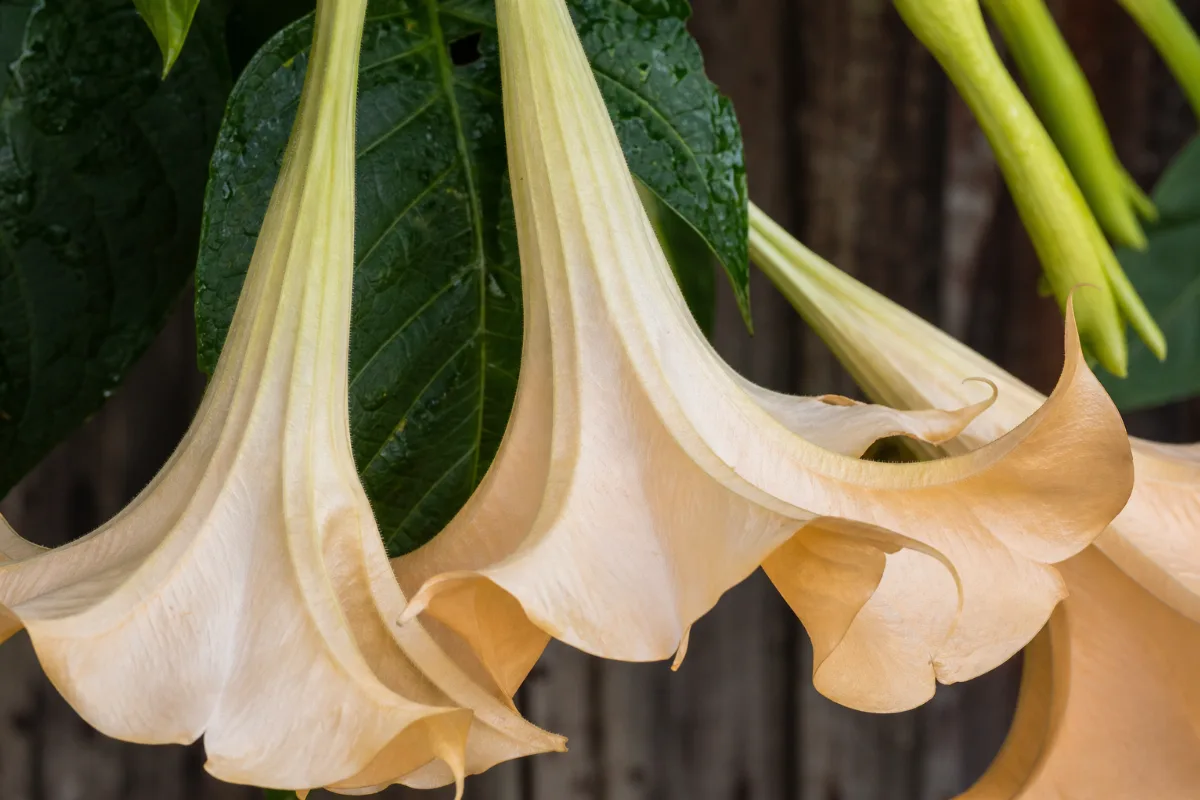
Brugmansia (angel's trumpet)
Brugmansia spp. · also called Angel's trumpet, angel's trumpets
Brugmansia, or angel's trumpet, is a garden shrub with large hanging flowers. Every part is poisonous. It contains scopolamine, atropine and hyoscyamine, which can cause delirium, hallucinations, fast heartbeat and injury, and poisoning has been reported in children, teenagers and adults. It is a deliriant, not a classic psychedelic. No human trial shows it treats any condition. If anyone may have eaten or chewed any part, call poison control or emergency services now.
General information, not medical advice. Last substantive update · Not medically reviewed. A named clinician has not signed off on this page. Traditional-context wording has not had Indigenous or cultural review. How this page is made
About Brugmansia (angel's trumpet)
Brugmansia, or angel's trumpet, is a common ornamental shrub in the nightshade family. All parts are poisonous. Its alkaloids scopolamine, atropine and hyoscyamine block acetylcholine and cause an anticholinergic poisoning with delirium. Evidence is case reports and poison-centre series, not trials.
Children, gardens and pets
Angel's trumpet is a popular garden plant, so accidents happen: petals eaten as a garnish, leaves of an unrecognised plant, and eye contact that left a child with one large pupil. A case report notes accidental seed ingestion by children, and a 5-year-old needed a breathing machine for 35 days after ingesting the plant (a published comment questioned the exact diagnosis).
We did not read a veterinary source for pets or livestock. Because the plant is highly toxic in all parts, keep animals and children away from it, wash hands after touching it, and call a vet or poison helpline if an animal may have chewed it.
What it is
Brugmansia is a genus of about seven or eight species in the nightshade family (Solanaceae) according to a 2021 review. GBIF lists the genus Brugmansia Pers. as accepted. The scientific name used in some older papers is Datura suaveolens for what is now Brugmansia suaveolens.
The name 'angel's trumpet' is used for Datura in some papers, so check which plant a source means. Datura has the same alkaloids. Native range and conservation status could not be verified from a primary source.
A deliriant, not a classic psychedelic
Scopolamine, atropine and hyoscyamine block acetylcholine in the brain and body. This is a poisoning that can bring a confused, delirious state with vivid hallucinations that may be frightening and unsafe.
Reports of teenagers using the plant for its hallucinogenic effect describe agitation, psychosis, injury and hospital care, sometimes with sedation and restraint for more than a day.
Traditional context
A 2021 review says species of Brugmansia are used in traditional medicine and as a hallucinogen, for protection from evil and in magical rituals. A 2003 lab paper says Brugmansia arborea is used in the northern Peruvian Andes for magic-therapeutic purposes, and a 1969 paper studied the tree datura drugs of the Colombian Sibundoy (title only read).
We describe these traditions only as far as the sources say. Traditional use is not clinical evidence and says nothing about safety. This section needs Indigenous and cultural review before it is final.
Criminal use and 'devil's breath'
Forensic papers document scopolamine used as an incapacitating drug in robberies and sexual crimes. In one Dutch series, one victim died and two survived. A 2017 report from Venezuela describes six patients with toxic psychosis from non-pharmaceutical scopolamine nicknamed 'Devil's Breath'.
We did not find a source proving the popular story that blowing a plant powder in someone's face makes them obey, so those claims are not verified here. If you think someone has been drugged, get emergency help.
How strong is the evidence?
Poisoning evidence is case reports and case series; plant identity is often presumed. Benefit evidence is traditional use plus one mouse study and one in-vitro study. No human trial of any Brugmansia plant or extract was found.
Purified scopolamine, atropine and hyoscyamine are standardised medicines on the WHO essential medicines list (2022 review). The plant is not standardised, and its strength varies by part, plant and damage.
At a glance
Traditional uses history, not proof
- Used in traditional medicine in several regions for pain, inflammation, wounds, asthma and colic, according to a 2021 review that says many uses are not confirmed.
- Used as a hallucinogen, for protection from evil and in magical rituals (same review).
- Used in the northern Peruvian Andes for magic-therapeutic purposes (a 2003 lab paper); studied among the Sibundoy of Colombia in 1969 (title only read). Needs Indigenous and cultural review.
Studied for research
- Traditional medicine uses, insufficient (no human trial)
- Pain response in mice from a flower extract, very low (animal only)
- Morphine withdrawal in isolated tissue from pure alkaloids, insufficient (lab only)
- Other lab activities (anti-inflammatory, antibacterial), very low
- Hallucinogenic effect, against (it is a poisoning)
Main compounds
- Scopolamine (CID 5184), the most abundant alkaloid in B. suaveolens in one study
- Atropine (CID 174174)
- Hyoscyamine (CID 154417)
- About 189 compounds in the genus, including terpenes and flavonoids (2021 review)
Common forms
- Not given. This page does not advise any preparation or use of the plant.
Research links: Datura and Brugmansia poisoning, Taiwan poison centre, 203 cases (2019) · Presumed Brugmansia poisoning, 33 patients, Australia (2003) · Review of the genus Brugmansia: traditional use, chemistry and toxicity (2021) · Unknowing ingestion of leaves, case report (2019) · Brugmansia poisoning in a teenager, case report (2026) · Scopolamine-facilitated robberies, forensic cases (2017) · Anticholinergic tropane alkaloids in therapeutics (2022) · Royal Horticultural Society: Brugmansia · Poison help in the US · Research Library · Genes & Biomarkers Library
What it is and its history
- Accepted scientific name
- Brugmansia Pers. (genus); commonly Brugmansia suaveolens (Humb. & Bonpl. ex Willd.) Bercht. & J.Presl
- Naming authority
- Pers.
- Common names
- Angel's trumpet (English); Angel's trumpets (English); Trombeteira (Brazil) (Portuguese); Attana (Sri Lanka) (Sinhalese)
- Family or group
- Solanaceae (nightshade family)
- Classification
- Plantae > Solanales > Solanaceae > Brugmansia > Brugmansia suaveolens (example species)
- Native range
- A 2021 review says the genus has about 7-8 species distributed in America, Europe, Africa and Asia. GBIF lists B. suaveolens as introduced in places such as the Galapagos, Kenya and Tanzania. A native range in the Andes and Amazon is not stated in the sources read; Wikipedia says the genus is native to South America (NOT verified).
- Habitat
- Not verified here.
- What it looks like
- Roots: Not described in sources read.; Stems: Not described in sources read.; Leaves: Not described in sources read.; Flowers: Large hanging trumpet-shaped flowers (RHS guide describes tender tropical shrubs or small trees grown for fragrant flowers).; Fruit: Not described in sources read.
- Cultivation
- Not covered on this page.
- Harvest and processing
- Not covered on this page.
- Look-alikes and adulterants
- Name: Datura (thorn apple, jimsonweed); Note: A closely related genus with the same alkaloids; some papers call both 'angel's trumpet'. Botanical identification details were not verified from a source here.; Name: Edible flowers and garden plants; Note: Poisoning from petals used as a garnish and leaves mistaken for another plant are in case reports. Never eat a flower or leaf you cannot identify with certainty.
- Sustainability and conservation
- Wikipedia says Brugmansia is Extinct in the Wild per the IUCN Red List (NOT verified; IUCN returned 403).
Traditional use and history history, not clinical proof
| Tradition or era | Documented use | Source |
|---|---|---|
| Traditional medicine in several regions | A 2021 review says Brugmansia species are used in traditional medicine for inflammation, rheumatic arthritis, wounds, skin infections, headache, asthma, colic and aches, and as a hallucinogen, for protection from evil and in magical rituals. It says many traditional uses are not confirmed. | p33571613 |
| Northern Peruvian Andes | A 2003 lab paper says Brugmansia arborea is used in the northern Peruvian Andes for magic-therapeutic purposes. This needs Indigenous and cultural review by the owner. | p12916089 |
| Sibundoy, Colombia | A 1969 paper (title only read) studied the alkaloids of tree datura drugs of the Colombian Sibundoy. Its content was not read and is not summarised. | p5812243 |
| Ethnobotany of the genus | A 1979 paper called 'The ethnobotany of Brugmansia' exists (title only read). Its content was not read. | p542011 |
| Spread as a garden ornamental | Papers from Australia, Korea, Germany and elsewhere describe it as a popular ornamental shrub, and GBIF lists it as introduced in several regions. Claims about older Andean ceremonial uses beyond the sources above (including from Wikipedia: shamans' use for initiation, divination and sorcery) are NOT verified. | p25138632 |
Traditional use shows how it was used. It does not show that it works or is safe today.
What is inside, and how it may work
What it contains and how those compounds act in cells and animals. Laboratory and animal mechanisms are not proven effects in people.
Main compounds
| Compound | Family | Where it is concentrated | Activity studied | Level of evidence |
|---|---|---|---|---|
| Scopolamine PubChem 5184 | tropane alkaloid | young leaves, flowers and unripe fruit with seeds (in B. suaveolens) Not given; varies by tissue and after damage. | Blocks acetylcholine at muscarinic receptors. The most abundant alkaloid in B. suaveolens in one study. Used as a standardised medicine in purified form. 2 20 30 | Human pharmacology |
| Atropine PubChem 174174 | tropane alkaloid | not specified Not given. | Same anticholinergic action; atropine and hyoscyamine are listed in case reports and the genus review. 21 30 15 | Human pharmacology |
| Hyoscyamine PubChem 154417 | tropane alkaloid | not specified Not given. | The active form of atropine; same anticholinergic action. 22 30 15 | Human pharmacology |
| Other compounds (terpenes, flavonoids, about 189 compounds in the genus) | mixed | various Not given. | Lab and animal activities reported; not the cause of poisoning. 1 | Lab and animal |
Mechanisms, receptors and pathways
| Target or pathway | Gene or receptor | What was found | Level |
|---|---|---|---|
| Muscarinic acetylcholine receptors | muscarinic receptors (nicotinic also mentioned in the review) | Tropane alkaloids block acetylcholine in the brain and body. This explains dry mouth, wide pupils, fast heartbeat, urinary retention, confusion and hallucinations. It is a deliriant action and differs from the mainly serotonin action of classic psychedelics. 30 | Human pharmacology |
| Plant defence against insects | not applicable | Scopolamine at leaf-like levels raised mortality in moth larvae, and the plant increased scopolamine after damage. 2 | Plant ecology |
| Pain pathways (mice) | not established | A flower extract reduced pain-test responses in mice; the mechanism was not established. 26 | Animal research |
Absorption, metabolism and elimination
- Absorption
- Not studied for plant material in the sources read.
- Distribution
- Not studied.
- Metabolism
- Not studied.
- Elimination
- Not studied.
- Bioavailability
- Not established.
Isolated compounds versus whole extracts
Purified scopolamine, atropine and hyoscyamine are standardised medicines with known strength; a 2022 review says they are on the WHO essential medicines list. The plant is the opposite: strength varies by part, plant and damage, so accidental overdose is easy. The animal and lab studies on other tabs used extracts or isolated alkaloids, not the whole plant in people.
Nutritional composition
Brugmansia is an ornamental plant, not a food or a nutrient. Eating its flowers has caused poisoning.
1 low certainty2 very low certainty2 not enough evidence1 evidence against
What was looked at
The 6 benefits and uses checked for Brugmansia (angel's trumpet), each with how strong the evidence is. Tap one to open it.
- Traditional medicine uses (pain, inflammation, wounds, skin infections, asthma, colic)Not enough evidence
- Hallucinogenic effects and ritual use (not a health benefit)Evidence against
- Accidental poisoning from garden or food contactLow certainty
- Pain response in mice (flower extract)Very low certainty
- Morphine withdrawal in isolated tissue (pure alkaloids)Not enough evidence
- Anti-inflammatory, antispasmodic and other lab activitiesVery low certainty
Lab markers tracked in the studies
Wide pupils (mydriasis)Delirium (confused, agitated state)
What is Brugmansia (angel's trumpet) good for?
Brugmansia is not a remedy. This table shows the claims that have been studied and how strong the evidence is. None supports using the plant, and all must be read with the Safety tab.
Benefits, one by one
Each card is a research question, not a promise. Tap a goal to filter. Open a card to see the studies, doses and limits.
Traditional medicine uses (pain, inflammation, wounds, skin infections, asthma, colic)
Not enough evidenceA 2021 review says species of Brugmansia have been used in traditional medicine around the world for pain, swelling, wounds, skin infections, headache, asthma and colic. The review also says many of these uses are not confirmed. No human trial was found. The plant is poisonous, so this page does not suggest any use.
2 studiesNot given. This page does not describe any preparation, amount or way…
Studies, doses and limits
What the trials found
No clinical trial of any Brugmansia plant, extract or preparation was found.
Why this rating
No human trials. Evidence is traditional use plus lab and animal work, summarised in a narrative review.
Form and dose studied
Not given. This page does not describe any preparation, amount or way to use the plant.
Who was studied
Not studied.
Limits
Narrative review that ended in May 2020; plant parts and species vary.
Why researchers looked
Traditional use led scientists to test extracts and isolated compounds in the lab and in animals (see the other file).
Traditional use
Reported across several regions in a 2021 review; individual peoples are not named in the abstract we read.
Proposed mechanism Human pharmacology of isolated alkaloids
Plausible for some uses: the plant's tropane alkaloids block acetylcholine, which relaxes some muscles and dries secretions. The same action causes poisoning. Shown in pharmacology of the purified alkaloids, not in the whole plant.
A proposed mechanism does not show that the effect happens in people.
Every part is considered poisonous. Poisoning cases are described on the Safety tab.
Hallucinogenic effects and ritual use (not a health benefit)
Evidence againstSome Brugmansia species have been used as a hallucinogen, for protection from evil and in magical rituals, according to a 2021 review. In hospital reports, the same effects look like a poisoning: agitation, confusion, vivid hallucinations and delirium that can last many hours. This is a harm, not a benefit.
8 studiesNot given. This page gives no amounts and no way to use the plant.
Studies, doses and limits
What the trials found
Case series and reports: 33 patients in Australia, 203 poison-centre cases (Datura and Brugmansia) in Taiwan, 5 and 3 adolescents in two small series, and several single cases.
Results
In the Australian series of 33 presumed Brugmansia poisonings, all had wide pupils (mean 29 hours) and 88% had delirium (mean 18 hours); there were no deaths or seizures. In Taiwan 36% of 203 cases were severe, none died. A 2026 case needed more than 36 hours of sedation and restraint.
Why this rating
The effect is poisoning. No source supports benefit; the reports are of harm.
Form and dose studied
Not given. This page gives no amounts and no way to use the plant.
Who was studied
Case reports are mostly teenagers and young adults; some adults poisoned by accident.
Limits
Plant identity was often presumed from the person's description; reporting bias towards hospital cases.
Why researchers looked
Reports of intentional use, mostly by teenagers and young adults, led doctors to describe the effects.
Traditional use
The Andes and Amazon have long traditions with this plant. A 1969 paper studied tree datura drugs of the Colombian Sibundoy. A 2003 lab paper says Brugmansia arborea is used in the northern Peruvian Andes for magic-therapeutic purposes. This needs Indigenous and cultural review.
Proposed mechanism Human pharmacology
Established pharmacology: the alkaloids (scopolamine, atropine, hyoscyamine) block acetylcholine in brain and body. This is a deliriant effect, not the serotonin action of classic psychedelics.
A proposed mechanism does not show that the effect happens in people.
See the Safety tab: delirium, injuries, psychosis, rare severe illness and emergency steps.
Accidental poisoning from garden or food contact
Low certaintyCase reports describe people poisoned by eating a garden plant by mistake, including flower petals used as a garnish and a herbal drink made from leaves of an unrecognised plant. Eye contact after touching the plant has caused a widened pupil in a child. These cases show why the ornamental plant needs care in homes and gardens.
4 studiesNot given.
Studies, doses and limits
What the trials found
Single case reports from Sri Lanka, South Korea, the USA and Canada.
Results
A 60-year-old woman became delirious and recovered in 15 hours; a 64-year-old woman was confused for about 10 hours; a 12-year-old boy had one large pupil that cleared in 3 days.
Why this rating
Consistent case reports with clear mechanism, but no rates of occurrence.
Form and dose studied
Not given.
Who was studied
Adults and children in the case reports.
Limits
Single cases; no information on how often this happens.
Why researchers looked
Doctors report these cases so others can recognise them.
Proposed mechanism Human pharmacology
Same alkaloids block acetylcholine; in the eye this widens the pupil.
A proposed mechanism does not show that the effect happens in people.
Wash hands after touching the plant and keep it away from the eyes, children and pets. Call poison control if unsure.
Pain response in mice (flower extract)
Very low certaintyIn mice, an injected water extract of Brugmansia suaveolens flowers reduced responses in several pain tests. This is animal research only. It does not show that the plant is safe or helpful for pain in people.
1 studiesNot given.
Studies, doses and limits
Results
Mice given the extract by injection responded less in writhing, formalin, hot-plate and tail-flick tests.
Effect sizes as reported
Not extracted.
Why this rating
Animal study only, injected not swallowed, no human data.
Form and dose studied
Not given.
Who was studied
Mice.
Limits
Mice, injected extract, one lab.
Why researchers looked
The flower infusion is popularly used for pain in Brazil.
Traditional use
Popular use in Brazil, according to the paper's abstract.
Proposed mechanism Animal research
Not established. Tropane alkaloids act on acetylcholine receptors; the paper does not prove this is the cause.
A proposed mechanism does not show that the effect happens in people.
The plant is poisonous to people. Do not treat this as a suggestion to use it.
Morphine withdrawal in isolated tissue (pure alkaloids)
Not enough evidenceIn a lab study, three pure alkaloids from Brugmansia arborea reduced morphine withdrawal in isolated tissue. The authors called them potential anti-addiction agents. It is lab research on isolated alkaloids, not on the plant and not in people.
1 studiesNot given.
Studies, doses and limits
Results
Concentration-dependent reduction of morphine withdrawal in isolated tissue.
Effect sizes as reported
Not extracted.
Why this rating
In vitro only.
Form and dose studied
Not given.
Who was studied
Isolated tissue.
Limits
No animal or human follow-up was found.
Why researchers looked
Brugmansia arborea is used for magic-therapeutic purposes in the northern Peruvian Andes, which led scientists to test its alkaloids.
Traditional use
Northern Peruvian Andes (per the abstract). Needs cultural review.
Proposed mechanism Lab
Not established.
A proposed mechanism does not show that the effect happens in people.
Tropane alkaloids are poisonous at higher exposure. No claim is made about treating withdrawal or addiction.
Anti-inflammatory, antispasmodic and other lab activities
Very low certaintyThe 2021 review lists lab and animal findings for extracts and compounds from Brugmansia: anti-inflammatory, antioxidant, antibacterial, antispasmodic, anti-asthma, antiprotozoal and cytotoxic activity. These are early findings. The review says traditional uses of many species are not confirmed.
1 studiesNot given.
Studies, doses and limits
Results
Reported as activity in lab or animal tests in a narrative review.
Effect sizes as reported
Not extracted.
Why this rating
Lab and animal findings summarised in a review we read only as an abstract.
Form and dose studied
Not given.
Who was studied
Lab systems and animals.
Limits
We did not read the individual studies.
Why researchers looked
To test traditional claims.
Traditional use
See the traditional-uses item.
Proposed mechanism Lab and animal
Varied; not reliably established.
A proposed mechanism does not show that the effect happens in people.
No human safety data for these uses.
Connections to the rest of health
How Brugmansia (angel's trumpet) connects to the rest of our health knowledge graph. Every link says what kind of connection it is. A safety link (for example to the liver) is a warning, not a benefit. A study that merely mentions a topic never creates a benefit link.
Explore every connection: goals, body systems, organs, symptoms, genes
B. Body systems
| Connected to | Kind of connection | Evidence status | Context | Studies |
|---|---|---|---|---|
| Nervous System | Biological association | Evidence against | Studied for: Hallucinogenic effects and ritual use (not a health benefit) Studied for: Accidental poisoning from garden or food contact | 14 7 9 13 19 12 5 1 15 16 8 11 26 6 |
| Eyes | Biological association | Low certainty | Studied for: Accidental poisoning from garden or food contact | 15 16 8 11 |
I. Biomarkers
| Connected to | Kind of connection | Evidence status | Context | Studies |
|---|---|---|---|---|
| Wide pupils (mydriasis) | Biological association | Moderate certainty | Measured in trials: raised (pupil size). A lab change is not the same as a health benefit. | 14 7 |
| Delirium (confused, agitated state) | Biological association | Moderate certainty | Measured in trials: present. A lab change is not the same as a health benefit. | 14 7 19 |
J. Genes, receptors and enzymes
| Connected to | Kind of connection | Evidence status | Context | Studies |
|---|---|---|---|---|
| Muscarinic acetylcholine receptors | Preliminary mechanism | Human pharmacology | Blocked by the plant's tropane alkaloids. | 30 |
L. Active compounds
| Connected to | Kind of connection | Evidence status | Context | Studies |
|---|---|---|---|---|
| Scopolamine | Low certainty | The most abundant alkaloid in Brugmansia suaveolens in one plant study. The most abundant alkaloid in Brugmansia suaveolens in one plant study; also a standardised prescription medicine in purified form. Preparation or compound: main alkaloid |
2 18 30 | |
| Scopolamine | Biological association | Human pharmacology | Blocks acetylcholine at muscarinic receptors. The most abundant alkaloid in B. suaveolens in one study. Used as a standardised medicine in purified form. Preparation or compound: young leaves, flowers and unripe fruit with seeds (in B. suaveolens) |
2 20 30 |
| Atropine | Biological association | Human pharmacology | Same anticholinergic action; atropine and hyoscyamine are listed in case reports and the genus review. | 21 30 15 |
| Hyoscyamine | Biological association | Human pharmacology | The active form of atropine; same anticholinergic action. | 22 30 15 |
| Other compounds (terpenes, flavonoids, about 189 compounds in the genus) | Biological association | Lab and animal | Lab and animal activities reported; not the cause of poisoning. Preparation or compound: various |
1 |
Each connection is stored with the ingredient, the connected record, the kind of connection, the evidence status, the supporting studies, the preparation or compound involved, and a review date (last reviewed October 25, 2026).
Evidence at a glance: what the research found for 6 outcomes
Each outcome below is one thing researchers measured. Certainty is how far the evidence can be trusted, not how well it works. The full studies are on the next tab.
The evidence
The research centre for Brugmansia (angel's trumpet). Every record here was checked against PubMed or the publisher's page; we never list a study we have not verified.
Evidence by outcome
Bars show how many studies we found for each outcome, not how well it works. People are added up across trials only (reviews are not added, to avoid double counting).
How we rate evidence
High certainty
Several well-run trials or reviews agree; further research is unlikely to change the picture much.
Moderate certainty
Good trials point the same way, but some doubt remains.
Low certainty
Small, short or inconsistent trials. The finding could change with better research.
Very low certainty
Very little or very weak human data. Treat as a possibility only.
Mixed findings
Trials or reviews disagree with each other.
Not enough evidence
Not enough human research to say either way.
Evidence against
Good research found no benefit, or found harm.
We take the reviewers' own risk-of-bias and GRADE statements where they exist, and otherwise judge from study size, design, consistency, directness and whether a product matches what is sold. Many publications do not make evidence high. Method note: We read PubMed abstracts for the case series, case reports and reviews, read poison-control, NHS, NSW Poisons Information Centre and RHS pages, and checked GBIF and PubChem. Five papers had no abstract and are cited by title only. Full texts were not read.
Study library: every study we checked 31
| Study | Design | People | Product, dose, length | Result |
|---|---|---|---|---|
| Algradi 2021 Review on the genus Brugmansia: Traditional usage, phytochemistry, pharmacology, and toxicity. Journal of Ethnopharmacology · PMID 33571613 · DOI |
Narrative review review |
Literature on the genus Brugmansia (about 7-8 species) up to May 2020 | Brugmansia (angel's trumpet) species various plant parts not given here not given here |
The review says the genus is used in traditional medicine for inflammation, rheumatic arthritis, wounds, skin infections, headache, asthma, colic and aches, and as a hallucinogen, for protection from evil and in magical rituals. About 189 compounds are reported, mostly tropane alkaloids, terpenes and flavonoids. Extracts show anti-inflammatory, antispasmodic, antinociceptive and other activity in lab and animal work. It concludes that the traditional uses of many species are not confirmed and that much more research is needed. Review; lab and animal findings, no human trials Methods, limits and fundingOutcomes: Traditional uses, chemistry, lab and animal pharmacology, toxicity Limitations: Narrative review; search ended May 2020; most pharmacology is lab or animal work. Funding and conflicts: Not stated in the abstract. Read: abstract |
| Alves 2007 Scopolamine in Brugmansia suaveolens (Solanaceae): defense, allocation, costs, and induced response. Journal of Chemical Ecology · PMID 17195118 · DOI |
Plant ecology experiment plant |
Brugmansia suaveolens plants and moth larvae | Brugmansia suaveolens leaves, flowers, unripe fruits not given here not given here |
Scopolamine is the most abundant tropane alkaloid in this species. Young leaves, flowers and unripe fruits with seeds have higher scopolamine levels than other tissues, and leaves increase scopolamine after damage. At leaf-like concentrations it increased mortality of moth larvae. This shows that alkaloid levels vary by tissue and condition. Alkaloid content varies within the plant Methods, limits and fundingOutcomes: Scopolamine content and effect on insect larvae Limitations: Insect and plant ecology study, not human data. Funding and conflicts: Not stated in the abstract. Read: abstract |
| Ardila-Ardila 2006 [Scopolamine poisoning ('burundanga'): loss of the ability to make decisions]. Revista de Neurologia · PMID 16450329 |
Clinical paper (Spanish) |
Scopolamine poisoning in Colombia | Scopolamine ('burundanga') not given here not given here |
No abstract is available in PubMed; only the title and citation were confirmed. The title links the street name 'burundanga' with scopolamine poisoning and loss of the ability to make decisions. Nothing else from it is stated on this page. Title only Methods, limits and fundingOutcomes: Not read Limitations: Abstract not available; full text not read. Funding and conflicts: Not applicable Read: title-only |
| Aćimović 2025 Datura stramonium - A Dangerous Weed and Alternative Drug of Abuse: An Overview of Poisoning Cases in 21st Century. Planta Medica · PMID 40086888 · DOI |
Narrative review of 114 papers review |
Poisoning reports 2001-2024 involving Datura stramonium (a related genus) | Datura stramonium all parts not given here not given here |
Review of 114 papers: all parts contain hyoscyamine, scopolamine and atropine and cause an anticholinergic syndrome with neuropsychiatric effects. Cases fall into accidental (crop contamination, misidentification, children's curiosity, self-medication) and misuse (recreational use, suicide attempts, criminal activities, magico-religious practices). It advises education about the plant's appearance and dangers. Related genus; same alkaloid family Methods, limits and fundingOutcomes: Poisoning patterns Limitations: About Datura, not Brugmansia; used here only for the shared poisoning pattern. Funding and conflicts: No conflict of interest declared. Read: abstract |
| Bristol 1969 The alkaloids of the genus Datura, section Brugmansia. VI. Tree Datura drugs (Datura condida cvs.) of the Colombian Sibundoy. Lloydia · PMID 5812243 |
Phytochemical paper plant |
Tree datura cultivars of the Colombian Sibundoy | Brugmansia (then called Datura, section Brugmansia) cultivars not given here not given here |
No abstract is available in PubMed; only the title and citation were confirmed. The title shows that scientists studied the alkaloids of tree datura drugs of the Sibundoy people of Colombia in 1969. Nothing from its content is stated on this page. Title only Methods, limits and fundingOutcomes: Not read Limitations: Abstract not available; full text not read. Funding and conflicts: Not applicable Read: title-only |
| Capasso 2003 Alkaloids from Brugmansia arborea (L.) Lagerhein reduce morphine withdrawal in vitro. Phytotherapy Research · PMID 12916089 · DOI |
Lab (in vitro) experiment lab |
Isolated tissue | Three pure tropane alkaloids from Brugmansia arborea (northern Peruvian Andes magic-therapeutic plant) isolated alkaloids not given here not given here |
The three pure alkaloids reduced morphine withdrawal in isolated tissue in a concentration-dependent way. The authors suggest they may be potential anti-addictive agents. This is lab research on isolated alkaloids, not on the plant and not in people. Lab effect only Methods, limits and fundingOutcomes: Morphine withdrawal response in isolated tissue Limitations: In vitro only; isolated alkaloids; no human data. Funding and conflicts: Not stated in the abstract. Read: abstract |
| Doan 2019 Datura and Brugmansia plants related antimuscarinic toxicity: an analysis of poisoning cases reported to the Taiwan poison control center. Clinical Toxicology (Phila) · PMID 30522351 · DOI |
Retrospective case series |
203 203 poison-centre cases in Taiwan, 1986-2015 (114 Datura, 89 Brugmansia suaveolens) |
Datura and Brugmansia suaveolens plants flowers and other parts not given here not given here |
Most common reason for poisoning was medicinal use without consulting a Chinese medicine practitioner (81.2%). None of the 203 used it recreationally. Common effects: wide pupils (53.2%), confusion (40%), fast heartbeat (35.5%), dry mouth (35.5%), delirium (31%). 73 cases (36%) were severe; none died. Misidentifying the plant and eating parts other than flowers were linked to severe poisoning. Of 40 patients given physostigmine in hospital, earlier recovery of brain effects was seen. 36% severe, no deaths Methods, limits and fundingOutcomes: Clinical effects, severity, predictors, physostigmine response Limitations: Retrospective poison-centre data; Datura and Brugmansia pooled; physostigmine comparison not randomised. Funding and conflicts: Not stated in the abstract. Read: abstract |
| Firestone 2007 Not your everyday anisocoria: angel's trumpet ocular toxicity. Journal of Emergency Medicine · PMID 17630070 · DOI |
Case report |
1 12-year-old boy, USA |
Angel's trumpet (Datura suaveolens, a former name of Brugmansia suaveolens) eye exposure not given here not given here |
A boy had one large pupil and blurry vision from eye exposure to the plant; visual acuity was normal and the pupil returned to normal by itself in 3 days. The case shows that touching the plant and then the eye can look like a serious eye or brain problem. Resolved in 3 days Methods, limits and fundingOutcomes: Eye findings Limitations: Single case. Funding and conflicts: Not stated in the abstract. Read: abstract |
| Francis 1999 Angel trumpet lily poisoning in five adolescents: clinical findings and management. Journal of Paediatrics and Child Health · PMID 10234644 · DOI |
Case series |
5 Five adolescent boys at one Australian emergency department |
Angel trumpet plant material leaves and flowers not given here not given here |
All five presented with agitation and confusion and anticholinergic signs. They were treated with charcoal and cathartics and discharged after 36 hours. The authors say misuse for hallucinogenic effects is not uncommon in adolescents and should be suspected when altered mental state and hallucinations come with other anticholinergic signs. All recovered Methods, limits and fundingOutcomes: Presentation and outcome Limitations: Five patients; one hospital. Funding and conflicts: Not stated in the abstract. Read: abstract |
| GBIF Secretariat 2026 GBIF Backbone Taxonomy: Brugmansia Pers. (genus match) and species matches GBIF API · Source |
Database record plant |
not applicable | Brugmansia (angel's trumpet) not given here not given here |
Queried 2026-10-25. Genus Brugmansia Pers. is ACCEPTED (key 2928883), family Solanaceae, order Solanales. Accepted species matches include B. suaveolens (5341758), B. arborea (5341759), B. aurea (5581099), B. sanguinea (5341760), B. versicolor (5581019), B. x candida (9099468) and B. insignis (7509313). GBIF lists B. suaveolens as introduced in places such as Galapagos, Kenya and Tanzania. Identity confirmed Methods, limits and fundingOutcomes: see results Limitations: Taxonomy only. Plants of the World Online could not be queried (no usable response). Native range in the Andes/Amazon is not stated by GBIF in what was read. Funding and conflicts: not applicable Read: full-text |
| Goldfarb 2019 Gardening and dilated pupils: an interesting case of anisocoria from Brugmansia versicolor. Canadian Journal of Ophthalmology · PMID 30975362 · DOI |
Case report |
1 Person gardening, Canada |
Brugmansia versicolor garden plant contact not given here not given here |
No abstract is available in PubMed; only the title and citation were confirmed. The title reports one unequal-pupil case linked to Brugmansia versicolor while gardening. Nothing else from it is stated on this page. Title only Methods, limits and fundingOutcomes: Not read Limitations: Abstract not available; full text not read. Funding and conflicts: Not applicable Read: title-only |
| Gundogdu 2026 Brugmansia suaveolens Abuse in a Patient With Multiple Substance Use Disorders: A Case Report. Cureus · PMID 42099313 · DOI |
Case report |
1 Man with multiple substance use disorders, Turkey |
Brugmansia suaveolens leaves and flowers not given here not given here |
A man who reported long-term daily use of the plant for four years to obtain relief had drowsiness, sedation, agitation, unsteady walking, dry mouth, palpitations, fever and visual and auditory hallucinations. He was discharged after a four-week treatment course. The authors say such plants may be misused especially by people with a history of multiple substance use disorders. Four-week treatment Methods, limits and fundingOutcomes: Symptoms and treatment Limitations: Single case; self-reported history. Funding and conflicts: No funding or financial relationships declared. Read: abstract |
| Göpel 2002 Three cases of angel's trumpet tea-induced psychosis in adolescent substance abusers. Nordic Journal of Psychiatry · PMID 11869466 · DOI |
Case series |
3 Three adolescents with substance use problems in Germany |
Angel's trumpet plant material not given here not given here |
Severe psychotic pictures with hallucinations, disorientation and agitation, with only mild or no body signs of anticholinergic poisoning. The authors report rising intoxications among adolescents using ornamental plants of this kind and warn that prevention messages should stress medical harm, not the hallucinogenic effect. Severe psychosis in all three Methods, limits and fundingOutcomes: Psychotic symptoms after ingestion Limitations: Three cases; author expectation of fatalities is an opinion, not a finding. Funding and conflicts: Not stated in the abstract. Read: abstract |
| Isbister 2003 Presumed Angel's trumpet (Brugmansia) poisoning: clinical effects and epidemiology. Emergency Medicine (Fremantle) · PMID 14631706 · DOI |
Retrospective case series |
33 33 patients (median age 18; 82% male) admitted to a toxicology unit in Australia, 1990-2000, presumed Brugmansia poisoning |
Brugmansia spp. (identified from the patient's description) flower and other parts not given here not given here |
31 of 33 used it recreationally. All had wide pupils (mean 29 hours) and 88% had delirium (mean 18 hours). Only 33% had fast heartbeat. No deaths, seizures or heart-rhythm problems other than fast heartbeat were seen. 19 needed sedation, mainly benzodiazepines. Authors judged most cases moderate and severe toxicity rare in this series. No deaths; delirium in 88% Methods, limits and fundingOutcomes: Clinical features, time course, complications Limitations: Plant identity presumed from description; one hospital; patients who died before arrival or never reached hospital would not appear. Funding and conflicts: Not stated in the abstract. Read: abstract |
| Jayawickreme 2019 Unknowing ingestion of Brugmansia suaveolens leaves presenting with signs of anticholinergic toxicity: a case report. Journal of Medical Case Reports · PMID 31665073 · DOI |
Case report |
1 60-year-old woman in Sri Lanka |
Brugmansia suaveolens leaves not given here not given here |
A woman who drank a herbal drink made from leaves of a garden plant she did not recognise arrived with confusion, delirium and agitation, urinary retention, wide pupils and fast heartbeat. She recovered with supportive care within 15 hours. The authors note seeds are usually described as the most toxic part but leaves are also significantly toxic, and that accidental seed ingestion by children has been reported. Recovered in 15 hours Methods, limits and fundingOutcomes: Presentation and outcome Limitations: Single case. Funding and conflicts: No competing interests declared. Read: abstract |
| Kim 2014 Intoxication by angel's trumpet: case report and literature review. BMC Research Notes · PMID 25138632 · DOI |
Case report with literature review |
1 64-year-old woman in South Korea |
Brugmansia (angel's trumpet) petals not given here not given here |
A woman ate petals of angel's trumpet flowers served as a garnish in a traditional dish and developed acute mental changes; she regained her usual awareness after 10 hours. The authors say the plant has become a popular ornamental shrub in Korea and its tropane alkaloids are not generally known to the public. Recovered in 10 hours Methods, limits and fundingOutcomes: Presentation and outcome Limitations: Single case. Funding and conflicts: Not stated in the abstract. Read: abstract |
| Lockwood 1979 The ethnobotany of Brugmansia. Journal of Ethnopharmacology · PMID 542011 · DOI |
Ethnobotanical paper review |
Brugmansia in traditional cultures | Brugmansia not given here not given here |
No abstract is available in PubMed; only the title and citation were confirmed. Cited as an ethnobotanical source on the genus. Nothing from its content is stated on this page. Title only Methods, limits and fundingOutcomes: Not read Limitations: Abstract not available; full text not read. Funding and conflicts: Not applicable Read: title-only |
| Lusthof 2017 Toxicological results in a fatal and two non-fatal cases of scopolamine-facilitated robberies. Forensic Science International · PMID 28237441 · DOI |
Forensic case series |
3 One fatal and two non-fatal robbery cases, Netherlands |
Scopolamine as an incapacitating drug (source of the scopolamine not stated in the abstract) not given here not given here |
Scopolamine as an incapacitating drug in sexual crimes and robberies has been known for many decades, but blood levels are largely unknown. In the fatal case the postmortem heart-blood level was about 3,000 times the average level from one therapeutic skin patch, and the femoral-blood level about 50 times. One survivor had scopolamine detected in serum 23 hours later; another in urine and hair. Documents crime use of scopolamine Methods, limits and fundingOutcomes: Blood and urine levels Limitations: Three cases; abstract does not say whether the scopolamine came from a plant or a purified drug; not a Brugmansia study. Funding and conflicts: Not stated in the abstract. Read: abstract |
| Martínez 2026 Brugmansia poisoning - a case report highlighting a preventable port call hazard for seafarers and travelers. International Maritime Health · PMID 42803453 · DOI |
Case report |
1 16-year-old male in Costa Rica with a history of substance use |
Brugmansia sp. flowers not given here not given here |
Three hours after ingesting flowers recreationally he had agitated delirium, visual hallucinations, incoherent speech, wide pupils, fast heartbeat and dry mouth. He needed prolonged sedation with intravenous diazepam and physical restraint for over 36 hours. After the delirium he expressed suicidal thoughts and was referred to psychiatry. Severe delirium, 36+ hours Methods, limits and fundingOutcomes: Presentation and course Limitations: Single case; published online ahead of print. Funding and conflicts: Not stated in the abstract. Read: abstract |
| NCBI PubChem 2026 PubChem compound 5184: scopolamine PubChem PUG REST · Source |
Database record plant |
not applicable | Scopolamine not given here not given here |
Queried 2026-10-25. CID 5184, scopolamine, formula C17H21NO4. Identity confirmed Methods, limits and fundingOutcomes: see results Limitations: Identity only. Funding and conflicts: not applicable Read: full-text |
| NCBI PubChem 2026 PubChem compound 174174: atropine (dl-hyoscyamine) PubChem PUG REST · Source |
Database record plant |
not applicable | Atropine not given here not given here |
Queried 2026-10-25. CID 174174 lists the names atropine and dl-hyoscyamine, formula C17H23NO3. Identity confirmed Methods, limits and fundingOutcomes: see results Limitations: Identity only. Funding and conflicts: not applicable Read: full-text |
| NCBI PubChem 2026 PubChem compound 154417: hyoscyamine (L-hyoscyamine) PubChem PUG REST · Source |
Database record plant |
not applicable | Hyoscyamine not given here not given here |
Queried 2026-10-25. CID 154417 lists the names hyoscyamine and L-hyoscyamine, formula C17H23NO3. Identity confirmed Methods, limits and fundingOutcomes: see results Limitations: Identity only. Funding and conflicts: not applicable Read: full-text |
| NHS (UK) 2026 NHS: Poisoning nhs.uk · Source |
Regulator page plant |
not applicable | Brugmansia (angel's trumpet) not given here not given here |
Read 2026-10-25. In the UK, call 999 or go to A&E if you think someone may have swallowed, touched or breathed in something harmful, or if someone has lost consciousness or stopped breathing. Emergency contact Methods, limits and fundingOutcomes: see results Limitations: General poisoning page; does not mention Brugmansia. Funding and conflicts: not applicable Read: full-text |
| NSW Poisons Information Centre 2026 NSW Poisons Information Centre (Australia) poisonsinfo.nsw.gov.au · Source |
Regulator page plant |
not applicable | Brugmansia (angel's trumpet) not given here not given here |
Read 2026-10-25. The site shows the Australian Poisons Information Centre number 13 11 26 and an emergency button. Emergency contact Methods, limits and fundingOutcomes: see results Limitations: General page; does not mention Brugmansia. Funding and conflicts: not applicable Read: full-text |
| National Capital Poison Center 2026 Poison Help / web POISON CONTROL (National Capital Poison Center) poison.org · Source |
Regulator or NGO page plant |
not applicable | Brugmansia (angel's trumpet) not given here not given here |
Read 2026-10-25. The page tells people in the US to use the web POISON CONTROL tool or call a poison center at 1-800-222-1222 (free, expert, confidential), and to call 911 if the person collapses, has a seizure, has trouble breathing or can't be awakened. Emergency contact Methods, limits and fundingOutcomes: see results Limitations: Does not mention Brugmansia. Used for the emergency number only. Funding and conflicts: not applicable Read: full-text |
| Parker 2007 Antinociceptive effects of the aqueous extract of Brugmansia suaveolens flowers in mice. Biological Research for Nursing · PMID 17172322 · DOI |
Animal experiment animal |
Mice | Water extract of Brugmansia suaveolens flowers, given by injection flowers not given here not given here |
In mice, the injected extract reduced responses in several pain tests (writhing, formalin, hot plate, tail flick). The authors say this supports the popular use of the infusion for pain in Brazil. It does not show safety or benefit in people. Pain-test responses reduced in mice Methods, limits and fundingOutcomes: Pain-response tests Limitations: Mouse study only; injected, not swallowed; no human data; tropane alkaloids are toxic. Funding and conflicts: Not stated in the abstract. Read: abstract |
| Royal Horticultural Society 2026 Brugmansia growing guide (Royal Horticultural Society) rhs.org.uk · Source |
Horticultural society page plant |
not applicable | Brugmansia (angel's trumpet) not given here not given here |
Read 2026-10-25. The RHS says brugmansias are very poisonous, that all parts are highly toxic, and that the sap can be a skin irritant, so gloves are advised when handling; seeds should be kept out of reach of children. Ornamental warning Methods, limits and fundingOutcomes: see results Limitations: A gardening guide, not a toxicology source; no case data. Planting and care advice on that page is not repeated here. Funding and conflicts: not applicable Read: full-text |
| Sandia S 2017 Treating 'Devil's Breath' intoxication: Use of rivastigmine in six patients with toxic psychoses due to non pharmaceutical scopolamine. European Neuropsychopharmacology · PMID 28601550 |
Letter / short report |
6 Six patients in Mérida, Venezuela, with toxic psychosis |
'Devil's Breath' (non-pharmaceutical scopolamine) not given here not given here |
No abstract is available in PubMed; only the title and citation were confirmed. The title reports six patients with toxic psychosis from non-pharmaceutical scopolamine, called 'Devil's Breath', treated with rivastigmine. Nothing else from it is stated on this page. Title only Methods, limits and fundingOutcomes: Not read Limitations: Abstract not available; full text not read. Funding and conflicts: Not stated Read: title-only |
| Sevketoglu 2010 An unusual cause of fulminant Guillain-Barré syndrome: angel's trumpet. Pediatric Neurology · PMID 20933184 · DOI |
Case report |
1 5-year-old boy, Turkey |
Brugmansia suaveolens ingestion (details not in abstract) not given here not given here |
A previously healthy 5-year-old with a Guillain-Barré-type nerve illness and one tonic pupil needed a breathing machine for 35 days and recovered stepwise after treatment. The authors established the cause as angel's trumpet ingestion. A published letter (PMID 21723465) questioned whether this was true Guillain-Barré syndrome; we did not read that letter's text. 35 days ventilated, recovered Methods, limits and fundingOutcomes: Neurological illness and recovery Limitations: Single case; diagnosis was questioned in a published comment. Funding and conflicts: Not stated in the abstract. Read: abstract |
| Shim 2022 Beauty of the beast: anticholinergic tropane alkaloids in therapeutics. Natural Products and Bioprospecting · PMID 36109439 · DOI |
Narrative review review |
Tropane alkaloids from Solanaceae plants (Datura, Atropa, Hyoscyamus, Mandragora and others) | tropane alkaloids (atropine, hyoscyamine, scopolamine) not given here not given here |
Plants of the nightshade family are rich sources of tropane alkaloids, which block acetylcholine at muscarinic and/or nicotinic receptors. Purified forms are used as antiemetics, anaesthetic aids, antispasmodics, bronchodilators and pupil-widening drugs; the review says they are on the WHO essential medicines list and available with FDA approval. Purified drugs are standardised medicines Methods, limits and fundingOutcomes: Pharmacology and therapeutic use Limitations: Narrative review; approvals not checked individually. Funding and conflicts: No conflict of interest declared. Read: abstract |
| Wikipedia contributors 2026 Wikipedia: Brugmansia (lead only) en.wikipedia.org · Source |
Encyclopedia (secondary) plant |
not applicable | Brugmansia (angel's trumpet) not given here not given here |
Read 2026-10-25 as a lead only. It says the genus has seven species, that all are known only in cultivation or as escapes, that the IUCN Red List lists them as Extinct in the Wild, and that Andean peoples have used them in medicine and ceremony. Cites De Feo 2004 (Economic Botany) for ritual use in northern Peru. NONE of this was verified against the primary sources. NOT verified Methods, limits and fundingOutcomes: see results Limitations: Wikipedia-only claims are NOT verified and are shown on this page only as flagged. Funding and conflicts: not applicable Read: summary-only |
What we do not know yet
- No clinical trial of any Brugmansia plant or extract was found.
- No reliable harmful or lethal amount figure and no pregnancy data.
- Veterinary data for pets and livestock were not read.
- Legal status of the ornamental plant not found in a regulator source.
- Native range and conservation status not verified from a primary source.
- The popular 'devil's breath' claims are unverified; five papers are cited by title only.
How new research is added
New studies are found by a saved PubMed search and are placed in a review queue. A person reads each one before it changes any evidence rating or safety wording.
Lab markers
What changed in blood or saliva tests during trials. A changed number is not the same as feeling or being healthier, and we give no "normal ranges".
Other 2
Wide pupils (mydriasis)
Raised (pupil size) in trials
Pupils stay wide open and do not narrow in light. It is the most common sign of poisoning by tropane alkaloids.
Moderate certaintyResults and what it means
Why it was measured
A quick bedside sign for doctors.
Statistical vs. clinical meaning
A reliable sign of exposure in case series; it also occurs from eye contact alone.
Safety implication
Pupil widening can last for days after eye contact.
| Study | Result | People | Product |
|---|---|---|---|
| 14 | All 33 presumed Brugmansia patients had wide pupils, lasting a mean of 29 hours (SD 13). | 33 patients in Australia | Presumed Brugmansia ingestion |
| 7 | Wide pupils were the most common effect (53.2%) among 203 Datura and Brugmansia exposures. | 203 poison-centre cases in Taiwan | Datura or Brugmansia suaveolens exposure |
Delirium (confused, agitated state)
Present in trials
A sudden, severe change in thinking and awareness, with confusion, hallucinations and agitation.
Moderate certaintyResults and what it means
Why it was measured
The main reason for hospital care and sedation.
Statistical vs. clinical meaning
Common and can last many hours; severe cases can need more than a day of sedation (2026 case).
Safety implication
Injury risk from confusion and agitation; emergency care needed.
| Study | Result | People | Product |
|---|---|---|---|
| 14 | 88% had delirium, lasting a mean of 18 hours (SD 12); 19 of 33 needed sedation, mainly benzodiazepines. | 33 patients in Australia | Presumed Brugmansia ingestion |
| 7 | Delirium in 31% of 203 cases; 73 cases (36%) were severe; none died. | 203 poison-centre cases in Taiwan | Datura or Brugmansia suaveolens exposure |
Safety
What studies and official sources say about side effects, medicines and who should check first. Each point shows what kind of evidence it comes from.
Main points to know 7
- Danger first: every part of the plant is poisonous. Brugmansia contains scopolamine, atropine and hyoscyamine, which block the nerve messenger acetylcholine. The Royal Horticultural Society says all parts are highly toxic and the sap can irritate skin. Poisoning gives wide pupils, delirium, hallucinations, fast heartbeat, dry mouth, urinary retention and fever. It can last a day or more. This page gives no amounts and no way to prepare or use the plant, and nothing here is a reason to try it. Case series and reports 27 14 7 15 30
- It is a common ornamental plant, so exposure can be accidental. Cases include a garden-plant herbal drink made from unknown leaves, flower petals eaten as a garnish, and eye contact in a child. Misidentifying the plant and eating parts other than flowers were linked to more severe poisoning in a Taiwan series. Case reports and series 15 16 8 7 11
- Children and young people are at risk. A case report notes accidental seed ingestion by children; one 5-year-old needed a breathing machine for 35 days after angel's trumpet ingestion (a published comment questioned the exact diagnosis). Several series involve teenagers who took the plant for its hallucinogenic effect. A 16-year-old in 2026 needed more than 36 hours of sedation and restraint and later had suicidal thoughts. The authors of one paper say prevention messages should stress the medical harm rather than the effect. Case series and reports 15 29 9 13 19
- Dangerous behaviour and injury. Confusion, agitation and hallucinations can lead to injury. In the Australian series two patients had accidental injuries and 19 of 33 needed sedation. Some people were restrained in hospital. Case series 14 19
- Severe outcomes are less common but possible. In 203 Taiwan cases (Datura and Brugmansia) 36% were severe and none died; in 33 Australian presumed cases there were no deaths or seizures. These series do not rule out deaths or serious illness elsewhere, and plant strength varies. We did not find a source giving a safe or lethal amount. Case series 7 14 2
- Pets and livestock. We did not read a veterinary source for this plant. Because the RHS calls all parts highly toxic, keep animals away from it, and call a vet or an animal poison helpline at once if an animal may have chewed it. Authoritative guidance only 27
- Criminal use of scopolamine ('devil's breath', 'burundanga'). Forensic papers document scopolamine, a Brugmansia alkaloid, used as an incapacitating drug in robberies and sexual crimes; in one Dutch series one victim died and two survived. A Spanish paper title links the street name 'burundanga' to scopolamine poisoning, and a 2017 Venezuelan report concerns six patients with 'Devil's Breath' psychosis. We did not read a source proving that a plant powder blown in the face makes a person obey, and the abstract of the Dutch paper does not say whether the scopolamine was plant or pharmaceutical. Such popular claims are NOT verified here. If you think someone has been drugged, get emergency help. Forensic case series and titles 18 3 28 4
Side effects 7
| Effect | How often | Severity and recovery | Evidence |
|---|---|---|---|
| Anticholinergic syndrome: wide pupils, dry mouth, dry or flushed skin, fast heartbeat, fever, urinary retention In Taiwan: wide pupils 53.2%, confusion 40%, fast heartbeat 35.5%, dry mouth 35.5%, delirium 31%. In Australia fast heartbeat was seen in only 33%, so a normal heart rate does not rule it out. | Not established | moderate to severe usually reversible with hospital care | Case series 14 7 15 |
| Delirium, hallucinations, agitation, confusion, psychosis Some adolescents had severe psychotic symptoms with only mild body signs. | 88% in the Australian series | moderate to severe usually reversible; may last 18 hours or more | Case series 14 13 19 |
| Injury from confusion; restraint in hospital Accidental injuries occurred in 2 of 33 Australian patients. | Not established | moderate varies | Case series and report 14 19 |
| Nerve illness resembling Guillain-Barré syndrome with breathing failure (one child) A single case, and a published comment questioned the diagnosis. Rare if real. | Not established | life-threatening recovered stepwise in the reported case | Case report 29 |
| One enlarged pupil after eye contact Looks like a serious brain or eye problem and can cause unnecessary alarm; still needs medical review. | Not established | mild to moderate resolved in 3 days in the case read | Case report 8 11 |
| Skin irritation from sap From the RHS growing guide; no clinical data. | Not established | mild not described | Horticultural guidance 27 |
| Low mood and suicidal thoughts after the delirium (one teenager) A single case in a young person with a substance-use history. | Not established | serious unknown | Case report 19 |
Liver
No liver injury from Brugmansia was found in the sources read. LiverTox was not checked. The main danger is nervous-system and heart-rate poisoning. 14
How often. Unknown.
This is a safety connection. It is not evidence that Brugmansia (angel's trumpet) supports liver health.
Medicines and supplements 3
| With | Why it matters | Importance | Evidence | What to do |
|---|---|---|---|---|
| Other anticholinergic medicines: first-generation antihistamines, tricyclic and some other antidepressants, bladder-control medicines, some Parkinson's and motion-sickness medicines drug | Same type of action, so effects are expected to add up: confusion, fast heartbeat, overheating, urinary retention. | Potentially serious; mechanism-based, no study of the plant. | Mechanism based Low certainty 30 | Do not combine. Tell a doctor or pharmacist if you have been exposed to the plant. |
| Sedatives, benzodiazepines, alcohol and other depressants drug | Benzodiazepines are used by doctors to calm agitation in poisoning. Whether other depressants add to the plant's effects was not shown in the sources read. | Not established. | Not established Not enough evidence 14 | Medical care only; do not self-treat. |
| Cholinesterase-inhibiting medicines (physostigmine in hospital; rivastigmine in a 2017 report) drug | These raise acetylcholine and work against the plant's alkaloids. In Taiwan, physostigmine was linked to earlier recovery of brain effects. A Venezuelan short report used rivastigmine in six patients (we read only its title). | Hospital treatment under medical supervision only. | Observational case series Low certainty 7 28 | Treatment decision for doctors, not for home use. |
Who should check first 6
| Situation | Advice | Evidence |
|---|---|---|
| Any eating, drinking or other use of the plant by anyone | Do not. It is poisonous. | Case series and guidance 27 14 7 |
| Children and teenagers | Keep the plant out of reach and teach children not to eat or touch the flowers, leaves or seeds. | Case reports 15 9 13 |
| Pregnancy and breastfeeding | No safety data were found. Avoid any exposure. | Insufficient |
| Glaucoma, urinary retention or prostate enlargement, heart rhythm problems, dementia | Anticholinergic drugs are generally cautioned in these conditions. This was not checked in a source for this plant, so it is mechanism-based only. | Mechanism based 30 |
| People with a history of substance use or mental illness | The reports of repeated or severe psychotic episodes involve people with substance-use histories. Ask a doctor for help rather than using the plant. | Case reports 12 13 19 |
| Driving or operating machinery after any exposure | Confusion, blurred vision and wide pupils can last many hours or days. Do not drive. | Mechanism and case reports 14 8 |
Overdose, product quality and regulators
Summary. The poisonous action comes from tropane alkaloids that block acetylcholine. Scopolamine is the most abundant alkaloid in Brugmansia suaveolens, and young leaves, flowers and unripe fruits with seeds had more of it than other tissues in a plant study. Strength therefore varies by part, plant and condition. We did not find a reliable figure for a harmful or lethal amount and give none.
Animal. A mouse extract study and moth-larvae toxicity are in the studies list; no animal lethal-dose data are stated.
Human doses studied. Not given.
High dose or long term signals. A 2026 case describes four years of daily use with sedation, agitation, hallucinations and fever; a single case, no conclusion about long-term risk.
Overdose response. Hospital care is mainly supportive (calming medicine, fluids, monitoring). Physostigmine has been used in some hospitals. Never self-treat. This page gives no amounts.
Genotoxicity. Not reviewed.
Toxic or hazardous parts. All parts per the RHS. A case report says seeds are usually described as the most toxic, while leaves also have significant toxicity. In Taiwan, eating parts other than flowers was linked to severe poisoning.
Variable strength and misidentification are the main concerns. No contamination data were found.
Variable alkaloid strength. Scopolamine content differs between tissues and rises after leaf damage in a plant study, so the same plant can vary. 2
Misidentification. In Taiwan, misidentifying Datura or Brugmansia was linked to more severe poisoning. 7
Look-alike angel's trumpet names. The name 'angel's trumpet' is also used for Datura plants in some papers (for example Datura stramonium in a Canadian report and 'Datura suaveolens' as an older name of Brugmansia suaveolens). Several sources mix the two genera. 8 4
| Body | Action | Date |
|---|---|---|
| National Capital Poison Center (US) (US) | Free, confidential help from a poison center at 1-800-222-1222 or the web POISON CONTROL tool; call 911 if the person collapses, has a seizure, has trouble breathing or can't be awakened. source | 2026-10-25 |
| NHS (UK) (GB) | Call 999 or go to A&E if someone may have swallowed, touched or breathed in something harmful. source | 2026-10-25 |
| NSW Poisons Information Centre (Australia) (AU) | Australian poisons information number 13 11 26. source | 2026-10-25 |
| Royal Horticultural Society (GB) | Brugmansias are very poisonous, all parts are highly toxic, sap can irritate skin, keep seeds out of children's reach. source | 2026-10-25 |
| Purified atropine, hyoscyamine, scopolamine (WHO / US) | A 2022 review says purified tropane alkaloids are on the WHO list of essential medicines and available with FDA approval. These are standardised medicines, not the plant. source | 2022 |
When to get medical help
- Anyone who may have eaten, drunk or put in their mouth any part of the plant: call Poison Control (US 1-800-222-1222), your local emergency number (UK 999, Australia 13 11 26 for poisons advice) or go to hospital now. Do not wait for symptoms
- Wide pupils, very dry mouth, flushed hot dry skin, fast heartbeat
- Confusion, agitation, hallucinations, slurred speech or unsteady walking
- Seizure, collapse, trouble breathing, high temperature or unable to pass urine
- One pupil much larger than the other after touching the plant, or a child who suddenly becomes weak or unable to walk
- A child, pet or anyone who may have chewed a seed, leaf or flower
- Thoughts of suicide after an episode: seek urgent help
If someone may be poisoned or in a crisis, contact a clinician or emergency service straight away. In the US, Poison Control is 1-800-222-1222.
General information only, not medical advice. Ask a clinician or pharmacist before use, especially with medicines, in pregnancy or with a health condition. See the Natural Remedy Safety guide.
Frequently asked questions
Is angel's trumpet poisonous?
What are the signs of poisoning?
What should I do if someone ate or chewed any part?
Is it dangerous for children?
Can it kill?
Is it a psychedelic?
Can pets be affected?
We did not read a veterinary source. The plant is highly toxic in all parts according to the RHS, so keep animals away and call a vet if an animal may have chewed it.
What is 'devil's breath'?
Is it used in traditional medicine or ritual?
Does it treat pain, withdrawal or any other condition?
Does it interact with medicines?
Is it legal?
We did not find a regulator source on the legal status of the ornamental plant, and laws differ by country and local area and change. This is not legal advice. Ask a local authority or pharmacist.
Explore by health goal
Editorial transparency
- Written by
- AlternativeMed editorial team. Research compiled with AI assistance, then checked against PubMed records.
- Medical review
- None. This page has not been reviewed by a physician or pharmacist.
- First published
- 2026-10-25
- Last substantive update
- 2026-10-25
- How we research
- We read PubMed abstracts for the case series, case reports and reviews, read poison-control, NHS, NSW Poisons Information Centre and RHS pages, and checked GBIF and PubChem. Five papers had no abstract and are cited by title only. Full texts were not read.
- How we rate evidence
- See "How we rate evidence" in the Evidence tab.
- Independence
- No product is promoted on this page. No affiliate links are shown.
Sources 31
Each source was opened and checked. Where we read only the abstract, it says so. The small numbers in the text point here.
- Algradi AM, Liu Y, Yang BY, Kuang HX. Review on the genus Brugmansia: Traditional usage, phytochemistry, pharmacology, and toxicity.. Journal of Ethnopharmacology. 2021. PMID 33571613. DOI 10.1016/j.jep.2021.113910. (abstract)
- Alves MN, Sartoratto A, Trigo JR. Scopolamine in Brugmansia suaveolens (Solanaceae): defense, allocation, costs, and induced response.. Journal of Chemical Ecology. 2007. PMID 17195118. DOI 10.1007/s10886-006-9214-9. (abstract)
- Ardila-Ardila A, Moreno CB, Ardila-Gómez SE. [Scopolamine poisoning ('burundanga'): loss of the ability to make decisions].. Revista de Neurologia. 2006. PMID 16450329. (title-only)
- Aćimović M. Datura stramonium - A Dangerous Weed and Alternative Drug of Abuse: An Overview of Poisoning Cases in 21st Century.. Planta Medica. 2025. PMID 40086888. DOI 10.1055/a-2552-4434. (abstract)
- Bristol ML, Evans WC, Lampard JF. The alkaloids of the genus Datura, section Brugmansia. VI. Tree Datura drugs (Datura condida cvs.) of the Colombian Sibundoy.. Lloydia. 1969. PMID 5812243. (title-only)
- Capasso A, de Feo V. Alkaloids from Brugmansia arborea (L.) Lagerhein reduce morphine withdrawal in vitro.. Phytotherapy Research. 2003. PMID 12916089. DOI 10.1002/ptr.1218. (abstract)
- Doan UV, Wu ML, Phua DH, Mendez Rojas B, Yang CC. Datura and Brugmansia plants related antimuscarinic toxicity: an analysis of poisoning cases reported to the Taiwan poison control center.. Clinical Toxicology (Phila). 2019. PMID 30522351. DOI 10.1080/15563650.2018.1513527. (abstract)
- Firestone D, Sloane C. Not your everyday anisocoria: angel's trumpet ocular toxicity.. Journal of Emergency Medicine. 2007. PMID 17630070. DOI 10.1016/j.jemermed.2007.02.046. (abstract)
- Francis PD, Clarke CF. Angel trumpet lily poisoning in five adolescents: clinical findings and management.. Journal of Paediatrics and Child Health. 1999. PMID 10234644. DOI 10.1046/j.1440-1754.1999.00328.x. (abstract)
- GBIF Secretariat. GBIF Backbone Taxonomy: Brugmansia Pers. (genus match) and species matches. GBIF API. 2026. (full-text)
- Goldfarb J, Pesin N, Margolin E. Gardening and dilated pupils: an interesting case of anisocoria from Brugmansia versicolor.. Canadian Journal of Ophthalmology. 2019. PMID 30975362. DOI 10.1016/j.jcjo.2018.05.004. (title-only)
- Gundogdu I, Aras N. Brugmansia suaveolens Abuse in a Patient With Multiple Substance Use Disorders: A Case Report.. Cureus. 2026. PMID 42099313. DOI 10.7759/cureus.106535. (abstract)
- Göpel C, Laufer C, Marcus A. Three cases of angel's trumpet tea-induced psychosis in adolescent substance abusers.. Nordic Journal of Psychiatry. 2002. PMID 11869466. DOI 10.1080/08039480252803927. (abstract)
- Isbister GK, Oakley P, Dawson AH, Whyte IM. Presumed Angel's trumpet (Brugmansia) poisoning: clinical effects and epidemiology.. Emergency Medicine (Fremantle). 2003. PMID 14631706. DOI 10.1046/j.1442-2026.2003.00477.x. (abstract)
- Jayawickreme KP, Janaka KVC, Subasinghe SASP. Unknowing ingestion of Brugmansia suaveolens leaves presenting with signs of anticholinergic toxicity: a case report.. Journal of Medical Case Reports. 2019. PMID 31665073. DOI 10.1186/s13256-019-2250-1. (abstract)
- Kim Y, Kim J, Kim OJ, Kim WC. Intoxication by angel's trumpet: case report and literature review.. BMC Research Notes. 2014. PMID 25138632. DOI 10.1186/1756-0500-7-553. (abstract)
- Lockwood TE. The ethnobotany of Brugmansia.. Journal of Ethnopharmacology. 1979. PMID 542011. DOI 10.1016/0378-8741(79)90004-7. (title-only)
- Lusthof KJ, Bosman IJ, Kubat B, Vincenten-van Maanen MJ. Toxicological results in a fatal and two non-fatal cases of scopolamine-facilitated robberies.. Forensic Science International. 2017. PMID 28237441. DOI 10.1016/j.forsciint.2017.01.024. (abstract)
- Martínez A, Pardo J, Fallas GF. Brugmansia poisoning - a case report highlighting a preventable port call hazard for seafarers and travelers.. International Maritime Health. 2026. PMID 42803453. DOI 10.5603/imh.111342. (abstract)
- NCBI PubChem. PubChem compound 5184: scopolamine. PubChem PUG REST. 2026. (full-text)
- NCBI PubChem. PubChem compound 174174: atropine (dl-hyoscyamine). PubChem PUG REST. 2026. (full-text)
- NCBI PubChem. PubChem compound 154417: hyoscyamine (L-hyoscyamine). PubChem PUG REST. 2026. (full-text)
- NHS (UK). NHS: Poisoning. nhs.uk. 2026. (full-text)
- NSW Poisons Information Centre. NSW Poisons Information Centre (Australia). poisonsinfo.nsw.gov.au. 2026. (full-text)
- National Capital Poison Center. Poison Help / web POISON CONTROL (National Capital Poison Center). poison.org. 2026. (full-text)
- Parker AG, Peraza GG, Sena J, Silva ES, Soares MC, Vaz MR, Furlong EB, Muccillo-Baisch AL. Antinociceptive effects of the aqueous extract of Brugmansia suaveolens flowers in mice.. Biological Research for Nursing. 2007. PMID 17172322. DOI 10.1177/1099800406293984. (abstract)
- Royal Horticultural Society. Brugmansia growing guide (Royal Horticultural Society). rhs.org.uk. 2026. (full-text)
- Sandia S I, Ramírez V J, Piñero A J, Baptista T T. Treating 'Devil's Breath' intoxication: Use of rivastigmine in six patients with toxic psychoses due to non pharmaceutical scopolamine.. European Neuropsychopharmacology. 2017. PMID 28601550. (title-only)
- Sevketoglu E, Tatlı B, Tuğcu B, Demirelli Y, Hatipoglu S. An unusual cause of fulminant Guillain-Barré syndrome: angel's trumpet.. Pediatric Neurology. 2010. PMID 20933184. DOI 10.1016/j.pediatrneurol.2010.05.019. (abstract)
- Shim KH, Kang MJ, Sharma N, An SSA. Beauty of the beast: anticholinergic tropane alkaloids in therapeutics.. Natural Products and Bioprospecting. 2022. PMID 36109439. DOI 10.1007/s13659-022-00357-w. (abstract)
- Wikipedia contributors. Wikipedia: Brugmansia (lead only). en.wikipedia.org. 2026. (summary-only)


