Psychedelic Therapy · Poisonous plant
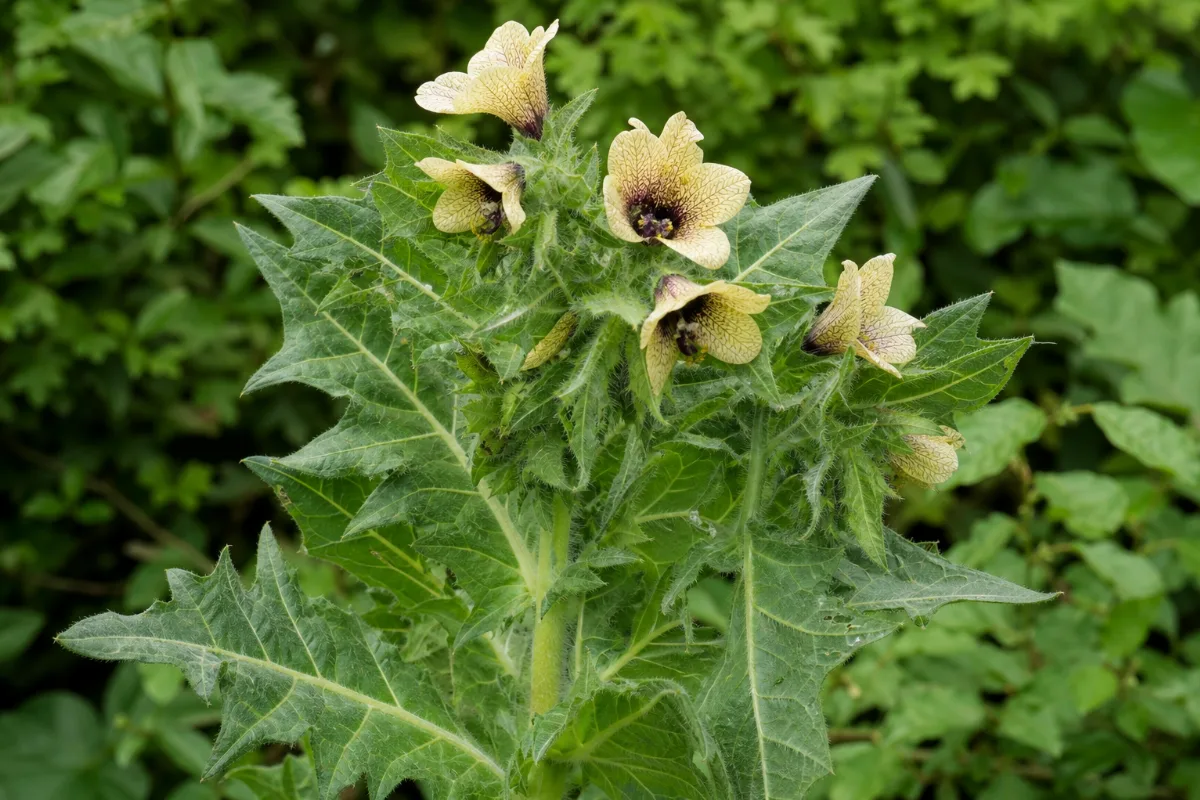
Henbane
Hyoscyamus niger · also called Black henbane
Henbane is a poisonous plant of the nightshade family. Its leaves, seeds and roots contain alkaloids that can cause hallucinations, delirium, seizures, kidney injury and coma, and children are often the ones poisoned. It is not a safe psychedelic and no trial supports using the plant. If anyone may have eaten any part, call Poison Control (US 1-800-222-1222) or your local emergency number right away.
General information, not medical advice. Last substantive update · Not medically reviewed. A named clinician has not signed off on this page. How this page is made
About Henbane
Henbane (Hyoscyamus niger) is a poisonous plant in the nightshade family. It has a long history as a poison, a pain-relieving plant and an ingredient of old magic ointments. Its alkaloids are real drugs when purified, but the plant itself causes poisoning and has no proven use.
What it is
Henbane is a plant of the nightshade family. Its accepted scientific name is Hyoscyamus niger L. (GBIF, 25 October 2026). It is a relative of deadly nightshade, jimson weed, brugmansia and mandrake, which carry the same kind of alkaloids.
A 2020 review of published poisonings found henbane was largely eaten when mistaken for other plants. We could not verify identification details from a source, so never eat a wild plant, seed or root unless an expert has identified it.
Is it a psychedelic?
Not in the usual sense. Henbane's alkaloids block acetylcholine, another nerve messenger. The hallucinations that follow are part of a poisoning picture that also includes confusion, a fast heartbeat and loss of control. That is why it sits in this section as a hazard, not as a candidate therapy.
History, with its risks
A 2006 historical article says henbane was used from ancient times as both a poison and a narcotic, appeared in the hallucinatory ointments said to be used by witches and soothsayers, and was used by poisoners. It adds that hyoscine was isolated from it in the nineteenth century and was used in the 1910 Crippen murder. A 2014 chapter shows ancient writers listed it with other pain-relieving but poisonous plants.
One scholar has suggested henbane may explain the Norse berserker trance, but says the evidence cannot prove it. Popular accounts of henbane in medieval beer are not confirmed by any source we read.
Plant versus medicine
Purified hyoscyamine and scopolamine are standardised drugs of known strength. A 2022 review says they are used for nausea, spasm, airway narrowing and pupil dilation. The plant is different: its strength varies and no safe amount is known.
How strong is the evidence?
No trial of the plant alone was found. Two small trials of a propolis plus henbane syrup in COVID-19 reported milder symptoms, but the product is a combination and the trials share authors. One mouse study of a seed extract is lab evidence only. The best-documented topic is poisoning: case reports and hospital series, mostly in children.
Law and regulators
Laws differ by country and change. In the US eCFR Schedules I to V (text current to 21 October 2026) we found no entry for henbane, hyoscyamine or scopolamine. That is a statement about one list, not legal advice, and food law, medicines law, state law and other countries are separate questions. We did not find a regulator statement on the plant itself.
At a glance
Traditional uses history, not proof
- Pain relief and sedation in ancient and traditional medicine (history only)
- Witches' ointments and as a poison (historical accounts)
- Anxiety (Ayurvedic seed powder; adverse reactions reported)
- Parkinson disease (Ayurvedic, tested in mice only)
Studied for research
- COVID-19 symptoms: two trials of a propolis plus henbane syrup, very low certainty
- Parkinson-like injury in mice: one seed-extract study, lab and animal only
- The plant itself: no clinical trial found
Main compounds
- Hyoscyamine
- Scopolamine (hyoscine)
- Atropine (tropane alkaloids)
Common forms
- Not given. This page does not advise any preparation or use of the plant.
Research links: Henbane poisoning in 68 children, intensive care series (2026) · Black henbane and its toxicity, review (2014) · Henbane poisoning with euphoria in an 11-year-old (2026) · Children with henbane poisoning treated without physostigmine (2007) · Poisoning case in Sudan (2025) · Anticholinergic nightshade poisonings in Europe, review (2020) · Henbane, hags and Crippen: history (2006) · Tropane alkaloids in therapeutics, review (2022) · Research Library · Genes & Biomarkers Library
What it is and its history
- Accepted scientific name
- Hyoscyamus niger L.
- Naming authority
- L.
- Common names
- Henbane (English); Black henbane (English)
- Family or group
- Solanaceae (nightshade family)
- Classification
- Plantae > Solanales > Solanaceae > Hyoscyamus > Hyoscyamus niger
- Native range
- Not verified. A 2020 review describes henbane as a temperate plant of Europe's nightshade group; native range was not checked against Plants of the World Online.
- Habitat
- Not verified here.
- What it looks like
- Roots: Contain tropane alkaloids (review); not described further.; Stems: Not described in sources read.; Leaves: Contain tropane alkaloids (review).; Flowers: Not described in sources read.; Fruit: Seeds contain tropane alkaloids; seeds were eaten in a 2026 child case.
- Cultivation
- Not covered on this page.
- Harvest and processing
- Not covered on this page.
- Look-alikes and adulterants
- Name: Other plants; Note: A 2020 review says henbane was largely eaten when mistaken for other plants. We could not verify identification details from a source, so none are given.
- Sustainability and conservation
- Not assessed here.
Traditional use and history history, not clinical proof
| Tradition or era | Documented use | Source |
|---|---|---|
| Ancient world | A 2006 historical article says henbane was used from antiquity as both a poison and a narcotic. A 2014 chapter says Pliny and his Greek sources discussed it among pain-relieving and narcotic plants, and that such plants were sometimes rejected or condemned as poisonous. | p17526134 |
| Medieval and early modern Europe | The 2006 article says witches and soothsayers used henbane in hallucinatory and flying ointments and that poisoners such as Madame Voisin used it. These are historical claims by one author. The risk is poisoning. | p17526134 |
| Nineteenth and early twentieth century | Hyoscine (scopolamine) was isolated from henbane in the nineteenth century by Ladenburg. In 1910 Dr Hawley Crippen killed his wife with it, a case that became famous in forensic medicine, per the 2006 article. Hyoscine is now hardly used in medicine, per the same author. | p17526134 |
| Ayurveda | Henbane seed (Parasika Yavani) appears in Ayurvedic use for anxiety and in a list of plants for Parkinson disease; adverse reactions have been reported. | p27011719 |
| Viking-age Scandinavia (hypothesis) | A 2019 paper argues henbane may have caused the Norse berserker trance, but says there is not enough archaeological and historical evidence to prove or disprove it. | p31404578 |
| Use in beer (NOT verified) | Popular accounts say henbane was added to beer in medieval Europe. We found and read no source for this, so it is not confirmed here. It would not make henbane safe. | not read |
Traditional use shows how it was used. It does not show that it works or is safe today.
What is inside, and how it may work
What it contains and how those compounds act in cells and animals. Laboratory and animal mechanisms are not proven effects in people.
Main compounds
| Compound | Family | Where it is concentrated | Activity studied | Level of evidence |
|---|---|---|---|---|
| Hyoscyamine PubChem 154417 | tropane alkaloid | leaves, seeds, roots (review) Not given; strength varies. | Blocks acetylcholine at muscarinic receptors. Also reported in henbane: atropine and scopolamine. 1 20 | Human pharmacology |
| Scopolamine (hyoscine) PubChem 5184 | tropane alkaloid | leaves, seeds, roots (review) Not given. | Same acetylcholine-blocking action; a purified drug with medicine uses. Isolated from henbane in the nineteenth century (historical article). 1 11 21 | Human pharmacology |
| L-DOPA (small amount in a seed extract) | amino acid | seeds (aqueous methanol extract) 0.03% w/w of that laboratory extract | Found in a mouse study extract; relevance to people is unknown. 13 | Lab and animal |
Mechanisms, receptors and pathways
| Target or pathway | Gene or receptor | What was found | Level |
|---|---|---|---|
| Muscarinic (and possibly nicotinic) acetylcholine receptors | muscarinic receptors | Tropane alkaloids block acetylcholine in the body and brain. That explains dry mouth, wide pupils, fast heartbeat, heat and delirium. Unlike classic psychedelics such as psilocybin, which act on serotonin receptors, henbane works through acetylcholine. 14 1 | Human pharmacology |
| Monoamine oxidase and free-radical formation | MAO | A seed extract inhibited monoamine oxidase and reduced hydroxyl radical formation in isolated mitochondria in a mouse-model study. Laboratory only. 13 | Lab and animal |
Absorption, metabolism and elimination
- Absorption
- Not studied for plant material in the sources read.
- Distribution
- Not studied.
- Metabolism
- Not studied.
- Elimination
- Not measured. Clinical recovery was reported within about 24 hours in one child (supportive care) and within 48 hours in 23 children.
- Bioavailability
- Not established.
Isolated compounds versus whole extracts
Purified hyoscyamine and scopolamine are standardised drugs. The plant has unpredictable strength and causes poisoning; trials of the plant are limited to a combination syrup.
Nutritional composition
Henbane is a poisonous plant, not a food or a nutrient.
1 very low certainty4 not enough evidence
What was looked at
The 5 benefits and uses checked for Henbane, each with how strong the evidence is. Tap one to open it.
- COVID-19 symptoms (propolis plus henbane extract syrup, two trials)Very low certainty
- Purified henbane-type alkaloids as medicines (scopolamine, hyoscyamine): the drugs, not the plantNot enough evidence
- Parkinson disease (mouse study of a seed extract)Not enough evidence
- Anxiety (Ayurvedic henbane seed powder)Not enough evidence
- Pain relief and sedation (traditional and historical uses)Not enough evidence
Lab markers tracked in the studies
C-reactive protein and arterial oxygen pressure in COVID-19Brain dopamine in toxin-treated mice
What is Henbane good for?
Henbane is not a safe remedy and not a safe psychedelic. This table shows what has been studied and how strong the evidence is. None of it supports using the plant.
Benefits, one by one
Each card is a research question, not a promise. Tap a goal to filter. Open a card to see the studies, doses and limits.
COVID-19 symptoms (propolis plus henbane extract syrup, two trials)
Very low certaintyTwo trials from one Iranian research network gave hospitalised or suspected COVID-19 patients a syrup of propolis plus henbane extract. Both reported milder symptoms than placebo. The syrup is a combination, so henbane cannot be credited, and the trials are small and not independent.
2 studiesNot given. This page does not advise any use or amount of henbane.
Studies, doses and limits
What the trials found
Two randomised placebo-controlled trials: 140 hospitalised adults with severe COVID-19 (2024) and 50 patients with suspected COVID-19 (2021).
Results
The 2024 trial reported less cough from day 2, less shortness of breath on day 4, and lower C-reactive protein and higher arterial oxygen pressure on day 6 than placebo, plus a 3.6-day shorter hospital stay. The 2021 pilot reported fewer symptoms (cough, breathlessness, sore throat, chest pain, fever, headache and others) but no help for nausea and vomiting.
Effect sizes as reported
p-values below 0.05 for several outcomes; no effect sizes or confidence intervals in the abstracts.
Why this rating
A combination product, so the effect of henbane cannot be separated from propolis. Small trials from the same research group, many outcomes tested, no independent repeat, abstracts that do not describe registration, funding or checks that blinding held. The 2021 trial included people with only suspected COVID-19.
Form and dose studied
Not given. This page does not advise any use or amount of henbane.
Who was studied
Adults with COVID-19 or suspected COVID-19 in Iran.
Limits
Combination product; same authors in both trials; strong conclusions in the 2024 abstract about intensive care and deaths go beyond what a 140-person trial can show. Henbane is a poison and the abstracts do not describe how the alkaloid content was controlled.
Why researchers looked
The researchers tested a syrup of propolis (a bee product) plus a henbane extract in people with COVID-19 during the pandemic. The abstracts do not explain why henbane was chosen.
Traditional use
Reviews list bronchodilating and cough-calming effects among henbane's known actions (descriptive, from case-based literature).
Proposed mechanism Human pharmacology
Plausible only in part. The alkaloids block acetylcholine, which can relax airway muscle and dry secretions. Whether that explains any benefit in a viral illness is not shown.
A proposed mechanism does not show that the effect happens in people.
Henbane contains tropane alkaloids that cause poisoning at higher intakes. The abstracts do not report alkaloid content or side effects in detail. This is not a reason to use henbane.
Purified henbane-type alkaloids as medicines (scopolamine, hyoscyamine): the drugs, not the plant
Not enough evidenceHyoscyamine and scopolamine, first found in plants like henbane, are made into standardised medicines. A 2022 review says they are used for nausea, spasm, airway narrowing and to widen pupils. That evidence belongs to the drugs, not to henbane.
2 studiesNot given. Prescription drugs are prescribed by a clinician; the plan…
Studies, doses and limits
What the trials found
A 2022 narrative review of the purified drugs; no trial of the henbane plant itself was found.
Results
The review says the purified alkaloids are used as antiemetics, anaesthesia aids, antispasmodics, bronchodilators and pupil-widening drops, and are on the WHO essential medicines list. It also notes ongoing worry about anticholinergic drugs and memory problems.
Why this rating
Certainty is not rated here because the review is about purified drugs of known strength. For the henbane plant itself the evidence is insufficient, and its strength is unpredictable.
Form and dose studied
Not given. Prescription drugs are prescribed by a clinician; the plant is not a substitute.
Who was studied
Patients treated by doctors with the drugs.
Limits
Narrative review; says nothing reliable about the plant.
Why researchers looked
They block acetylcholine, a nerve messenger, so doctors have used them for decades.
Traditional use
Henbane was used in old medicine for pain, sleep and cough. Its alkaloids were later isolated and replaced the plant.
Proposed mechanism Human pharmacology
Tropane alkaloids block acetylcholine at muscarinic and/or nicotinic receptors in the body and brain.
A proposed mechanism does not show that the effect happens in people.
Even as drugs these have anticholinergic side effects. Henbane plant material is far less predictable.
Parkinson disease (mouse study of a seed extract)
Not enough evidenceA seed extract protected mice from a Parkinson-like injury in one lab study. There is no human trial. It does not show that henbane is useful or safe for people.
1 studiesNot given. This page does not advise any use or amount of henbane.
Studies, doses and limits
Results
Mice given the toxin MPTP and an aqueous methanol seed extract moved better and lost less dopamine than untreated mice; a petroleum ether extract did not help.
Why this rating
Mouse and test-tube evidence only.
Form and dose studied
Not given. This page does not advise any use or amount of henbane.
Who was studied
Mice.
Limits
Animal model; laboratory extract; no human data; henbane is poisonous.
Why researchers looked
Henbane is one of several plants named in Ayurveda for Parkinson disease.
Traditional use
Used in Ayurveda; henbane seed is named for this purpose.
Proposed mechanism Lab and animal
In test-tube work the extract inhibited monoamine oxidase and reduced hydroxyl radical formation in isolated mitochondria. The seed extract also contained a small amount of L-DOPA.
A proposed mechanism does not show that the effect happens in people.
A laboratory extract is not safe to copy. Henbane seeds contain poisonous alkaloids.
Anxiety (Ayurvedic henbane seed powder)
Not enough evidenceAn Ayurvedic seed powder is described as being used for anxiety. The one article found reports two people who had adverse reactions. It gives no results for anxiety.
1 studiesNot given. This page does not advise any use or amount of henbane.
Studies, doses and limits
What the trials found
Two adverse-reaction case reports from a larger group; no efficacy results.
Results
Many patients tolerated the capsules, but two developed adverse drug reactions.
Why this rating
No measured benefit reported; the article is about harm.
Form and dose studied
Not given. This page does not advise any use or amount of henbane.
Who was studied
People with generalised anxiety in an Ayurvedic clinical setting.
Limits
Tiny report; explanation uses Ayurvedic constitution categories.
Why researchers looked
Ayurvedic texts describe henbane seed (Parasika Yavani) for mental disorders.
Traditional use
Ayurvedic medicine, India.
Proposed mechanism None
Not established.
A proposed mechanism does not show that the effect happens in people.
Adverse reactions were reported even under clinical supervision.
Pain relief and sedation (traditional and historical uses)
Not enough evidenceHenbane has been described since ancient times as a pain-relieving and narcotic plant, and a 2014 review lists sedative, spasm-relaxing and sleep-inducing effects. No modern trial tests it. The same sources describe it as poisonous.
2 studiesNot given. This page does not advise any use or amount of henbane.
Studies, doses and limits
Results
The 2014 review says henbane has bronchodilating, antisecretory, bladder-relaxing, spasm-relieving, hypnotic, hallucinogenic, pupil-dilating, sedative and anti-diarrhoea properties. A historical chapter says ancient writers treated these plants as both useful and dangerous.
Why this rating
Descriptive and historical sources, no trials.
Form and dose studied
Not given. This page does not advise any use or amount of henbane.
Limits
Not clinical evidence.
Why researchers looked
Ancient and medieval writers listed henbane with opium and mandrake.
Traditional use
Roman and Greek writing; the 2014 review says henbane is described in all traditional medicines.
Proposed mechanism Human pharmacology
Blocking acetylcholine can sedate and relax smooth muscle, but the same action causes poisoning.
A proposed mechanism does not show that the effect happens in people.
The same reviews describe poisoning as the main hazard.
Connections to the rest of health
How Henbane connects to the rest of our health knowledge graph. Every link says what kind of connection it is. A safety link (for example to the liver) is a warning, not a benefit. A study that merely mentions a topic never creates a benefit link.
Explore every connection: goals, body systems, organs, symptoms, genes
B. Body systems
| Connected to | Kind of connection | Evidence status | Context | Studies |
|---|---|---|---|---|
| Respiratory System | Biological association | Very low certainty | Studied for: COVID-19 symptoms (propolis plus henbane extract syrup, two trials) | 10 9 |
| Nervous System | Biological association | Not enough evidence | Studied for: Purified henbane-type alkaloids as medicines (scopolamine, hyoscyamine): the drugs, not the plant Studied for: Parkinson disease (mouse study of a seed extract) | 14 11 13 |
| Stress Mood | Biological association | Not enough evidence | Studied for: Anxiety (Ayurvedic henbane seed powder) | 2 |
| Pain Inflammation | Biological association | Not enough evidence | Studied for: Pain relief and sedation (traditional and historical uses) | 1 3 |
I. Biomarkers
| Connected to | Kind of connection | Evidence status | Context | Studies |
|---|---|---|---|---|
| C-reactive protein and arterial oxygen pressure in COVID-19 | Biological association | Very low certainty | Measured in trials: CRP lower, oxygen pressure higher. A lab change is not the same as a health benefit. | 10 |
| Brain dopamine in toxin-treated mice | Biological association | Not enough evidence | Measured in trials: less dopamine loss. A lab change is not the same as a health benefit. | 13 |
J. Genes, receptors and enzymes
| Connected to | Kind of connection | Evidence status | Context | Studies |
|---|---|---|---|---|
| Muscarinic acetylcholine receptors | Preliminary mechanism | Human pharmacology | Blocked by henbane's tropane alkaloids. | 14 |
L. Active compounds
| Connected to | Kind of connection | Evidence status | Context | Studies |
|---|---|---|---|---|
| Hyoscyamine | Low certainty | The main alkaloid behind henbane poisoning; purified forms are standardised prescription drugs. Preparation or compound: main alkaloid |
1 14 | |
| Scopolamine | Low certainty | Second main alkaloid; a purified drug with medical uses. Preparation or compound: main alkaloid |
1 11 | |
| Hyoscyamine | Biological association | Human pharmacology | Blocks acetylcholine at muscarinic receptors. Also reported in henbane: atropine and scopolamine. Preparation or compound: leaves, seeds, roots (review) |
1 20 |
| Scopolamine (hyoscine) | Biological association | Human pharmacology | Same acetylcholine-blocking action; a purified drug with medicine uses. Isolated from henbane in the nineteenth century (historical article). Preparation or compound: leaves, seeds, roots (review) |
1 11 21 |
| L-DOPA (small amount in a seed extract) | Biological association | Lab and animal | Found in a mouse study extract; relevance to people is unknown. Preparation or compound: seeds (aqueous methanol extract) |
13 |
Each connection is stored with the ingredient, the connected record, the kind of connection, the evidence status, the supporting studies, the preparation or compound involved, and a review date (last reviewed October 25, 2026).
Evidence at a glance: what the research found for 5 outcomes
Each outcome below is one thing researchers measured. Certainty is how far the evidence can be trusted, not how well it works. The full studies are on the next tab.
The evidence
The research centre for Henbane. Every record here was checked against PubMed or the publisher's page; we never list a study we have not verified.
Evidence by outcome
Bars show how many studies we found for each outcome, not how well it works. People are added up across trials only (reviews are not added, to avoid double counting).
How we rate evidence
High certainty
Several well-run trials or reviews agree; further research is unlikely to change the picture much.
Moderate certainty
Good trials point the same way, but some doubt remains.
Low certainty
Small, short or inconsistent trials. The finding could change with better research.
Very low certainty
Very little or very weak human data. Treat as a possibility only.
Mixed findings
Trials or reviews disagree with each other.
Not enough evidence
Not enough human research to say either way.
Evidence against
Good research found no benefit, or found harm.
We take the reviewers' own risk-of-bias and GRADE statements where they exist, and otherwise judge from study size, design, consistency, directness and whether a product matches what is sold. Many publications do not make evidence high. Method note: We searched PubMed for henbane studies, read the abstracts of every study cited, read the US eCFR schedules, and checked GBIF and PubChem. Full texts were not read. Plants of the World Online and several regulators could not be checked.
Study library: every study we checked 21
| Study | Design | People | Product, dose, length | Result |
|---|---|---|---|---|
| Alizadeh 2014 Black henbane and its toxicity - a descriptive review. Avicenna Journal of Phytomedicine · PMID 25386392 |
Narrative review human (case reports) |
Published descriptions of henbane poisoning | Black henbane (Hyoscyamus niger) leaves, seeds and roots not given here |
The review says all parts of black henbane contain hyoscyamine, atropine, tropane and scopolamine, and lists the wide range of poisoning signs (wide pupils, fast or irregular heartbeat, agitation, convulsion, coma, dry mouth, urinary retention, hallucinations, delirium). It describes treatment as mainly supportive: stomach emptying (not with ipecac), activated charcoal and benzodiazepines. Descriptive; no pooled numbers Methods, limits and fundingOutcomes: Descriptive review Limitations: Narrative review; not a systematic search; relies on case reports. Funding and conflicts: Not stated in the abstract. Read: abstract |
| Aparna 2015 Adverse reaction of Parasika Yavani (Hyoscyamus niger Linn): Two case study reports. Ayu · PMID 27011719 · DOI |
Case reports |
2 Two people given Ayurvedic henbane seed powder for generalised anxiety disorder |
Parasika Yavani (Ayurvedic henbane seed powder in capsules) seeds not given here not given |
Many patients took the capsules with no adverse reaction, but two developed adverse drug reactions. The authors adjusted the amount for those two. The article gives no measured outcomes for anxiety. Adverse reactions in 2 people; no efficacy result in the abstract Methods, limits and fundingOutcomes: Adverse reactions Limitations: Two cases; the explanation uses Ayurvedic constitution types, which are not tested by the usual methods; no anxiety results given. Funding and conflicts: Not stated in the abstract. Read: abstract |
| Bonet 2014 On analgesic and narcotic plants: Pliny and his Greek sources, the history of a complex graft. Studies in Ancient Medicine · PMID 25195330 · DOI |
Historical chapter not applicable |
Roman and Greek writing on pain-relieving and narcotic plants | Henbane, opium poppy, mandrake plants not given here |
The chapter looks at how Pliny the Elder handled Greek sources on pain-relieving and narcotic plants, including henbane. It says these plants were seen as so special and poisonous that they were sometimes rejected or even condemned. Historical analysis Methods, limits and fundingOutcomes: History of texts Limitations: About ancient texts, not about whether the plants work. Funding and conflicts: Not stated in the abstract. Read: abstract |
| Doneray 2007 Clinical outcomes in children with hyoscyamus niger intoxication not receiving physostigmine therapy. European Journal of Emergency Medicine · PMID 17968201 · DOI |
Retrospective case series |
23 Children with henbane poisoning in Turkey, where physostigmine was not available |
Accidental henbane poisoning plant (ingested) not given here |
None of the 23 children had abnormal laboratory findings. All had stomach lavage and supportive care. None had complications, needed a ventilator or died. All were discharged in good health within 48 hours. Good outcomes with supportive care in this series Methods, limits and fundingOutcomes: Complications, ventilation, death, hospital stay Limitations: Small retrospective series; the diagnosis rested on history and symptoms, not on blood tests; may not apply to severe adult or deliberate poisonings. Funding and conflicts: Not stated in the abstract. Read: abstract |
| Fatur 2019 Sagas of the Solanaceae: Speculative ethnobotanical perspectives on the Norse berserkers. Journal of Ethnopharmacology · PMID 31404578 · DOI |
Hypothesis paper not applicable |
Norse berserkers (historical) | Henbane (hypothesis) plant not given here |
The author argues that henbane is a more likely cause of the berserker trance than the fly agaric mushroom, but says there is not enough archaeological and historical evidence to prove or disprove the idea. Speculation Methods, limits and fundingOutcomes: Hypothesis Limitations: Speculative; no direct evidence. Funding and conflicts: Not stated in the abstract. Read: abstract |
| Fatur 2020 Common anticholinergic solanaceaous plants of temperate Europe - A review of intoxications from the literature (1966-2018). Toxicon · PMID 32217234 · DOI |
Literature review human (case reports) |
Published poisonings with jimson weed, deadly nightshade, henbane and Scopolia | Anticholinergic nightshade plants plants (various parts) not given here |
Jimson weed poisoning was mostly linked to drug use in teenagers, deadly nightshade to berries mistaken for edible fruit, and henbane was largely eaten when mistaken for other plants. The authors note that case reports often lack detail and that doctors often lack knowledge of these plants. Descriptive Methods, limits and fundingOutcomes: Circumstances of poisoning Limitations: The literature itself is incomplete and ambiguous; no pooled numbers. Funding and conflicts: Not stated in the abstract. Read: abstract |
| Fatur 2021 Nixing the nightshades: Traditional knowledge of intoxicating members of the Solanaceae among hallucinogenic plant and mushroom users in Slovenia. PLoS One · PMID 33617573 · DOI |
Interview study human (survey) |
People in Slovenia who had used other hallucinogenic plants or mushrooms | Anticholinergic nightshades including henbane plants not given here |
Few participants had real knowledge of these plants and fewer had used them. Many confused them with other nightshades. The authors say knowledge has been largely lost, likely because of the dangers and unwanted effects. Descriptive Methods, limits and fundingOutcomes: Knowledge and use Limitations: Small, self-selected group in one country; says nothing about safety of use. Funding and conflicts: Not stated in the abstract. Read: abstract |
| Hassan 2025 Hyoscyamus niger poisoning in Sudan: A case report. Tropical Doctor · PMID 39420840 · DOI |
Case report |
1 A 35-year-old man (a gardener) in Sudan |
Accidental ingestion of parts of the henbane plant plant (parts not specified) not given here |
He had confusion, hallucinations, dry mouth and widened pupils. He was treated with fluids, activated charcoal and physostigmine and improved quickly. Recovered with hospital care Methods, limits and fundingOutcomes: Clinical course Limitations: Single case; the abstract does not say which plant part was eaten. Funding and conflicts: Not stated in the abstract. Read: abstract |
| Kosari 2021 The effect of propolis plus Hyoscyamus niger L. methanolic extract on clinical symptoms in patients with acute respiratory syndrome suspected to COVID-19: A clinical trial. Phytotherapy Research · PMID 33860587 · DOI |
Randomized clinical trial |
50 Patients in Iran with acute respiratory illness suspected to be COVID-19 |
Syrup combining propolis with a henbane methanolic extract (a combination product) henbane extract (part not stated in the abstract) not given here 6 days · vs placebo |
Over 6 days, symptoms such as dry cough, shortness of breath, sore throat, chest pain, fever, dizziness, headache, abdominal pain and diarrhoea were reduced more than with placebo. Nausea and vomiting were not improved. Reported symptom improvement Methods, limits and fundingOutcomes: Clinical symptoms Limitations: Small; combination product; infection not confirmed in all ('suspected'); no information in the abstract on registration or funding. Funding and conflicts: Not stated in the abstract. Read: abstract |
| Kosari 2024 The influence of propolis plus Hyoscyamus niger L. against COVID-19: A phase II, multicenter, placebo-controlled, randomized trial. Phytotherapy Research · PMID 37992760 · DOI |
Randomized controlled trial |
140 Hospitalised adults with severe COVID-19 in Iran |
Syrup combining propolis with a henbane extract (a combination product) henbane extract (part not stated in the abstract) not given here 6 days · vs placebo syrup |
For 6 days the syrup group had less cough from day 2, less shortness of breath on day 4, and lower C-reactive protein, less weakness and higher arterial oxygen pressure on day 6 than placebo (p below 0.05). The authors report a 3.6-day shorter hospital stay and conclude it may reduce intensive care referral and deaths. Reported benefit on several symptom and blood measures Methods, limits and fundingOutcomes: Symptoms, CRP, arterial oxygen, hospital stay Limitations: Combination product, so henbane's part cannot be separated from propolis; abstract does not give registration, blinding checks or funding; many outcomes tested; written by the same research network as the 2021 pilot; the abstract's claims about deaths and intensive care are stronger than a 140-person trial can show. Funding and conflicts: Not stated in the abstract. Read: abstract |
| Lee 2006 Solanaceae III: henbane, hags and Hawley Harvey Crippen. Journal of the Royal College of Physicians of Edinburgh · PMID 17526134 |
Historical article not applicable |
History of henbane and hyoscine | Henbane and hyoscine plant and isolated alkaloid not given here |
The author says henbane was used from ancient times as both a poison and a narcotic, was adopted by witches and soothsayers in hallucinatory and flying ointments, and was used by notorious poisoners such as Madame Voisin. Its active principle, hyoscine, was isolated in the nineteenth century by Ladenburg. In 1910 Dr Crippen murdered his wife with it. Hyoscine is now hardly ever used in modern therapeutics, says the author. Historical account Methods, limits and fundingOutcomes: History Limitations: Historical essay, not primary research; the author's claims about witches and poisoners are not independently checked here. Funding and conflicts: Not stated in the abstract. Read: abstract |
| National Institute of Child Health and Human Development (NIH) 2024 Scopolamine (Drugs and Lactation Database, LactMed) LactMed · PMID 30000542 |
Database entry human (database) |
Breastfeeding mothers and infants | Scopolamine (the purified drug) not given here |
No information is available on scopolamine use during breastfeeding. Use during labour appears to affect newborns' nursing behaviour. Long-term use might reduce milk production or letdown, but a single systemic or eye dose is not likely to interfere with breastfeeding. Drug-level advice for scopolamine only Methods, limits and fundingOutcomes: Lactation Limitations: About the purified drug, not henbane; nothing was found specific to henbane. Funding and conflicts: Not stated in the abstract. Read: abstract |
| Sengupta 2011 Antiparkinsonian effects of aqueous methanolic extract of Hyoscyamus niger seeds result from its monoamine oxidase inhibitory and hydroxyl radical scavenging potency. Neurochemical Research · PMID 20972705 · DOI |
Animal study mouse and lab |
Mice given the toxin MPTP to model Parkinson disease | Aqueous methanol extract of henbane seeds seeds not given here · vs untreated MPTP mice |
The aqueous methanol extract (which contained a small amount of L-DOPA) reduced movement problems and loss of dopamine in the mouse brain; the petroleum ether extract did not. The extract also inhibited monoamine oxidase and reduced hydroxyl radical formation in isolated mitochondria. Benefit in a mouse model only Methods, limits and fundingOutcomes: Movement tests, striatal dopamine, MAO activity Limitations: Mice and test-tube work; no human data; extract chemistry is not the same as the whole plant. Funding and conflicts: Not stated in the abstract. Read: abstract |
| Shim 2022 Beauty of the beast: anticholinergic tropane alkaloids in therapeutics. Natural Products and Bioprospecting · PMID 36109439 · DOI |
Narrative review human pharmacology (review) |
Tropane alkaloids from nightshade-family plants and coca | Tropane alkaloids (isolated) Hyoscyamus niger and other nightshade plants (sources) not given here |
The review says henbane, jimson weed, deadly nightshade, mandrake and other plants are rich in tropane alkaloids, which block acetylcholine at muscarinic and/or nicotinic receptors. Purified alkaloids are used as antiemetics, anaesthesia aids, antispasmodics, bronchodilators and pupil-widening drops, appear on the WHO essential medicines list and are FDA-approved as drugs. Descriptive Methods, limits and fundingOutcomes: Mechanism and drug uses Limitations: Narrative review; about the purified drugs, not the whole plant. Funding and conflicts: Not stated in the abstract. Read: abstract |
| Terzi 2026 The toxicity of Hyoscyamus niger (henbane) in children: a five-year experience in a pediatric intensive care unit. Clinical Toxicology · PMID 42090245 · DOI |
Retrospective observational study |
68 Children aged 1 month to 18 years treated for henbane poisoning in one paediatric intensive care unit in Turkey, 2018 to 2023 |
Accidental henbane poisoning plant (ingested; part not detailed in the abstract) not given here |
Agitation (55 of 68, 80.9%) and widened pupils (58 of 68, 85.3%) were the most common signs. Severe cases (28) had more seizures (10 of 28 versus 0 of 40), needed sedation more often (14 of 28 versus 0 of 40) and more often had acute kidney injury (19 of 28 versus 4 of 40; odds ratio 8.44, 95% CI 2.79 to 25.59). No child received physostigmine. All recovered fully. Serious poisoning in many children; all recovered Methods, limits and fundingOutcomes: Symptoms, severity score, seizures, sedation, kidney injury, outcome Limitations: One hospital; retrospective; only children who reached intensive care; severity groups inferred from the reported counts. Funding and conflicts: Not stated in the abstract. Read: abstract |
| Wendt 2022 Poisoning by Plants. Deutsches Ärzteblatt International · PMID 35140011 · DOI |
Narrative review human (review) |
German poison-centre enquiries and 12 poisonous plant species | Poisonous plants including henbane plants not given here |
Henbane is on the list of highly poisonous plants doctors should know. The review says a poison information centre should be contacted for plant identification and advice, and that physostigmine is a specific antidote for tropane alkaloid poisoning, while most plant poisonings are treated by relieving symptoms. Descriptive Methods, limits and fundingOutcomes: Recognition and management Limitations: Selective literature search; not specific to henbane. Funding and conflicts: Not stated in the abstract. Read: abstract |
| Yucal 2026 Hyperactivity and Euphoria Without Agitation Due to Hyoscyamus niger (Henbane) Poisoning in a Child. Cureus · PMID 42181405 · DOI |
Case report |
1 An 11-year-old boy |
Accidental ingestion of fresh henbane seeds seeds not given here |
About four hours after ingestion he showed hyperactivity, unexplained euphoria, disorientation and visual hallucinations, with only mild flushing and minimal widening of the pupils. Heart rate was fast; tests were normal. Symptoms resolved fully within 24 hours with supportive care. Atypical presentation; full recovery Methods, limits and fundingOutcomes: Clinical course Limitations: Single case; the authors suggest henbane poisoning can look like unexplained behaviour change, but one case cannot show how often. Funding and conflicts: Not stated in the abstract. Read: abstract |
| n/a 2026 US eCFR: 21 CFR 1308.11 to 1308.15, Schedules I to V (text current to 21 October 2026, read 25 October 2026) n/a · Source |
Registry or database n/a |
n/a | n/a |
Searched the five schedule sections for henbane, Hyoscyamus, hyoscyamine, scopolamine, belladonna, datura and mandrake: no entries. The word atropine appears only inside listings for difenoxin or diphenoxylate with atropine sulfate (Schedules IV and V). n/a Methods, limits and fundingOutcomes: n/a Limitations: Database or regulation text, not a study. Funding and conflicts: n/a Read: full record |
| n/a 2026 GBIF Backbone Taxonomy: Hyoscyamus niger L. (key 2928978), read 25 October 2026 n/a · Source |
Registry or database n/a |
n/a | n/a |
GBIF species match: Hyoscyamus niger L., status ACCEPTED, exact match, family Solanaceae, order Solanales. n/a Methods, limits and fundingOutcomes: n/a Limitations: Database or regulation text, not a study. Funding and conflicts: n/a Read: full record |
| n/a 2026 PubChem compound 154417 (hyoscyamine), read 25 October 2026 n/a · Source |
Registry or database n/a |
n/a | n/a |
PubChem REST: CID 154417, molecular formula C17H23NO3, the (S)-tropate ester of the 8-methyl-8-azabicyclo[3.2.1]octane (l-hyoscyamine). n/a Methods, limits and fundingOutcomes: n/a Limitations: Database or regulation text, not a study. Funding and conflicts: n/a Read: full record |
| n/a 2026 PubChem compound 5184 (scopolamine), read 25 October 2026 n/a · Source |
Registry or database n/a |
n/a | n/a |
PubChem REST: CID 5184, molecular formula C17H21NO4 (the tropate ester of the epoxy tropane scopine). n/a Methods, limits and fundingOutcomes: n/a Limitations: Database or regulation text, not a study. Funding and conflicts: n/a Read: full record |
What we do not know yet
- No clinical trial of henbane alone was found.
- The two COVID-19 trials used a combination and share authors; no independent repeat was found.
- No reliable safe or lethal amount is known; plant strength varies.
- No pregnancy data; breastfeeding information exists only for purified scopolamine.
- Regulator status outside the US eCFR schedules was not verified.
- Interactions are reasoned from how the alkaloids work, not studied.
How new research is added
New studies are found by a saved PubMed search and are placed in a review queue. A person reads each one before it changes any evidence rating or safety wording.
Lab markers
What changed in blood or saliva tests during trials. A changed number is not the same as feeling or being healthier, and we give no "normal ranges".
Other 2
C-reactive protein and arterial oxygen pressure in COVID-19
CRP lower, oxygen pressure higher in trials
C-reactive protein (CRP) is a blood marker of inflammation. Arterial oxygen pressure shows how well the lungs get oxygen into the blood.
Very low certaintyResults and what it means
Why it was measured
Secondary outcomes in the 2024 syrup trial.
Statistical vs. clinical meaning
One combination-product trial.
Safety implication
Not reported in the abstract.
| Study | Result | People | Product |
|---|---|---|---|
| 10 | On day 6, CRP was reported lower and arterial oxygen pressure higher with the propolis-plus-henbane syrup than with placebo (p below 0.05). Numbers are not in the abstract. | 140 hospitalised adults with severe COVID-19 | Propolis plus henbane extract syrup, 6 days |
Brain dopamine in toxin-treated mice
Less dopamine loss in trials
Dopamine in the striatum, the brain area damaged in Parkinson disease; measured in mice.
Not enough evidenceResults and what it means
Why it was measured
Main outcome of the mouse study.
Statistical vs. clinical meaning
Mouse model only.
Safety implication
Not applicable.
| Study | Result | People | Product |
|---|---|---|---|
| 13 | The aqueous methanol seed extract reduced dopamine loss in MPTP-treated mice; the petroleum ether extract did not. Numbers are not in the abstract. | Mice | Seed extract, 2 days |
Safety
What studies and official sources say about side effects, medicines and who should check first. Each point shows what kind of evidence it comes from.
Main points to know 5
- Every part of henbane is poisonous: do not eat it, brew it, smoke it or use it as a remedy. A 2014 review says leaves, seeds and roots all contain hyoscyamine, scopolamine and related alkaloids. These block acetylcholine, a nerve messenger, and can cause hallucinations, delirium, fast or irregular heartbeat, seizures and coma. Poisoning has been reported in children and adults. This is a poisoning risk, not a gentle psychedelic effect. Review and case reports 1 15 8
- Children are the group most often reported poisoned in the research found. In a Turkish intensive care unit, 68 children were treated for henbane poisoning over about five years. 28 were classed as severe; among them 10 had seizures and 19 had acute kidney injury. All recovered fully. In another Turkish series of 23 children, all recovered with supportive care within 48 hours. Recovery in these series reflects hospital care and cannot be counted on. Case series 15 4
- Henbane is often eaten by mistake. A 2020 review of published poisonings says henbane was largely eaten when mistaken for other plants. A 2026 case report describes an 11-year-old who ate fresh seeds. Never eat a wild plant, seed or root unless an expert has identified it. Review and case report 6 17
- Poisoning can look different from the textbook picture. The 11-year-old above showed hyperactivity, euphoria, confusion and visual hallucinations with only mild flushing and small changes in the pupils. Doctors may not suspect a plant when symptoms are unusual. Always tell emergency staff if a plant or seed may have been eaten. Case report 17
- There is no known safe amount or safe way to use the plant. Plant strength varies and no reliable safe amount has been established. A study of people who use other hallucinogens in Slovenia found knowledge of these plants has largely faded, probably because of the dangers and unwanted effects. Review and survey 7 6
Side effects 5
| Effect | How often | Severity and recovery | Evidence |
|---|---|---|---|
| Anticholinergic syndrome: dry mouth, widened pupils, hot flushed skin, fast heartbeat, agitation, confusion, hallucinations, delirium Numbers are from one Turkish hospital; they are not a risk estimate for the general public. | In 68 children in intensive care: agitation 80.9%, widened pupils 85.3% | moderate to severe usually reversible with hospital care | Case series 15 1 |
| Seizures and coma Severe cases needed sedation (14 of 28). | Seizures in 10 of 28 severe cases and 0 of 40 non-severe cases in the same children's series | severe in the series, all recovered | Case series and review 15 1 |
| Acute kidney injury The authors suggest reduced kidney blood flow and note that a fast heartbeat was linked with kidney injury. Association, not proof. | 19 of 28 severe cases versus 4 of 40 others (odds ratio 8.44, 95% CI 2.79 to 25.59) | severe all children recovered fully | Case series 15 |
| Fast or irregular heartbeat, urinary retention, high temperature, difficulty swallowing and speaking Listed as clinical manifestations in a descriptive review. | Not established | moderate to severe usually reversible | Review 1 |
| Adverse reactions to an Ayurvedic henbane seed powder given for anxiety Seen even in supervised clinical use. | 2 reported cases | not graded not stated | Case report 2 |
Liver
No liver injury from henbane was found in the sources read. LiverTox was not checked. The main danger is to the nervous system, heart and kidneys, not the liver. 15
How often. Unknown.
This is a safety connection. It is not evidence that Henbane supports liver health.
Medicines and supplements 4
| With | Why it matters | Importance | Evidence | What to do |
|---|---|---|---|---|
| Other anticholinergic medicines: first-generation antihistamines, some antidepressants, some bladder and Parkinson medicines, scopolamine patches drug | Same drug action (blocking acetylcholine), so effects would be expected to add up: confusion, fast heartbeat, overheating, urinary retention. | Potentially serious; reasoning from drug action, no study of the plant. | Mechanism based Low certainty 14 | Do not combine. Tell a doctor or pharmacist about any henbane exposure. |
| Alcohol, sedatives, sleeping medicines and other drugs that dull the brain drug and alcohol | Henbane poisoning causes agitation and coma; added sedation could worsen confusion and breathing. Not read in a source. | Unknown; no study found. | Unverified Very low certainty | Ask a doctor or pharmacist. |
| Monoamine oxidase inhibitors (antidepressants such as phenelzine) drug | A seed extract inhibited monoamine oxidase in test-tube and mouse work. No human interaction data exist. | Unknown. | Lab only Not enough evidence 13 | Ask a pharmacist. |
| Cholinesterase-type medicines used for dementia or myasthenia, and physostigmine drug | These raise acetylcholine, the opposite of henbane's action. Physostigmine is used in hospitals as an antidote to tropane alkaloid poisoning. | Antidote use is a hospital decision. | Review Low certainty 16 8 | Antidote use is for doctors only. |
Who should check first 5
| Situation | Advice | Evidence |
|---|---|---|
| Any use of the plant, seeds, leaves or roots as food, tea, smoke, ointment or home remedy | Do not. The plant is poisonous. | Review and case reports 1 6 |
| Children and anyone who cannot be supervised around garden or wild plants | Keep henbane away from children; call poison help if seeds or leaves may have been eaten. | Case series 15 4 |
| Pregnancy | No pregnancy data on henbane were found. Do not use. | Gap |
| Breastfeeding | No data on henbane. For the purified drug scopolamine, LactMed says long-term use might reduce milk production, and no breastfeeding information is available. Avoid the plant. | Database entry for the purified drug 12 |
| Heart rhythm problems, narrow-angle glaucoma, urinary blockage, bowel blockage, confusion or dementia | General cautions for anticholinergic drugs; not tested for henbane. Ask a doctor. | General drug class caution, not read in a source |
Overdose, product quality and regulators
Summary. The poisoning is caused by tropane alkaloids (hyoscyamine, scopolamine and related compounds) that block acetylcholine. Poisoning has been reported after eating seeds, leaves or roots.
Animal. Not reviewed.
Human doses studied. Not given here. No reliable lethal or safe amount was found.
High dose or long term signals. Severe cases in children: seizures, sedation need and kidney injury. Symptoms in the cases read resolved within one to two days with hospital care.
Overdose response. Treatment is mainly supportive in the reviews read (monitoring, fluids, activated charcoal, benzodiazepines for agitation). Physostigmine is described as an antidote in some cases; one Turkish series of 23 children and a series of 68 treated without it reported full recovery. Antidote decisions belong to a hospital.
Genotoxicity. Not reviewed.
Toxic or hazardous parts. Leaves, seeds and roots (review). Seeds were the part eaten in the 2026 child case.
No contamination testing of henbane products was found.
Variable strength. The two COVID-19 trials and the Ayurvedic report do not state how much alkaloid the products contained, so their strength cannot be known from the abstracts. 10 2
Mistaken identity. Henbane is largely eaten by mistake for other plants (review). 6
| Body | Action | Date |
|---|---|---|
| US Drug Enforcement Administration (21 CFR 1308.11 to 1308.15) (US) | We searched Schedules I to V in the eCFR text current to 21 October 2026 for henbane, Hyoscyamus, hyoscyamine, scopolamine, belladonna, datura and mandrake and found no entries. Atropine sulfate appears only inside listings for difenoxin or diphenoxylate with atropine. That is one statement about one list, not legal advice. source | 2026-10-21 |
| LactMed (NIH), scopolamine (US) | No breastfeeding information for scopolamine; long-term use might reduce milk production; a single systemic or eye dose is not likely to interfere. Nothing on henbane itself. source | 2024-05-15 |
When to get medical help
- Anyone who may have eaten henbane seeds, leaves or roots: call Poison Control (US 1-800-222-1222) or your local emergency number now (for example 112 in the EU, 999 in the UK, 000 in Australia). Do not wait for symptoms.
- Wide pupils, very dry mouth, hot flushed skin, fast heartbeat
- Confusion, hallucinations, agitation, unusual hyperactivity or unusual euphoria
- Seizure, collapse, breathing difficulty, high temperature or not passing urine
- Symptoms returning or changing after seeming better
If someone may be poisoned or in a crisis, contact a clinician or emergency service straight away. In the US, Poison Control is 1-800-222-1222.
General information only, not medical advice. Ask a clinician or pharmacist before use, especially with medicines, in pregnancy or with a health condition. See the Natural Remedy Safety guide.
Frequently asked questions
Is henbane poisonous?
What should I do if someone ate henbane?
What does henbane poisoning look like?
Are children at special risk?
Is henbane a psychedelic?
Are hyoscyamine and scopolamine medicines?
Purified forms are drugs of known strength with medical uses such as nausea, spasm and pupil dilation. That does not make the plant safe. Ask a doctor about the medicines.
Does henbane work for COVID-19 or anything else?
What is the history of henbane?
Was henbane really added to beer?
Popular accounts say so, but we read no source that confirms it, so we cannot vouch for it. Whatever the past, henbane is not safe to consume.
Did Norse berserkers use henbane?
One 2019 paper argues it may have caused the berserker trance, but says there is not enough evidence to prove or disprove it. It is speculation, and it does not make henbane safe.
Does henbane interact with medicines?
Is henbane legal?
Laws differ by country and change. We found no entry for henbane in the US Schedules I to V (text to 21 October 2026), which is not legal advice. We found no regulator statement on the plant itself. Ask a pharmacist or regulator.
Explore by health goal
Editorial transparency
- Written by
- AlternativeMed editorial team. Research compiled with AI assistance, then checked against PubMed records.
- Medical review
- None. This page has not been reviewed by a physician or pharmacist.
- First published
- 2026-10-25
- Last substantive update
- 2026-10-25
- How we research
- We searched PubMed for henbane studies, read the abstracts of every study cited, read the US eCFR schedules, and checked GBIF and PubChem. Full texts were not read. Plants of the World Online and several regulators could not be checked.
- How we rate evidence
- See "How we rate evidence" in the Evidence tab.
- Independence
- No product is promoted on this page. No affiliate links are shown. If one is added later it will be labelled and kept apart from the evidence.
Sources 21
Each source was opened and checked. Where we read only the abstract, it says so. The small numbers in the text point here.
- Alizadeh A, Moshiri M, Alizadeh J, Balali-Mood M. Black henbane and its toxicity - a descriptive review.. Avicenna Journal of Phytomedicine. 2014. PMID 25386392. (abstract)
- Aparna K, Joshi AJ, Vyas M. Adverse reaction of Parasika Yavani (Hyoscyamus niger Linn): Two case study reports.. Ayu. 2015. PMID 27011719. DOI 10.4103/0974-8520.175550. (abstract)
- Bonet V. On analgesic and narcotic plants: Pliny and his Greek sources, the history of a complex graft.. Studies in Ancient Medicine. 2014. PMID 25195330. DOI 10.1163/9789004273863_014. (abstract)
- Doneray H, Orbak Z, Karakelleoglu C. Clinical outcomes in children with hyoscyamus niger intoxication not receiving physostigmine therapy.. European Journal of Emergency Medicine. 2007. PMID 17968201. DOI 10.1097/MEJ.0b013e328122de2f. (abstract)
- Fatur K. Sagas of the Solanaceae: Speculative ethnobotanical perspectives on the Norse berserkers.. Journal of Ethnopharmacology. 2019. PMID 31404578. DOI 10.1016/j.jep.2019.112151. (abstract)
- Fatur K, Kreft S. Common anticholinergic solanaceaous plants of temperate Europe - A review of intoxications from the literature (1966-2018).. Toxicon. 2020. PMID 32217234. DOI 10.1016/j.toxicon.2020.02.005. (abstract)
- Fatur K, Kreft S. Nixing the nightshades: Traditional knowledge of intoxicating members of the Solanaceae among hallucinogenic plant and mushroom users in Slovenia.. PLoS One. 2021. PMID 33617573. DOI 10.1371/journal.pone.0247688. (abstract)
- Hassan IN. Hyoscyamus niger poisoning in Sudan: A case report.. Tropical Doctor. 2025. PMID 39420840. DOI 10.1177/00494755241289456. (abstract)
- Kosari M, Noureddini M, Khamechi SP, Najafi A, Ghaderi A, Sehat M, Banafshe HR. The effect of propolis plus Hyoscyamus niger L. methanolic extract on clinical symptoms in patients with acute respiratory syndrome suspected to COVID-19: A clinical trial.. Phytotherapy Research. 2021. PMID 33860587. DOI 10.1002/ptr.7116. (abstract)
- Kosari M, Khorvash F, Sayyah MK, Ansari Chaharsoughi M, Najafi A, Momen-Heravi M, Karimian M, Akbari H, Noureddini M, Salami M, Ghaderi A, Amini Mahabadi J, Khamechi SP, Yeganeh S, Banafshe HR. The influence of propolis plus Hyoscyamus niger L. against COVID-19: A phase II, multicenter, placebo-controlled, randomized trial.. Phytotherapy Research. 2024. PMID 37992760. DOI 10.1002/ptr.8047. (abstract)
- Lee MR. Solanaceae III: henbane, hags and Hawley Harvey Crippen.. Journal of the Royal College of Physicians of Edinburgh. 2006. PMID 17526134. (abstract)
- National Institute of Child Health and Human Development (NIH). Scopolamine (Drugs and Lactation Database, LactMed). LactMed. 2024. PMID 30000542. (abstract)
- Sengupta T, Vinayagam J, Nagashayana N, Gowda B, Jaisankar P, Mohanakumar KP. Antiparkinsonian effects of aqueous methanolic extract of Hyoscyamus niger seeds result from its monoamine oxidase inhibitory and hydroxyl radical scavenging potency.. Neurochemical Research. 2011. PMID 20972705. DOI 10.1007/s11064-010-0289-x. (abstract)
- Shim KH, Kang MJ, Sharma N, An SSA. Beauty of the beast: anticholinergic tropane alkaloids in therapeutics.. Natural Products and Bioprospecting. 2022. PMID 36109439. DOI 10.1007/s13659-022-00357-w. (abstract)
- Terzi K, Ersan FG, Sarıtaş Nakip Ö. The toxicity of Hyoscyamus niger (henbane) in children: a five-year experience in a pediatric intensive care unit.. Clinical Toxicology. 2026. PMID 42090245. DOI 10.1080/15563650.2026.2655383. (abstract)
- Wendt S, Lübbert C, Begemann K, Prasa D, Franke H. Poisoning by Plants.. Deutsches Ärzteblatt International. 2022. PMID 35140011. DOI 10.3238/arztebl.m2022.0124. (abstract)
- Yucal A, Yucal M. Hyperactivity and Euphoria Without Agitation Due to Hyoscyamus niger (Henbane) Poisoning in a Child.. Cureus. 2026. PMID 42181405. DOI 10.7759/cureus.107588. (abstract)
- n/a. US eCFR: 21 CFR 1308.11 to 1308.15, Schedules I to V (text current to 21 October 2026, read 25 October 2026). n/a. 2026. (full record)
- n/a. GBIF Backbone Taxonomy: Hyoscyamus niger L. (key 2928978), read 25 October 2026. n/a. 2026. (full record)
- n/a. PubChem compound 154417 (hyoscyamine), read 25 October 2026. n/a. 2026. (full record)
- n/a. PubChem compound 5184 (scopolamine), read 25 October 2026. n/a. 2026. (full record)


